Claire recommends Little Glass Planet by Dobby Gibson:
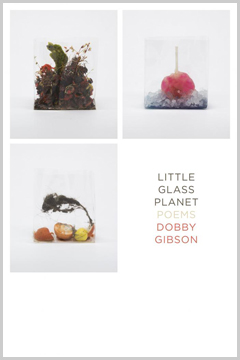 Poet Dobby Gibson is a gondolier, your most trusted confidante, a stern assistant principal who has taken you, a troubled student, under his wing. In Dobby’s poems, you can feel the tenderness with which he treats each line, examining each trinket and bauble of the world as though they were talismans, investigating every subject as if it were an injury on our collective body. He gives us the diagnosis, administers the salve and wrappings. In Little Glass Planet, Dobby writes as if we’re having a heart-to-heart with him, jocular at times, but never shirking the difficult conversation:
“The most horrible person
has been elected president.
The hardest thing to fathom
is the present.”
This kind of odd near rhyme is an instance in which we feel the terrifying comedy injected into everything in this world. Dobby’s lines often linger on the precipice of platitude, but don’t fall. He’s interested in truth—a real kind of hope, since most of us have become so skeptical—and the poet’s diligent eye will follow any spark of veracity unto its end, even into the eely crevices where we tuck away the worst parts of human nature.
From the first poem, titled “Dear Reader,” we know that Dobby is on our side. In a time when it’s difficult to assure anyone of anything, Dobby manages to put my heart at ease in the last line of “Prayer for November”:
we can be loved after all.
Even in his truth-seeking, he reaches toward the ineffable, for a sign—from cherubim, from the powers of ten, from a dog with one eye, from arsonists with no matches. This book surveys the pieces and shards of this world in all their shabbiness, and it is in them that we find the shades of real beauty that we can hold on to:
a lemon tree dressed in December ice
like a girl in her grandmother’s jewelry
Dobby is a poet who is engaging with the social issues and climate change in earnest, nuanced ways, never completely turning his gaze away from the parts of humanity still connected to mythos, and eternity. But he’s not afraid to make bold declarations about the true state of things. This feels especially poignant, after reading a new report by Australian climate experts which warns us that “climate change now represents a near- to mid-term existential threat” to human civilization. This prognosis, endorsed by the former chief of the Australian Defense Force, warns that human civilization could face complete destruction by the year 2050 due to the destabilizing societal and environmental factors caused by a rapidly warming planet. This, of course, is difficult to picture, let alone to truly believe, as we walk through the alarming fog of calamitous news each day and yet, the next day always comes. But as Dobby warns in his easy, yet ominous way:
When our great fire finally arrives
it will make no sound
As we look down the barrel of the next few decades, it is difficult to even process these possibilities. The small, personal actions we can each take to do our part in prevention don’t even come close to shutting down the sensation of inevitable doom. I find that the times when I feel the most hopeful are in small instances of humanness, our persistence in preserving the mysteries of this life, presumably our only, and as Dobby puts it in a title, “Inside the Compulsion to Wonder Lurks the Will to Survive.”
Dobby’s tall intuition is eternally reassuring, offering a kind of knowing that can’t be taught. His poems do not hesitate to gesture toward the eternal, even as they inhabit the irreverent humor of adolescence:
All of time is with us here,
each next moment waiting right where we left it
when we last felt safe inside our heads
wondering what kind of leathery faces
they might grow into as we held
the flashlight beneath our chins
to say the one funny thing we needed to
while leaning into the dark.
These poems have an irresistible way of reaching out to us as the reader, of drawing us in, and showing us compassion. As the reader, I know that I am part of this conversation, and that it continues far beyond the last poem in the book. I feel loved, taken care of, seen. This is the particular magic of these poems, one that creates the sensation of peace in a time of chaos, that pours us a glass of wine and offers to talk it out:
This is my love letter to the world,
someone call us a sitter.
We’re going to be here awhile.
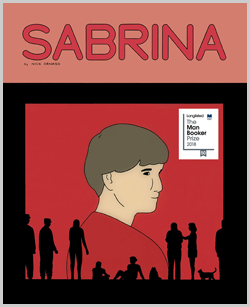 There doesn’t need to be another review of Nick Drnaso’s Sabrina; it was heaped with praise when it was published by Drawn and Quarterly in 2018. Zadie Smith said, “Sabrina is the best book—in any medium—I have read about our current moment.” And if you come across as many Zadie Smith blurbs as I do, you can spot the difference between a lukewarm this-certainly-wasn’t-the-worst-book-in-the-world Zadie Smith blurb and a glowing I-actually-loved-this-book Zadie Smith blurb. Sabrina also caught the attention of the Man Booker judges, becoming the first graphic novel to be longlisted for the prize. Suddenly, Sabrina was a book everyone wanted to read, and booksellers were forced to say “sorry, we’re sold out.”
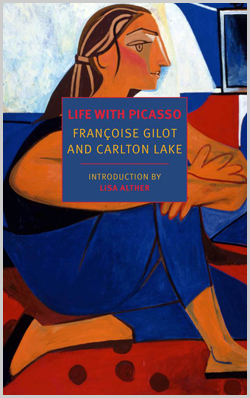 Françoise Gilot was in her early twenties, Picasso in his sixties, when they became friends and developed a decade-long relationship. Gilot was herself an ambitious artist, and this book chronicles Picasso through her eyes in those ten years, during which they had two children and she eventually left him. A revealing account of Picasso, and of Gilot’s singular experience coming into her own as an artist—this is a great read for your summer list.
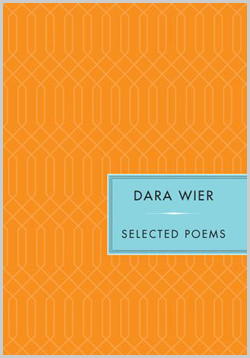 Dara Wier is a poet whose work transcends the evolving cycles of American poetry. This collection, her tenth, offers a cross-section of her poetry, and if you’re looking for an entry point into her work, Selected Poems is the book. In it, Wier doesn’t suppress a thing—we are met with the full force of her weirdness, poetry that explores an intensity of experience that is unpoliced, full of humor, longing, and human fragility.
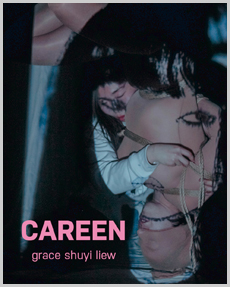 [Careen] captures the strangeness of our times, and the particular strangeness of being an Asian woman living in America. These poems are fierce. They are naked and unadorned, completely without fear even as they enter into the most unstable spaces of the mind, the body and the spirit. This book is a necessary handbook for all of us who are navigating the treacherous sociopolitical climate. It shows us how to remain human, even as we feel more and more alien in our own minds.