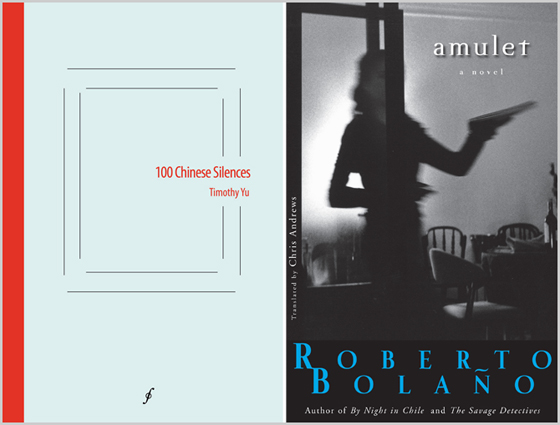
Stephanie recommends 100 Chinese Silences by Timothy Yu:
Yu uses poems by Collins, Oliver, Pound and more to skewer the original texts (and their creators) for their racist representations. “Often I run out of ideas / for poems,” Yu writes in a riff on a Dan Gerber poem, “but then I remember I am an American / and so can end my poem with something Chinese / and call it original, like that / ancient American railroad / built miraculously by silent hands, / helping me drive my golden spike home.”
Fernando recommends Amulet by Roberto Bolaño:
What can I tell you that you don’t already know? Perhaps it’s too easy to recommend a book by Bolaño, but this is the first novel by him I ever read. I bought it on a whim around 2007ish, after having witnessed his corner of the shelf at the local bookstore get a little bigger year after year. Finally I said, Who is this guy?, and picked one up. I will say now, after ten years of distance, that nothing could have prepared me at that time for Amulet.
This is a story about immigrants, about the government doing the unthinkable, and about resistance. At the time a novel like this was not easy to come by, especially one that was contemporary. It is narrated throughout the course of twelve days by an older Uruguayan woman as she hides in a bathroom stall while the army invades the university in Mexico City. She calls herself the mother of all poets and passionately recounts her life, passions, fantasies, and fears.
Maybe since 2007 Bolaño’s popularity has gotten out of control, but I try not to think about this when I consider one of his books as a work of literature. Though his longer, imperfect novels are certainly works of art in their own right, I really enjoy the impact and immediacy of shorter ones like Amulet.
By the end everything is devastating and holy, in a way only the rapture can be. Even if you’re in a crowded room as you finish it, you’ll feel completely alone, in the best way.
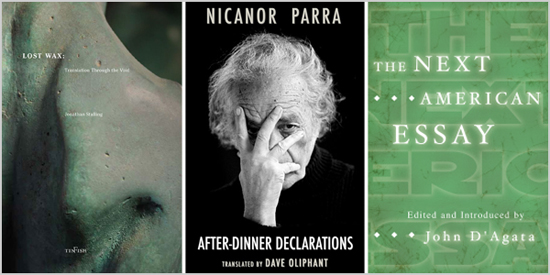 Schandra recommends
 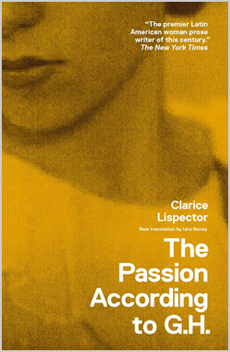 Since her death in 1977, Clarice Lispector has earned recognition as Brazil’s greatest modern writer. And Benjamin Moser, editor of her anthology The Complete Stories, is often quoted as saying she’s the most important Jewish writer in the world since Kafka. Perhaps the most Kafkaesque of Lispector’s nine novels—yes, it involves a cockroach—is the mystical
  Varieties of Exile
 Sometimes the dirty politics of your time catch up to your immediate reality. Just ask Russian anarchist writer Victor Serge (1890 – 1947). He lived in Paris as a young man, then in 1919 traveled Russia supporting the Bolshevik revolution. In 1933, after a few imprisonments, he was deported and settled in France, where he began his career as a novelist. This is his last novel, which stirs together the themes Serge explored his entire life, revolving around the Soviet Great Terror of the early 20th Century. Perfect for fans of political thrillers. In the same vein, check out
  There’s something like a quiet magic in the art of the “meaning of life” western, as opposed to a violent, shoot-em-up kind of western. This book is perhaps the kind of western Herman Melville would have written—it retains elements of realism yet elevates moments into the realm of the epic: