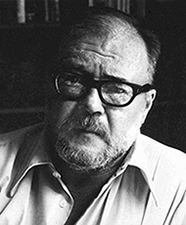
 This week’s assortment of stuff in triplicate is devoted to one of my favorite poets, James Wright (1927-1980). I first discovered Wright’s words on the forearm of a friend: he had a few lines of Wright’s poetry tattooed in a tidy cursive from elbow to wrist. They were beautiful lines, and I wanted to read more from their author, so I picked up Wright’s Collected Poems and immediately fell in love with his contemplative, compassionate voice—a voice that Wright, born and raised in a shitty midwestern steel mill town, simply referred to as his “Ohioan.” Below, three of Wright’s best:
1. Wright’s most well-known poem is probably “A Blessing,” aka the pony poem. One of the few poems he was able “to get … finished in almost nothing flat,” Wright wrote it after a drive in the Minnesota countryside with his friend Robert Bly. In his essay, “James Wright and the Slender Woman,” Bly recalls the occasion:
James saw two ponies off to the left and said, “Let’s stop.” So we did, and climbed over the fence toward them. We stayed only a few minutes, but they glowed in the dusk, and we could see it. On the way to Minneapolis James wrote in his small spiral notebook the poem he later called “A Blessing.” … In a few passages [in the poem] we feel too much idealization. The two ponies are just ponies, and probably would have bit one of us if we had stayed much longer without giving them sugar.
The poem may overstate the charms of roadside ponies, but this anthropomorphism also demonstrates one of Wright’s greatest strengths as a poet: his ability to evoke nature as a path to the metaphysical or divine.
A Blessing
Just off the highway to Rochester, Minnesota,
Twilight bounds softly forth on the grass.
And the eyes of those two Indian ponies
Darken with kindness.
They have come gladly out of the willows
To welcome my friend and me.
We step over the barbed wire into the pasture
Where they have been grazing all day, alone.
They ripple tensely, they can hardly contain their happiness
That we have come.
They bow shyly as wet swans. They love each other.
There is no loneliness like theirs.
At home once more,
They begin munching the young tufts of spring in the darkness.
I would like to hold the slenderer one in my arms,
For she has walked over to me
And nuzzled my left hand.
She is black and white,
Her mane falls wild on her forehead,
And the light breeze moves me to caress her long ear
That is delicate as the skin over a girl’s wrist.
Suddenly I realize
That if I stepped out of my body I would break
Into blossom.
2. Wright pays terrific attention to rhythm. In a Paris Review interview, he says, “I wouldn’t say that I’m a frustrated musician, but I love music and I think this is why I usually begin a poem that way. Music has given me a much greater sense of the possibilities of quantity in poetry.” So why read when you can listen? Here’s Wright reciting “Lying in a Hammock at William Duffy’s Farm in Pine Island, Minnesota.”
3. My favorite of Wright’s collections is Shall We Gather at the River (1969). In the Paris Review interview, Wright has this to say about the book:
I was trying to move from death to resurrection and death again, and challenge death finally. Well, if I must tell you, I was trying to write about a girl I was in love with who has been dead for a long time. I tried to sing with her in that book. Not to recreate her; you can’t recreate anybody, at least I can’t. But I thought maybe I could come to terms with that feeling which has hung on in my heart for so long. The book has been damned because it is so carefully dreamed.
“To the Muse,” the poem whose last three lines are etched on my friend’s forearm, is the final poem in the collection:
To the Muse
It is all right. All they do
Is go in by dividing
One rib from another. I wouldn’t
Lie to you. It hurts
Like nothing I know. All they do
Is burn their way in with a wire.
It forks in and out a little like the tongue
Of that frightened garter snake we caught
At Cloverfield, you and me, Jenny
So long ago.I would lie to you
If I could.
But the only way I can get you to come up
Out of the suckhole, the south face
Of the Powhatan pit, is to tell you
What you know:You come up after dark, you poise alone
With me on the shore.
I lead you back to this world.Three lady doctors in Wheeling open
Their offices at night.
I don’t have to call them, they are always there.
But they only have to put the knife once
Under your breast.
Then they hang their contraption.
And you bear it.It’s awkward a while. Still, it lets you
Walk about on tiptoe if you don’t
Jiggle the needle.
It might stab your heart, you see.
The blade hangs in your lung and the tube
Keeps it draining.
That way they only have to stab you
Once. Oh Jenny.I wish to God I had made this world, this scurvy
And disastrous place. I
Didn’t, I can’t bear it
Either, I don’t blame you, sleeping down there
Face down in the unbelievable silk of spring,
Muse of black sand,
Alone.I don’t blame you, I know
The place where you lie.
I admit everything. But look at me.
How can I live without you?
Come up to me, love,
Out of the river, or I will
Come down to you.


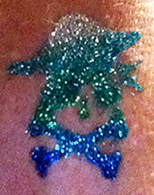 We got a glitter tattoo. While sober! Malvern Books likes pirates—who doesn’t?!—so we requested a picture of a sparkly marauder. The photo at right shows the finished, ahem, design. When a woman at the drugstore spots your pirate tattoo and says “nice spaceship!”… well, that’s when you know you don’t have a very good pirate tattoo. Worth noting: glitter tattoos last for two days, and those two days will feel like an eternity.
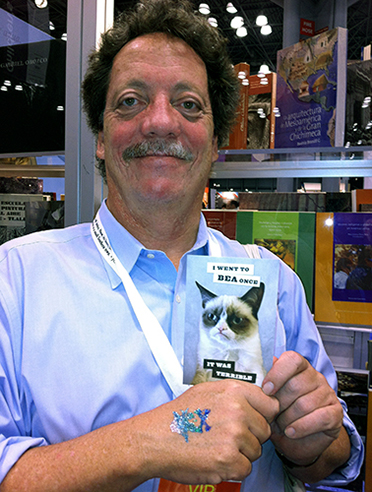
 Yep. Every single book. Spreadsheets at the ready, book nerds! Making a list of thousands of awesome indie and small press books is immensely fun, of course (and there’s so much good stuff to choose from), but it’s also rather time-consuming. And we’re hoping to finalize most of our selections before we head to next week’s BookExpo in New York.
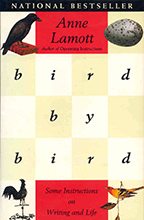 Perfectionism is the voice of the oppressor, the enemy of the people. It will keep you cramped and insane your whole life, and it is the main obstacle between you and a shitty first draft. I think perfectionism is based on the obsessive belief that if you run carefully enough, hitting each stepping-stone just right, you won’t have to die. The truth is that you will die anyway and that a lot of people who aren’t even looking at their feet are going to do a whole lot better than you, and have a lot more fun while they’re doing it.
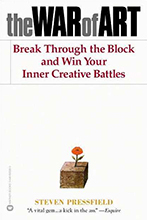 Resistance cannot be seen, touched, heard, or smelled. But it can be felt. We experience it as an energy field radiating from a work-in-potential. It’s a repelling force. Its aim is to shove us away, distract us, prevent us from doing our work … Resistance will tell you anything to keep you from doing your work … Resistance has no strength of its own. Every ounce of juice it possesses comes from us. We feed it with power by our fear of it.
 We may observe, first, that if the effect of the dream is to be powerful, the dream must … be vivid and continuous—vivid because if we are not quite clear about what it is we’re dreaming, who and where the characters are, what it is that they’re doing or trying to do and why, our emotions and judgements must be confused, dissipated, or blocked; and continuous because a repeatedly interrupted flow of action must necessarily have less force than an action directly carried through from its beginning to its conclusion.