Staff Picks: Found and Lost: Mittens, Miep, and Shovelfuls of Dirt

Julie recommends: Found and Lost: Mittens, Miep, and Shovelfuls of Dirt by Alison Leslie Gold
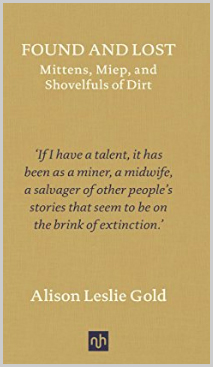
As a bookseller, I don’t take recommendations lightly, especially when a “recommendee” is seeking to soothe or be soothed after experiencing loss. Suggesting the wrong book to someone in pain feels like a lesser form of medical malpractice. Now when people come into the store asking for a title related to grief, I know just the book to place into their hands: Found and Lost by Alison Leslie Gold.

I hesitate to claim that books are a prescription for grief. When a friend of mine died suddenly a couple years ago, the last thing I wanted to do was read. In fact, I was reading (or cramming rather) for a class when I got the news; returning to the page, the print, language itself, was incomprehensible.

This is to say that when I initially read Gold’s prologue I felt strangely combative. She writes:

Not long ago a dear friend died, and shortly after that an aged aunt. So began a series of deaths. I became unmoored.

I fought a voice in my head that said, “Oh yeah?” I’ve been to so many funerals, that if there’s even the slightest wobble in my mother’s voice when she calls, my knee-jerk response is to ask, “Who’s dead?”

If there hadn’t been something so authentic in the tone of Gold’s prose, I might have stopped reading. “These were not my first experiences of loss,” she continues. “Several decades before, I had lost myself. I was a woman seriously adrift.” These lines feel earned, the weight behind each word tugs at you. From the onset, there’s an overwhelming sense that Gold isn’t prone to the confessional mode, nor does she parade her pain, or succumb to the sort of expository oversharing that seems synonymous with memoir writing.

“I always kept my personal life apart from my writing. Until today,” she writes. What follows the prologue is an incredible exploration of form. Gold’s Found and Lost reshapes memoir in one of the most inventive and moving ways I’ve yet to encounter in all my years of voraciously reading non-fiction. In a little over two-hundred pages, the book is a hand-sewn tapestry of letters, narratives (or “Interlogues” as they’re titled), lists and imagistic phrases. Interspersed throughout the text are poetic lines in a red italicized font that appears, to my eye, like a careful stitch-work that pulls the fragmentary material together.

Small tangerines with attached branches hung on my front doorknob in a plastic bag

It’s a bit like reading Basho’s haibun, except the terrain that Gold travels is not a landscape but encounters with past and present selves. Her excavations typically begin with a salutation: “Hi,” “Dear,” “Chère,” “Shalom,” “Geachte Mevrouw.”

A truncated sample:

Dear Alison Gold,

Were you once Alison Greenwald? I hope I’m not being foolish in my hope that you might remember me…[i]n the last years I knew you, you were only happy when you were setting fire to the drapes. Do you still bat for both teams? Do you still have high arches? Do you still wear Pucci underwear? Do you still look like Natalie Wood?

As I became familiar with the chorus of speakers, I began to crave the letters for their charm, humor, tonal variety, and revelatory details that shaped a chronology, a chronology that returns to sites of pain and beauty in a nonlinear way.

With her sister, Gold visits the grave of her friend, Lily.

I poured coffee for us all, left yours with a piece of bread on the gravestone. My knees went out from under me as I walked to the bench beside the church—buckled, actually. I didn’t fall, just crumbled against the stone. Am hurt but did not drop the remaining coffee and bread.

I treasure writing like this, how well it captures life’s capacity to mock us. This is apparent in nature too when even a bird might prefer to be captive. Another passage:

Dear Dorothy,

This would have made you smile: My neighbor’s lost love bird landed back on his terrace railing. When my neighbor carried its cage to the door of the terrace the love bird dropped a glistening tear of chartreuse shit on the railing, then hopped back into the cage.

Love,

Alison.

Gold achieves the sort of intimacy one finds mainly in lyric poetry, I’m thinking especially of Sappho, and the “overheard” nature of her poems. As I was reading, I kept wondering how she achieved this quality in prose. Perhaps it’s that as readers we’re eavesdropping on conversations not meant for our ears. Perhaps it’s the very mechanics of letter writing that spurs honesty, brevity, and a presentation of “self” chosen for a particular recipient.

One of the most memorable conversations I had with my friend took place in the car, as she was driving me home from an editing and publishing course we were both taking. Merging onto the freeway, she said, “You’re a good writer, but you really need to work on your sentences.” Her advice stung. My simple sentences revealed a simple mind. Only later did I realize that her call for complexity, variety, a semicolon (or two) was about making an effort to push my thoughts, ideas, and observations to their fullest development. To be less timid, I needed to take off the training wheels of subject/verb. In many ways, I’m still trying to live up to her expectations because she was one of the first individuals to expect anything better from me at all.

This might seem like a wild digression into the personal, except that I believe that a good book makes you contemplate your life. Found and Lost acts as catharsis; its art is in how it continues to live on in the reader; like a dear friend, you simply will not want to let this book go.
NYRB Classics Spotlight: Moderan

Malvern staff member Fernando is a New York Review Books Classics enthusiast, and he has an excellent recommendation for y’all…

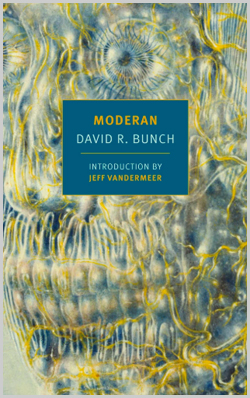
Moderan by David R. Bunch

For years this book was only a myth among certain aficionados of science fiction. First published as a series of stories taking place in the future of Moderan, where patches of the earth are covered in plastic and nature is all but gone, this book does magical things with poetry and language to a degree that is uncommon in the genre. Not only that, it is darkly hilarious, and in some ways reminds me of The Wizard of Oz meets the Marvel Universe. Great read to start the new year!
Also recommended: The Chrysalids by John Wyndham. One of the few science-fiction novels of the fifties about a world after nuclear war that has survived the test of time.

Staff Picks: Primeval and Other Times and Flights

Celia recommends Primeval and Other Times and Flights by Olga Tokarczuk:

Prior to being awarded the Man Booker International Prize for the recent translation of her novel Flights, Olga Tokarczuk, while famous in her native Poland, was mostly unknown in the US. Which is why I was so thrilled, after hearing the results of the Booker International, to find that we also had a translation at Malvern of Tokarczuk’s earlier novel, Primeval and Other Times, published by Twisted Spoon Press. Both novels are fascinating and accomplished, but as I read them (back to back, I should add) I was especially impressed by the range of Tokarczuk’s artistic vision, which has produced two amazing and rigorous but also extremely different novels.

Primeval and Other Times is set in the imaginary village of Primeval. Bordered by a forest, two other villages, and a larger, bustling town that’s just near enough that the residents can travel there to buy vodka, Primeval is isolated, forgotten, it seems, by time. At the beginning of the story, the First World War has just begun. The men are gone, the women make do, easily enough, on their own. A farmer’s wife, Genowefa, is pregnant. It seems she will stay pregnant for years, until the war is over, until her husband comes home, finally, remembering the war outside of Primeval as a kind of dream, a nightmare land that may or may not have ever existed.

This is Primeval: an enclosed snow globe, a world in itself, which it may or may not be possible to ever leave. Outside, wars rise and then break like waves, disgorging soldiers and refugees through the border of Primeval, whose residents are swept up in the flood without always being entirely certain whether the outside world really exists. In one of the novel’s most eerie and strange passages, Ruta, the daughter of a destitute prostitute, gives this speech:

This is where Primeval ends, there’s nothing beyond here…[Travelers] set off on a journey, they reach the boundary, and here they come to a standstill. Maybe they dream they’re traveling onwards, that Kielce or Russia are there. My mother once showed me some of those who looked like they’d turned to stone. They stand on the road to Kielce. They don’t move, their eyes are open and they look terrible. As if they’re dead. Then, after a while, they wake up and go home, and they take their dreams for memories.

History, in this novel that spans the bulk of the twentieth century, is a thing that happens elsewhere, a dream that, like Goya’s Sleep of Reason, gives birth to monsters. And yet, as much as the town of Primeval is devastated, over and over, by history, there is also a counter dream, full of creaturely magic and wonder, in which an immortal mushroom kingdom sleeps beneath the forest, a woman feuds with the moon, a flowering vine fathers a child with a wood woman, a forgetful and tempestuous angel watches (as best it can) over a farmer’s daughter, and maybe, just maybe, there may be a way out.

If Primeval and Other Times is a snow globe, a crystal ball in which wonderful and terrible visions appear, Flights is a network of neurons, a fragile map that might not be immediately recognizable as a system, but which is constantly transmitting impulses, stories, quick bursts of scenes. It claims to be about travel and the body, but a better description might be: what does a body look like in movement? What are its transitions, the way it’s constantly disintegrating and being born? Tokarczuk is inspired by Frederik Ruysch, the eighteenth-century anatomist who used his experimental embalming techniques to create macabre works of art—infant skeletons dining together atop a hill of preserved gall bladders, a perfect, pink child’s arm, in lace sleeve, floating in a preserving jar—and also by the modern Bodies and Body Worlds exhibits, which used plastination to preserve a wide array of human bodies and internal organs. In Flights, Tokarczuk traces a winding genealogy of these preserved bodies, pausing on Philip Verheyen, the Dutch anatomist who discovered the Achilles tendon while dissecting his own leg (to which he also writes anguished letters, afflicted by phantom pain from the amputation), and the fictional Dr. Mole, a genteel kind of mad scientist who, on his death bed, leaves in his study a life-like preserved cat, which, when opened to display its internal organs, plays a cheerful tune.

Interspersed with these passages are stories of people in transit: the biologist who specializes in the eradication of invasive species, who returns to her native Poland to find it changed beyond recognition; the housewife who walks away from her home and rides the subway for days on end, looking for salvation, or at least the compassion of religion; the lonely “travel psychologist,” who sets up lectures in airports, to ask, again and again: who are we, once we’ve sloughed off the structure of family, city, country, culture? Who are we when we’re somewhere else? “Each of my pilgrimages aims at another pilgrim,” Tokarczuk writes, over and over again, a kind of refrain. There are pilgrims of the globe and of the body, those who look outwards and those who look within. Throughout, Tokarczuk’s style is rigorous, analytical: disassemble, Tokarczuk seems to say. Abandon, leave behind, remove. Here is one glimpse into a life, as in a cabinet of wonders (another motif that appears over and over again in Flights). Do you really need more than the artifact itself? Or does this preserved lung, this fragment of overheard conversation, this formula for the plasticization of organic tissue, tell enough of a story?

Of the two novels, I think my favorite is Primeval and Other Times. Reading them back to back, I was mostly astounded by how two such different and successful works could come from the same author. There are traces of Primeval’s hallucinatory style in Flights, but for the most part, Tokarczuk seems to desire that the second novel be an exercise in analysis, that it hold the reader a little bit at arm’s length, the better to experience the unknowability of the body, and of the human consciousness that inhabits it. But, whatever a given reader’s preference is, I think we can all agree to eagerly await the next translation of a Tokarczuk novel—which, by the way, will be an ecological murder mystery called Drive Your Plough Over the Bones of the Dead, released in the US next month.

NYRB Classics Spotlight: Lost Time

Malvern staff member Fernando is a New York Review Books Classics enthusiast, and he has an excellent recommendation for y’all…

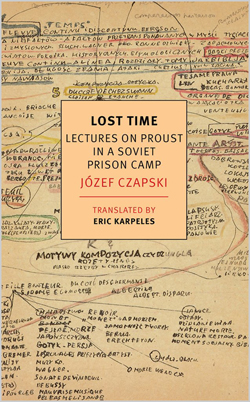
Lost Time: Lectures on Proust in a Soviet Prison Camp by Józef Czapski

At the beginning of every year I ask myself, “Is this the year I will finally read Proust?” and by its end the answer is always no—however, I always enjoy reading about Proust. Polish artist and soldier Józef Czapski was a prisoner in a Soviet camp during the Second World War, and this book is based on two transcriptions of his lectures on In Search of Lost Time, which he delivered to his fellow inmates with only his memory to go on. It is a slim book, and I can vouch that it is very enriching for anybody interested in art, memory, Proust, World War II, and the power of literature.
Also recommended: Monsieur Proust by Céleste Albaret. This memoir written by Proust’s housekeeper during the time Proust wrote In Search of Lost Time is essential for anybody interested in learning the peculiarities of this canonical writer.

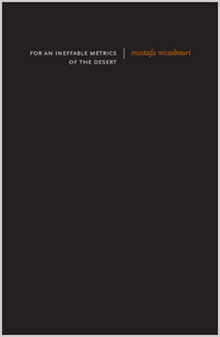
Staff Picks: For an Ineffable Metrics of the Desert

Stephanie recommends For an Ineffable Metrics of the Desert by Mostafa Nissabouri:
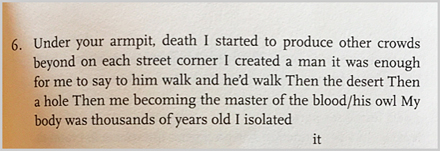
When Mostafa Nissabouri’s For an Ineffable Metrics of the Desert (Otis Books, 2018) arrived here at Malvern Books, its title immediately gripped me; it’s quite a mouthful, with its seven words and their twelve syllables combining to create an unruly abstraction. The title tells us the book of poems to follow will likely be concerned with language in favor of what can’t be said. Sure, that’s one of poetry’s “jobs,” but to make that claim a part of the title struck me as bold, so I started opening to pages at random to gauge my further interest. And Reader, I had no chance; I’ve been reading and rereading Ineffable Metrics ever since.

– from “Higher Memory,” translated by Pierre Joris
When I think about the experience of reading For an Ineffable Metrics of the Desert—edited by Guy Bennett and featuring translations from French by Bennett, Pierre Joris, Addie Leak, and Teresa Villa-Ignacio—I think about: water; identities and how they are constructed; language as a landscape; land as conquered space; conquering as cyclical; how a poem might make a music of the tension between interiors and exteriors. And I think of specific excerpts I can’t (and don’t want to) shake:

“Dead I drink your water to know I’m separated from myself” (“Diurnal,” AL)

“what identity if not / imagined” (“Approach to the Desert Space,” GB)

“like a life possibility that is other like a cry” (“Anticipation of an Exclusion,” PJ)

“the absurdity of the infinite in my body / assassinated / humiliated / vampire” (“Scheherazade the Tongue,” AL)

“I don’t know where to put you / or how to forget and die” (“Scheherazade the Tongue,” AL)

But let’s go back to the beginning; the book’s first line is:

“Caves opened for the crawling of my ribs as if I were as if” (“Caves Opened,” AL)

What strikes me here is the repetition of “as if,” both because this is the first line of the book and so the “stutter” carries a particular weight and also because the line ends on that stutter, emphasizing that the speaker’s identity (or perhaps any identity) is indeterminate.

For Nissabouri’s speakers, identity is inherently fraught. Nissabouri was born in Casablanca in 1943, just roughly thirty years after Morocco was divided into French and Spanish protectorates. In his teen years, Nissabouri’s home regained its independence after almost half a century of French rule.

During those occupied years, Nissabouri says in an interview included at the book’s end, “young Moroccans in the north of the country were educated in Spanish and, in the rest of the country, in schools modeled on those of the French Republic and … in line with the programs of Jules Ferry. In these establishments Arabic was considered a foreign language. In Tangiers English predominated.”

Nissabouri continues: “So up to the end of the protectorate in 1956, we would see an entire population educated in francophone institutions … burst into professional life having been prepared to serve as assistants to the French colonizer … in the country’s administration. Everything was in French, from signs, bus routes, names of shops and their displays … The only Arabic press was in the north of the country, and that with the permission—under certain conditions, to be sure—of the Spanish who, unlike the French, didn’t care two hoots about a ‘civilizing mission.’ … Since then Morocco has opted for bilingualism (classical Arabic as its official language and French as its second language), except in the courts and related services where only Arabic is allowed.”

So why does Nissabouri compose his poems in French rather than Arabic?

“Vicissitude of history? Fatality? Intentional choice? Re-appropriation of the language of the other, the better to live my own status as one who narrowly escaped oblivion? It’s all of those things,” he says.

Or, perhaps, as the speaker of his poem “Approach to the Desert Space” says:

“it is not the sky that establishes order / its image overhanging a silenced memory does” (GB)

The poems in Ineffable Metrics are both dense and expansive. “Nissabouri’s work explodes across the page,” translator Addie Leak says (click on View Translator Notes), “questioning genre by breaking with traditional French forms and defying linguistic imperialism with long, syntactically complex sentences that include mid-phrase or mid-sentence erasures and insist that the reader work to pull sense from them.”

While I’m by no means a source of knowledge about Morocco, it seems fitting to me that—given the wonderful context provided by the notes and author interview included in this book—Nissabouri’s poems are concerned with the way space perpetually opens once conquered, whether it’s opening up new space for itself to reclaim an identity or culture after colonization or whether it’s having space opened within it by such colonization. And these are of course both violences, infinite ones:

“which is this nowhere whose desert / at my side is the shattered incidence / like an allegorical I / that never stops being multiple” (“Approach to the Desert Space,” GB).

When I sell this brilliant text to Malvern customers, I often talk about the trauma (that I imagine must be) involved when one’s country is in a way divided into different languages and then rule shifts so quickly; how it must feel to have something as intimate as one’s way of communicating determined to be Not the National Language or shoved underground or labeled appropriate only in the vernacular or appropriate only for religious ceremony, etc., and then to have those determinations change again. Of course what is a native tongue and what is a foreign language and what is a country and why do I speak English and on and on—I can’t possibly get into all of that here on this little bookstore blog, but my point in (stumbling through) bringing up such concerns is this: For an Ineffable Metrics of the Desert, with its multiple tongues and diverse approaches to syntax, with its obsessions with “opposites” like desert and ocean, is a collection of poems rooted in such trauma. And Nissabouri’s language questions those roots, rips them from the ground, grows them into song.

I hope I’ve done this incredible work justice in this blog post; I had never before encountered Nissabouri’s poems and the book includes half of his published work and selections from current, unpublished work (including the astounding long poem “Seven Waves,” which I’ve not even touched on here!), so I found it particularly nerve-wracking to write about. But I wanted to write about it for two main reasons:

1) For an Ineffable Metrics of the Desert is one of the best books of poetry published by a small press in 2018 and 2) I haven’t read a single review of the book or heard buzz in the English-reading book world about this critical English translation of such a singular poet. If you don’t want to miss out on this intelligent, wide-ranging work, stop by Malvern for your copy here in Austin or seek it out from your local independent bookstore.

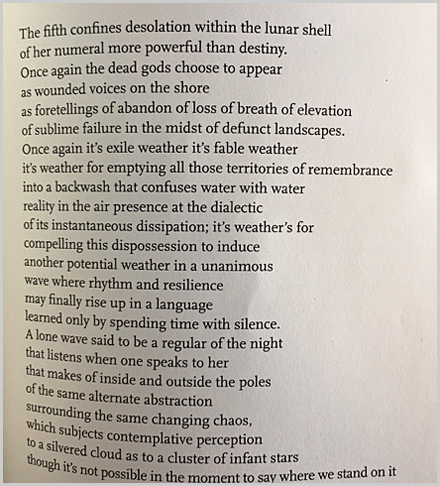
– from “Seven Waves,” translated by Teresa Villa-Ignacio

Staff Picks: The Education of a Gardener

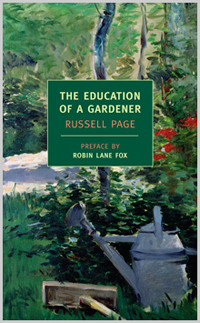
Julie recommends The Education of a Gardener by Russell Page:

It’s easy to imagine Russell Page (1906-1985), author of The Education of a Gardener, holding his thumb up to a distant hill to assess where to plant a cluster of ancient lemon trees. Where a landscape painter is concerned primarily with light, Page must take into account the elements of sun, water, wind, soil, seasonal changes as well as sensory concerns: How might citrus aromas blend with nearby lavender and lilac? How might a box hedge in the background make the yellow fruit pop? Difficult to define—gardener, landscape architect, artist, sage, Page is all these and more. He is the creator of living breathing “pictures,” as he calls them, so that wherever you happen to stand, plants are in harmony with each other, with the landscape, and with you the observer.

I didn’t read Page’s book because I have a deep interest in gardening (it’s quite superficial—if by gardening you count a small, dysfunctional family of houseplants), but because from page one (oh dear, a pun) I was swept away by his passionate lyricism. With modest directness, he writes:

I know that I cannot make anything new. To make a garden is to organize all the elements present and add fresh ones, but first of all, I must absorb as best I can all that I see, the sky, and the skyline, the soil, the colour of the grass and the shape and nature of the trees.

This is from the first chapter, “In search of style,” and I quickly began to absorb Page’s sentences as teachings on the broader categories of beauty, aesthetics, and craftsmanship. It seemed certain lines could be applied to my own artistic undertaking—poetry.

A serious composition cannot depend on intuition or on an intellectual concept alone. All the objects you are going to place require careful study. If it is a plant you must know its size, habit, colour, texture and cultural requirements as well as its place of origin, its history and the way it has been used whether commonly or uncommonly.

Replace “plant” with “word” and you have brilliant advice on the precision of language. There’s something about Page’s bountiful spirit and gorgeous use of language that both delights and inspires—so many times I felt this great sense of broadening within my skull—a student again, I listen with rapt attention.

You have only to take a magnifying glass to a wild orchid or columbine, to the smallest plant of primula or androsace and, at once, strength, will, design, colour and a tremendous rational simplicity invades eye and mind.

It took me months to read Education, which I kept at my bedside, because it was so densely packed with Latinate beauty—Stravanesia undulata and Y. filamentosa—it proved hard to sustain a rapid reading clip. My sleep was likely better for all the lush language: “the prostrate and horizontally growing junipers are wonderful evergreens for massing in full sun.” And the playful names for flowers, too: pinks, catmints, rue, zinnias, nemophilas, larkspur, sweet sultan, and my favorite, “bachelor’s buttons” (cornflowers).

Can I admit that it was also hard to finish Education because it would be like saying goodbye to a new friend? Page reveals very little about himself in the book proper, but there are moments when I genuinely felt I knew him. I particularly loved when he made clear his dislikes: “rhododendron addicts,” nude statues, and round swimming pools. He uses quotes to mention a prototypical showroom-style “American” garden. I laughed aloud when I read the sentence:

Central Park in New York was designed by Olmsted as a nineteenth-century pastiche of an eighteenth-century landscape park.

Page devoted his life to creating picturesque settings, and it saddens me that he wasn’t called on to design a public park because he would have considered every detail imaginable. A man The Telegraph called “the most famous garden designer no one’s ever heard of” would have fulfilled his aim “to lift people, if only for a moment, above their daily preoccupations” as he believed that “even a glimpse of beauty outside will enable them to make a healing contact with their own inner world.”

While there’s still time, see every Page garden you can. If you’re in New York see his garden at the Frick, which has been in a precarious state for the last few years. If you happen to be in Purchase, NY see the Donald M. Kendall Sculpture Garden at the PepsiCo headquarters. See the Anne Bass Garden in Fort Worth, Texas if it’s open to the public. Go abroad. See them all, as seasons shift and change—the best galleries are outdoors.