 The Journal of Hélène Berr is the English translation of a diary kept by a young Jewish woman in occupied Paris. The diary first came to light in 1992 when Mariette Job, Berr’s niece, decided to see if there was any truth to the family rumor that her aunt had kept a journal during the war. She tracked down Berr’s fiancé, and after numerous meetings he finally handed over the diary; he’d kept it tucked away in a brown envelope for almost fifty years. It was finally published in 2008, and became an immediate best seller, with reviewers dubbing Berr “the French Anne Frank.” Their journals cover much the same period, and the two young women shared the same fate—but while the teenage Frank was forced to remain hidden in her attic in Amsterdam, Berr was able, for a while at least, to carry out something that looked much like normal life.
We first meet twenty-one-year-old Berr on a rainy Tuesday in the spring of 1942. She’s going to Paul Valéry’s apartment to pick up a copy of his collected works that he’s inscribed for her: On waking, so soft is the light and so fine this living blue. Paul Valéry. Although the Germans have occupied France for nearly two years at this point, Berr’s life among the French elite still seems charmed, at least on the surface. She spends her days strolling in the Luxembourg Gardens and practicing the violin. She gossips with friends and agonizes about her romantic life: she has fallen in love with a young man called Jean Morawiecki (pictured with Berr below), but has already promised herself to a bore called Gérard (“there’s something too normal about him”), with whom she is in a fraught long-distance relationship.

She also attends lectures at the Sorbonne, where she’s studying English literature, and she spends many afternoons hunched over her desk, plugging away at a doctoral thesis on “Keats’ Hellenism” (the anti-Semitic laws of the Vichy regime prevent her, however, from sitting the final exams required for her degree). For a few months, the outside world barely intrudes, and worries about the future are pushed aside:
Already this evening Papa got an expropriation notice … Let’s think about something else. About the unreal beauty of this summer’s day at Aubergenville [the family’s country house]. A day that unfolded in perfection, from the rising of a cool and luminous sun full of promise to the soft, calm dusk so rich with sweet feeling that bathed me as I closed the shutters just now.
Berr is apolitical, and barely aware of her Jewish identity. Her father, a renowned scientist and decorated WWI veteran, runs a major chemical company, and her family is secular, assimilated, cultivated, and utterly French:
When I write the word Jew, I am not saying exactly what I mean, because for me that distinction does not exist: I do not feel different from other people, I will never think of myself as a member of a separate human group…
But as the oppression becomes more flagrant, Berr’s eyes are opened to the reality of life in occupied France, and she is forced to think more deeply about questions of identity:
This is the first day I feel I’m really on holiday. The weather is glorious, yesterday’s storm has brought fresher air. The birds are twittering, it’s a morning as in Paul Valéry. It’s also the first day I’m going to wear the yellow star. Those are the two sides of how life is now: youth, beauty, and freshness, all contained in this limpid morning; barbarity and evil, represented by this yellow star.
The order that all Jews in occupied France must wear the yellow star went into effect on May 29th, 1942. At first, Berr is hesitant to put on the “degrading” badge, but she decides to wear it out of a sense of solidarity, and “in order to test my own courage.” The passages in which she describes what this feels like are utterly compelling. The stares of passersby; a friend who refuses to look her in the eye; a kind stranger who tells her the star only makes her prettier. The familiarity of people’s reactions, and Berr’s tangled mix of shame and defiance, is a poignant reminder that all of this was happening in a world much like ours, to people much like us:
I was very courageous all day long. I held my head high, and I stared at other people so hard that it made them avert their eyes. But it’s difficult. This afternoon it all started over again. I had to fetch Vivi Lafon from her English exam at 2:00. I did not want to wear the star, but I ended up doing so, thinking my reluctance was cowardly. First of all there were two girls in avenue de La Bourdonnais who pointed at me. Then at Ecole Militaire métro station … the ticket inspector said: “Last carriage.” … I suddenly felt I was no longer myself, that everything had changed, that I had become a foreigner, as if I were in the grip of a nightmare. I could see familiar faces all around me, but I could feel their awkwardness and bafflement.
As summer approaches, the persecution escalates and further decrees are issued: Jews are no longer allowed to cross the Champs Elysees, or dine in restaurants, or go to the cinema. Berr writes: “The news has been couched in normal and hypocritical terms, as if it was an established fact that Jews are persecuted in France, as if it was a given.” Neighbors warn the family that people are being rounded up and taken to camps. Many of Berr’s friends flee the Occupied Zone to seek safety in the south. However, Berr and her parents refuse to leave, even after Berr’s father is arrested and interred for a few months at Drancy, a camp near Paris. (His company pays a ransom for his release, and from that point on he is under house arrest.) Instead, they decide to stay in the city and do what they can to help those who remain. Berr spends her days volunteering at a Jewish-run holding camp for children whose parents have already been deported.
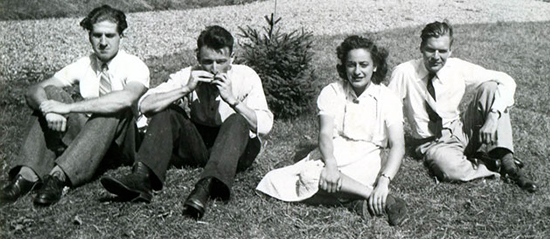
In November 1942, Morawiecki (far left, above, with Berr), now her fiancé, leaves Paris to join the Free French movement in London, and Berr is heartbroken. She stops writing in her diary for ten months, but as the persecution escalates, she feels a duty to begin writing again:
There are men who know and who close their eyes, and I’ll never manage to convince people of that kind, because they are hard and selfish, and I have no authority. But people who do not know and who might have sufficient heart to understand—on those people I must have an effect. For how will humanity ever be healed unless all its rottenness is exposed?
Her voice is somber now: she knows this is not going to end well. She no longer writes about lectures and literature and plans for the future; instead, she writes to bear witness, and also as a way of reaching out to Jean. She has a premonition that she won’t be there when he returns, and asks the family’s cook to give him the diary after the war. “I am leading a posthumous life,” she writes.
Knowing they might at any moment be taken in one of the raids, Berr and her parents leave their apartment, spending most evenings on various friends’ sofas. But on March 7th, 1944, the eve of Berr’s twenty-third birthday, the family decides to spend the night in their own home. They are arrested at 7.30am the next morning and sent to Auschwitz. The last words of Berr’s diary are in English: “Horror! Horror! Horror!”
Berr’s parents died at Auschwitz. Berr survived deportation for over a year, and was transferred to Bergen-Belsen in November 1944. She died there five days before the camp was liberated by the British (Anne Frank died there around the same time). In an afterword to the journal, Job describes Berr’s fate:
Hélène, sick with typhus, could not get up from her bunk for reveille. When her fellow inmates returned to the hut, they found her lying on the floor. She had been brutally beaten. The last spark of life she had clung to had gone out.
The Journal of Hélène Berr is an extraordinary account of a world gone mad. Berr is a wonderful writer, lucid, sensitive, and honest, and her journal is a nuanced and thoughtful record of the effects of persecution. It’s also a deeply unsettling book, because it reminds us that all this happened yesterday. This isn’t history—this is the entirely recognizable life of a whip-smart, modern young woman who lives in a cosmopolitan city. Everything feels so familiar. Most unsettling of all: we are always conscious of the impending conclusion, while Berr, recording events as they unfold, can only wait and hope. And as you turn each page and some ominous new horror is revealed, you want to shout at her to get out get out get out—but you already know how this all ends.
 Yep. Every single book. Spreadsheets at the ready, book nerds! Making a list of thousands of awesome indie and small press books is immensely fun, of course (and there’s so much good stuff to choose from), but it’s also rather time-consuming. And we’re hoping to finalize most of our selections before we head to next week’s BookExpo in New York.
 Perfectionism is the voice of the oppressor, the enemy of the people. It will keep you cramped and insane your whole life, and it is the main obstacle between you and a shitty first draft. I think perfectionism is based on the obsessive belief that if you run carefully enough, hitting each stepping-stone just right, you won’t have to die. The truth is that you will die anyway and that a lot of people who aren’t even looking at their feet are going to do a whole lot better than you, and have a lot more fun while they’re doing it.
 Resistance cannot be seen, touched, heard, or smelled. But it can be felt. We experience it as an energy field radiating from a work-in-potential. It’s a repelling force. Its aim is to shove us away, distract us, prevent us from doing our work … Resistance will tell you anything to keep you from doing your work … Resistance has no strength of its own. Every ounce of juice it possesses comes from us. We feed it with power by our fear of it.
 We may observe, first, that if the effect of the dream is to be powerful, the dream must … be vivid and continuous—vivid because if we are not quite clear about what it is we’re dreaming, who and where the characters are, what it is that they’re doing or trying to do and why, our emotions and judgements must be confused, dissipated, or blocked; and continuous because a repeatedly interrupted flow of action must necessarily have less force than an action directly carried through from its beginning to its conclusion.



 American poet Louise Glück isn’t the cheeriest duck in the pond—loneliness, divorce, and rejection are her favored themes—but she can shoulder the weight of myth like no one else, and her spare, intimate, unflinching voice is utterly compelling. If you’re new to Glück, her Pulitzer-Prize-winning collection,