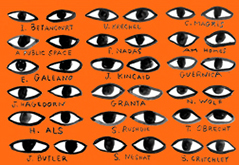
 On Monday night Malvern Books attended the opening night reading of the ninth annual PEN World Voices Festival of International Literature in New York. And if there’s one thing more exciting than attending a book reading, it’s hearing a blogger recount their experiences of attending a book reading, amirite?! Okay, hang in there, let’s try and make this fun.
First up, there were protesters! They were milling about outside the event center, politely encouraging attendees to sign a petition calling for PEN’s new Executive Director, Suzanne Nossel, to resign or be dismissed. As a former State Department official under Hillary Clinton, Nossel championed a strategy of “smart power” (i.e. using ‘soft’ diplomacy in conjunction with ‘hard’ military might, including preemptive strikes), and the protesters felt this made her an odd choice to lead an organization that supports peace and human rights. The leaflet quoted Chris Hedges, Pulitzer Prize-winning journalist and a leader of the Occupy movement, as saying “this appointment makes a mockery of PEN as a human rights organization and belittles the values PEN purports to defend.”
The protesters seemed very pleasant and sane—they looked like kindly middle-aged librarians—and nearly everyone they spoke to accepted one of the bright yellow leaflets before filing inside. I wondered if Nossel was going to give a speech at the event, and if so, what it would be like for her to talk to an audience whose members were fanning their faces with neon sheets that demanded her dismissal. But it turned out to be a bit more… confrontational than that, because one of the protesters, John Walsh, had purchased a ticket for the event, and managed to sit himself and his giant placard right near the front of the stage. The event’s organizers urged him to leave before the readings began, but he muttered something about the right to free speech and they decided it was best to let him stay.
Nossel never appeared, but Salman Rushdie came out to give the opening address. Rushdie is always slightly exciting, because you get to sit there having all sorts of tricky conflicting emotions about him. Genius? Lecherous old coot? Lecherous old genius coot? And on Monday night Rushdie’s presence was especially exciting, because he got heckled by Walsh as soon as he came onstage. Walsh and Rushdie had a bit of an electrifying barney about PEN/Rushdie’s human rights record, which ended when Rushdie dropped the F-bomb:
Walsh: “You supported the war in Iraq!”
Rushdie: “As president of this organization at the time, I led our stand against the war, so you can shut the fuck up!”
The crowd went wild when Rushdie lost his temper, and Walsh was silent after that. The whole thing was a little odd. Why was everyone cheering so vigorously for Rushdie? Why was everyone so enraged by Walsh’s interruptions? After all, the official theme of the event was “bravery,” and PEN is all about supporting VOICES, so you’d think there’d be room for a little heated debate. Also, Walsh doesn’t seem to be a crackpot—he’s a Professor of Physiology at the University of Massachusetts Medical School—and he’s certainly not the first person to criticize Rushdie’s position on the war, which is complicated at best. But I guess the good people of New York had paid their $25 entry fee to hear Rushdie give a speech, and they didn’t want that experience interrupted by anything as messy as, you know, an argument about human rights. Ah well, on with the show!
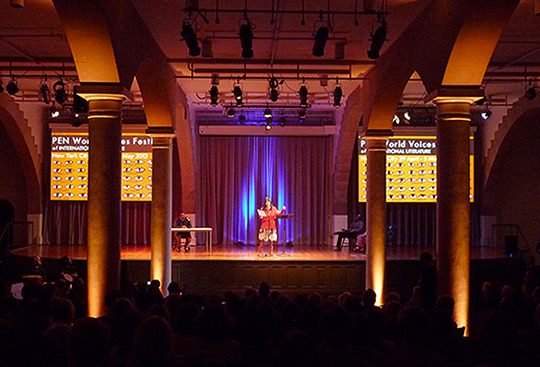
The first two readings were not really my cup of tea, and I had a little debate with myself that went something like this:
I do not like the line “When I thought you couldn’t walk, I wanted to make sure you could fly.” I think it is a bad line. NicholasSparksian. But since it’s from a fictionalized account of one woman’s experiences with the Khmer Rouge (spoiler alert: NOT VERY GOOD EXPERIENCES), am I allowed to say I don’t like it? What kind of person criticizes the prose stylings of someone whose family has been massacred by a despotic regime? Then again, it’s a novel. It was published. It’s open to spirited review, right? Then again, the Khmer Rouge murdered over a million people, so…
Thankfully, and in the spirit of Mr. Rushdie, I soon told myself to shut the fuck up:
Oi, Ms. Cynical-britches! This is the PEN World Voices Festival, not the PEN World Writers Festival. It doesn’t claim to be a celebration of the world’s most excellent prose. It’s a chance for thoughtful people from around the world to share their experiences without fear of reprisal, and this is a Good Thing. And if the smug middleclassness of the audience makes you feel a little… uncomfortable—lady, your conflict diamonds and sweatshop blazer clash mightily with your polite clapping for the words PEACE and FREEDOM—just remember that there are plenty of smug middleclass people out there right now who are kicking Golden Retrievers and arguing with each other about what kind of cheese to buy, so the ones who voluntarily go out into the night to hear stories and poems read aloud are probably sorta a-okay. In other words, shut the fuck up.
So I did. I stopped having tedious, sneery debates with myself and decided to pay attention—and there was lots of wonderful stuff.
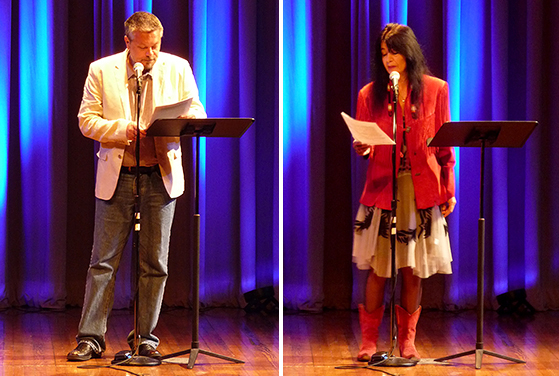
Mikhail Shishkin (pictured above left) is considered one of Russia’s finest contemporary writers, and his work has won all of Russia’s major literary awards. He read an excerpt from Vzyatie Izmaila (The Taking of Izmail), which was awarded the Russian Booker Prize in 2000. Although the novel is apparently non-linear, with no plot, no chapters, and no ongoing characters, the brief passage he read was a straightforward account of a man’s relationship with his mother, as seen through a series of childhood incidents, including a fight over that most precious of Cold War commodities, a pack of chewing gum. The story was very funny and moving, and made me want to read the rest of the book, although I’ll have to be patient—an English translation of The Taking of Izmail has yet to be published. (Get on to it, someone!)
Muscogee poet Joy Harjo (above right) chanted/sang “Equinox”:
I must keep from breaking into the story by force
for if I do I will find myself with a war club in my hand
and the smoke of grief staggering toward the sun,
your nation dead beside you.
I keep walking away though it has been an eternity
and from each drop of blood
springs up sons and daughters, trees,
a mountain of sorrows, of songs.
I tell you this from the dusk of a small city in the north
not far from the birthplace of cars and industry.
Geese are returning to mate and crocuses have
broken through the frozen earth.
Soon they will come for me and I will make my stand
before the jury of destiny. Yes, I will answer in the clatter
of the new world, I have broken my addiction to war
and desire. Yes, I will reply, I have buried the dead
and made songs of the blood, the marrow.
A sort of collective I-feel-moved murmur went through the crowd when she recited the last few lines.
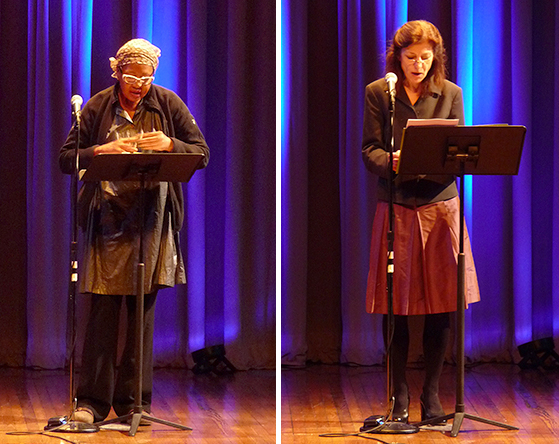
Jamaica Kincaid (above left) announced, “I’d much rather read from a book I didn’t write,” and proceeded to read from Milton’s Paradise Lost. How cool is that? As a disobedient child, Kincaid was made to copy out Books I-II as a punishment, but she claimed it was far from a punishment: she fell in love with the naughty protagonist.
German writer Ursula Krechel (above right) read from her most recent novel, Landgericht (State Justice), winner of the 2012 German Book Prize. It’s the story of Richard Kornitzer, a German-Jewish lawyer who flees to Cuba in 1933 to escape the Nazis, and then returns to Germany—and his wife—after the war to try and resume his old life. We’re big fans of Ursula here at Malvern (wearing our Host Publications hat, we published her bilingual poetry collection, Voices from the Bitter Core), and it was wonderful to hear her read.
James Kelman read something in a thick Scottish accent. I think it was about a leg wound.
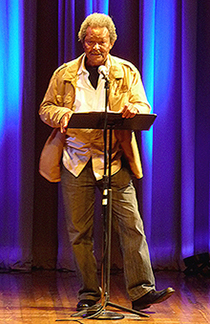 And then there was my favorite, the Trinidadian writer Earl Lovelace, who was very, very funny. He read from the novel Is Just a Movie, which was awarded the 2011 Grand Prize for Caribbean Literature. The book recounts the misadventures of Sonnyboy, a minor and hapless figure in Trinidad’s Black Power movement. In the section Lovelace read, he describes what is expected of you when you’re hired as local color for a Hollywood movie being shot in Trinidad: “The natives’ role is to die.” Sonnyboy is outraged by the ease with which his fellow local extras take a bullet. His pride won’t let him die “like an ass”—“even as a child playing stick-’em-up, I composed my dying like a poem”—and so he resolves to die deliberately, with drama and dignity.
I began the exquisite choreography of my dying.
“Cut,” the director said.

 1. Longform is really two sites: the original
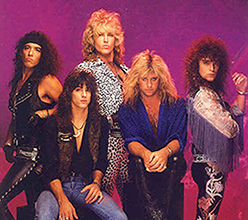 Once the movement hit America, it started undergoing changes. It began with a more pop-friendly commercial sound, which became known as glam metal. This genre was responsible for bands like Ratt (pictured at right), Poison (below left), and Mötley Crüe (below right). One of the common themes of this genre is the way the bands would dress. The members would wear feminine clothing and makeup; this is what started the name glam metal or glam rock. This look, mixed with the poppy lyrics about love and relationships, created a highly mainstream sensation. The music consisted of simple time structures with high pitched vocals. The guitars would sometimes offer good riffs and technical solos, but for the most part the appeal of the genre was lost on the metal fan base, who wanted something heavier.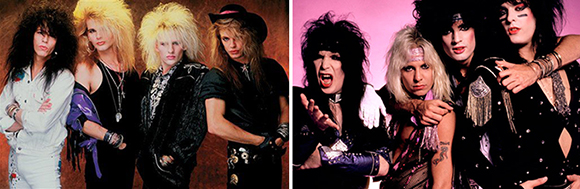
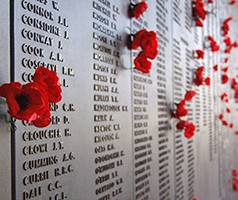 Following the Second World War, Anzac Day’s commemorative scope was broadened, and it became a day of general remembrance for all those lost in battle. Every year on April 25th, people all over New Zealand and Australia don red poppies, attend dawn services, and trade stories about great-uncles who never made it home. So, if you’ll forgive this soppy antipodean disruption to our regular services, let’s do our bit with an Anzac Day Three.
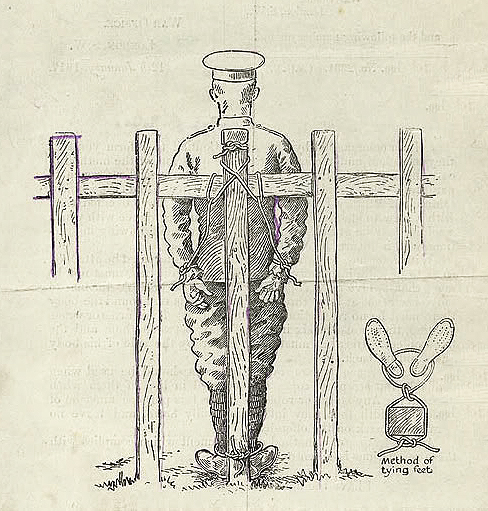 [The sergeant] took me over to the poles, which were willow stumps, six to eight inches in diameter and twice the height of a man, and placed me against one of them. It was inclined forward out of perpendicular. Almost always afterwards he picked the same one for me. I stood with my back to it and he tied me to it by the ankles, knees and wrists. He was an expert at the job, and he knew how to pull and strain at the ropes till they cut into the flesh and completely stopped the circulation. When I was taken off my hands were always black with congested blood. My hands were taken round behind the pole, tied together and pulled well up it, straining and cramping the muscles and forcing them into an unnatural position. Most knots will slacken a little after a time. His never did. The slope of the post brought me into a hanging position, causing a large part of my weight to come on my arms, and I could get no proper grip with my feet on the ground, as it was worn away round the pole and my toes were consequently much lower than my heels. I was strained so tightly up against the post that I was unable to move body or limbs a fraction of an inch…