
Malvern Books recently spent some time in Concord, Massachusetts, and I can highly recommend it as a vacation spot for lit-nerds (and also grape aficionados).
First up, you should plant your feet firmly on the North Bridge, site of the first proper battle of the Revolutionary War, and recite the opening lines of Ralph Waldo Emerson’s “Concord Hymn”:
By the rude bridge that arched the flood,
Their flag to April’s breeze unfurled,
Here once the embattled farmers stood
And fired the shot heard round the world.
From the bridge it’s a very short walk to The Old Manse, which was built by Emerson’s grandfather in 1770. As a young boy, Emerson’s father was able to observe those first few shots of the revolution from an upstairs window, which must have made for quite an exciting morning.
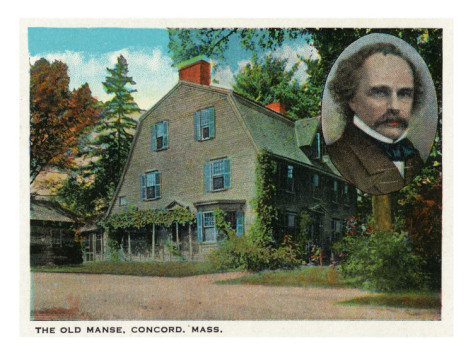
In 1834, Ralph Waldo Emerson (1803-1882) moved to the Manse, and he wrote the draft of his famous essay “Nature” there, which puts forth the foundations of transcendentalism. Emerson married the following year and bought a house nearby, which he named, oddly, Bush. He lived there for the rest of his life.
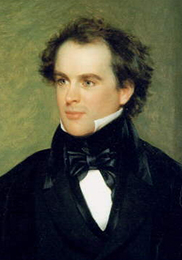 In 1842, newlyweds Nathaniel Hawthorne (1804-1864) and his wife Sophia rented the Manse for $100 a year. Since brushed chrome toasters and Le Creuset cookware had not yet been invented, their pal Thoreau planted a vegetable garden for them as a wedding gift. Nathaniel and Sophia were batty about each other, and on a tour of the Manse you’ll see the poems they wrote for each other etched into the Manse’s windowpanes with Sophia’s diamond ring. You’ll also meet Longfellow, Hawthorne’s spooky stuffed owl, which he would hide around the house to frighten his wife. Alas, after three happy years at the Manse (during which Hawthorne wrote a tribute to the house called Mosses from an Old Manse), the Hawthorne’s were evicted for not paying rent.
And speaking of Mr. Thoreau: yes, his famous pond is not far away. Henry David Thoreau (1817-1862) did his deliberate living at Walden from July 1845 to September 1847, on land owned by Emerson (and you thought the Austin literary world was incestuous!). Emerson agreed to let Thoreau conduct his “experiment in simplicity” and build a house on the land, in exchange for Thoreau clearing the woods. Thoreau’s one-room cabin is no longer intact (there’s a replica near the car park, and Concord Museum has the cabin’s bed, chair, and desk on display), but the foundations are still there, on the northern shore of the pond. If you’re a raging hippie you can visit the site, say a prayer to the gods of self-reliance, and add another rock tribute to this pile of rocks:
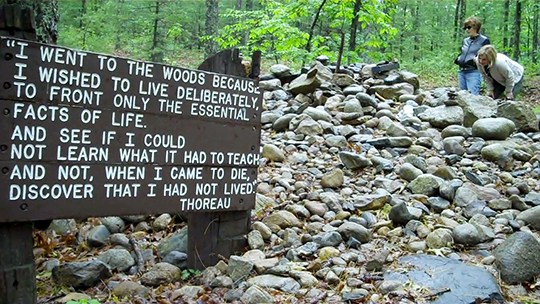
If you’re a cynic, you can sneer at the railway tracks that run behind the cabin (they were there in Thoreau’s day, too), and point out that Emerson and also Thoreau’s parents lived a mere twenty-minute walk away. (To be fair to Thoreau, he does make it clear in Walden that he was not living out in the wopwops.) After his time in the woods, Thoreau moved in with the Emersons at Bush.
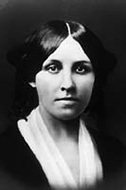 The next two stops on your whirlwind tour should be the Concord homes of Louisa May Alcott (1832-1888) and her family. When Alcott was a child, she lived briefly at Fruitlands, near Harvard, an agrarian commune founded by her somewhat hapless father, who admired his friend Emerson’s back-to-nature philosophies. Sadly, Fruitlands lasted only seven months—none of the resident transcendentalists turned out to have much of a knack for farming—and the family returned to Concord. In 1845, with the help of a loan from Emerson, they bought a home they called The Hillside; many of the incidents in Little Women are based on Alcott’s childhood there. However, Louisa May’s father was unable to support his family, and in 1852 they were forced to sell the home to Hawthorne, who renamed it The Wayside (Hawthorne had moved up in the world; The Scarlet Letter had been published in 1850, and was an immediate best seller).
The Alcotts moved to Boston for a few years, before returning to Concord in 1858 to purchase the adjacent Orchard House, where Louisa May Alcott wrote Little Women in her room on a tiny half-moon desk built for her by her father.
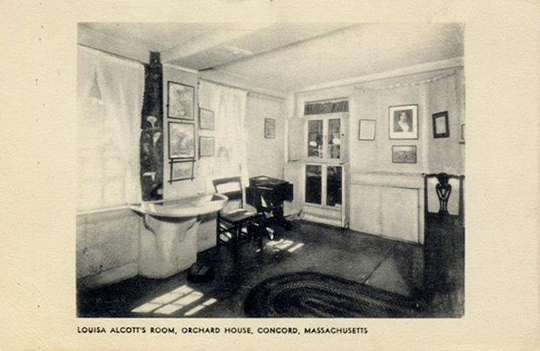
The book was an instant commercial and critical success, and Louisa May Alcott was able to make good on at least two of the three promises she recorded in her diary at age fifteen: “I’ll be rich and famous and happy before I die, see if I won’t!” She died of a stroke at age fifty-five, and is buried in Concord’s Sleepy Hollow Cemetery, on a hillside near Emerson, Hawthorne, and Thoreau.
If you need a rest after all this literary sightseeing, you can check in at the terribly old (1716) and supposedly haunted Colonial Inn, where Thoreau lived from 1835 to 1837 while he attended Harvard. Have a stiff drink in the wood-paneled bar, and reflect on how Concord’s mid-nineteenth-century literary scene seems a lot like today’s literary scene: it’s a tiny, tiny world where everyone knows everyone else, and for every jammy bastard who strikes it rich—you go, Louisa May!—there are a hundred impoverished scribblers who have no choice but to gift their newlywed friends a bunch of shitty vegetables.
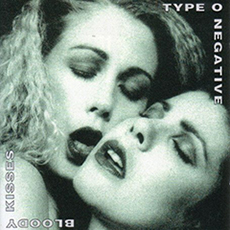 Type O Negative was a gothic metal band formed after the dissolution of the hardcore band Carnivore in 1987. Peter Steele, who played bass and was the lead vocalist, formed the band in Brooklyn, New York. The band would go platinum in 1993 and eventually go gold in 1996. Few could deny front man Peter Steele’s talent as both a songwriter and a musician. Many eager fans waited in anticipation for the release of his next band’s debut after Carnivore broke up, and in 1991 the wait finally ended with the release of the album Slow, Deep and Hard.
 Next, let’s check out
 613 W. 29th Street, to be exact. It’s a great location, not far from UT Austin, and with wonderful neighbors (why, hello there,
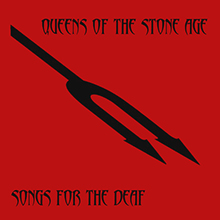 Queens of the Stone Age is a highly talented rock band formed in Palm Desert, California, in 1996. Queens of the Stone Age was formed following the 1995 demise of the massively influential stoner rock band Kyuss. The group’s founder, Josh Homme, briefly played guitar in a band called Screaming Trees, before deciding to form a new band of his own. Their first release was a two-track EP entitled Gamma Ray, released in January ’96. On their first full-length, self-titled album, Homme played guitar and bass, but shortly after, former Kyuss bass player Nick Oliveri joined the group.