
Celia recommends Anniversaries by Uwe Johnson:
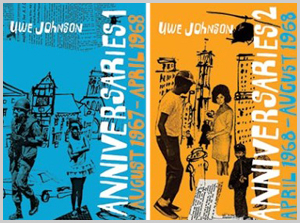 Some books you go back to. When I first read Uwe Johnson’s mammoth novel Anniversaries, I was living in New York City, about sixty blocks north of the apartment on West 96th Street that the novel’s heroine, Gesine Cresspahl, lives in with her ten-year-old daughter Marie. They are immigrants from East Germany, trying uneasily to make a life in America. I read the book on the subway, I read it lying in bed by the box fan in my window, and, as I read, the novel’s New York, the New York of 1967, became subtly intertwined with the landscape that I too inhabited. Gesine and her daughter take Sundays to go to South Ferry, riding back and forth to Staten Island on a ferry that, in those days, still had a restaurant and a bar. I rode the A train far out to the Rockaways and Jacob Riis beach with friends and a cooler full of popsicles. The city, of course, has changed immensely in the years since Uwe Johnson wrote Anniversaries, but as I read, I’d feel the ghosts return.
Of course, I was reading a somewhat different novel then. My copy was abridged, barely a third of the original 1,600-page novel. So now, in a new, unabridged translation by Damion Searls, it’s a book that begs one to return to it. You might compare it to the story of Scheherazade1: Johnson writes one chapter a day for an entire year, covering both Gesine’s present life in New York and her memories of growing up in Hitler’s Germany, her family history and her uneasiness with the politics of Cold War America. If I told you that Johnson devotes an entire chapter to riding an elevator, you might decide that this is not a book that you want to read. But he does, and it’s a small, sensory delight. For instance: “sometimes the elevator in the bank building falls a short way down as it starts up, as though genuflecting.”
Which is not to say that this is a book composed solely of beautiful and mundane details. It contains, also, a Mafia kidnapping, a secret journey behind the Iron Curtain, a runaway child, a secret agent, a Soviet prison camp, innumerable deaths.
Gesine has a routine: every day, she reads the New York Times, imagining her as a kind of august maiden aunt, dispensing advice and news from the world.2 She takes the subway to work and gets off of the lovingly described elevator on the floor of the bank that houses the Foreign Sales department, in which she works as a translator. She orders tea from the canteen in the basement, and as early as possible, she hurries home to Marie, the kind of whip-smart New York child who, at ten, is riding the subway by herself and making her own way to and from school. And then, at home, she tells Marie stories of her family history.
There is Gesine’s mother, desperately religious, the favorite daughter of a wealthy German landowner, and her father, a master carpenter with a promising new life laid out before him in England, who nevertheless finds himself drawn back into Germany with Nazism on the horizon. There are her aunts and uncles—the spendthrift who adores children and burns down his business for the insurance money, the prodigal son who, disowned, flees to Rio de Janeiro, the rebellious younger son who embraces Nazism mostly, it seems, to get out of his father’s shadow.
Gesine, barely ten at the time of the Second World War, remembers schoolchildren’s salutes to Hitler, sharing a sickbed with a refugee child after Germany’s defeat, visiting her father for lunch at the canteen of a German airfield, and she holds relentless mental conversations with the dead of her family, asking whether they can claim to have done the best they could in the face of injustice. Is that something that she herself can claim, as a witness to the Vietnam War, to the Civil Rights Movement, the Cold War, the death of Martin Luther King? (Don’t you like this country, Gesine? she asks herself at intervals. Go find another one.) Is it something she can claim as a child who came of age in East Germany, in the time of Stalin and the Berlin Wall, and who left her country and came to New York?
Her father, Heinrich Cresspahl (Hinrich, her mother’s family calls him in Gesine’s memory, in the accent of Mecklenburg), does the best he can under the Nazis. Which is to say: he takes a job building an airfield outside of Gesine’s hometown. He requests an application to join the National Socialist party, and then never fills it out. He tries to help a Jewish veterinarian, a friend of his, escape the country. He doesn’t have much to say about the few other Jews in Jerichow. They aren’t his personal friends. After the war, the East German government recognizes him as a hero, renames a street for him. It turns out that he’s been spying for the British, using his work at the airfield to provide them intelligence. Everyone in your family worked hand in glove with the Nazis, Gesine’s daughter Marie breaks in at this point in the story. Now you want to save the honor of at least one of them, and of course you pick your father.3
Gesine answers: Many people were braver than he was while they were betraying their country.
Cresspahl, more than a hero, is an expert survivor. In Jerichow during the Nazi regime, he makes the best of his situation, then makes the best of it, again, under the Soviets. He keeps his daughter protected from his anti-government activities, allowing her to grow up believing what she’s taught in school, and years later, Gesine is still doing the accounting for her childhood—a rhyme from an anti-Semitic children’s book she was given as a toddler, an orange that she accepted, in the lean early years of Soviet rule, from a former Nazi. She holds conversations with the dead—her father, her mother, her old neighbors in Jerichow. She interrogates her own motivations, and sometimes, too, those of her author, Johnson.4 She observes, often with dismay, how her daughter Marie is shaped by the prejudices of Cold War America—its wealth, its entrenched racism, its easy self-assurance.
She is afraid, as a foreigner, to protest the injustice she sees around her too loudly. Don’t like this country, Gesine? Go find another one. As a teenager, she laid her hope in the chance that her outward compliance might let her escape from the brutality of Soviet rule in East Germany. But the past and present are a kind of slant rhyme. There is no other country in which Gesine could live without guilt.
As I was reading this book, I sent my partner pictures of passages that I particularly liked, for their insight, their language, for the sad incorruptibility with which Johnson approaches the elements of life. And after I had finished the first volume, and started the second, he picked up the volume I’d finished, and began at the beginning. So that as we each moved forward in the book and the life of Gesine, he would come to me with chapters that he liked, or that I had marked when I was reading, and give me the chance to sit with them again.
When you spend this long with a book, you begin to build a personal relationship with it and with its author. Johnson spent more than fifteen years of his life writing Anniversaries, and reading it is an immense task, and as you do, you feel the weight of the time that Johnson devoted to it, and, perhaps, you feel as if it’s a project that you’re in together with him. In that situation, it’s easy to begin to believe that a book belongs to you in particular, that the intimacy and difficulty of the experience is a sign that the book exists only for you. But reading this together with another person made me wish that this was a book that everyone read, because it’s a book that wants to take the whole world in and account for it, that’s willing to ask what the enormous extent of our loss and guilt is, having reached this point in history, and why we go on in spite of it.
It wants to capture an entire world of experience. How vast and particular a single person’s life can be. And how much vaster are the forces that create it, the enormous movements of the outside world.
I haven’t finished reading Anniversaries yet. As I write, I’m more than 1500 pages in, and still a hundred pages or so from the end. In a few hours, if I sit with it, I’ll have read the whole thing. But what I want in this review is not to be writing at the point of completion, at the end of the year, but to still be in process, in a novel that doesn’t have to have an end.
-
“The piece of the past that is ours, because we were there, remains concealed in a mystery, sealed shut against Ali Baba’s magic words, hostile, inapproachable, mute and alluring like a huge gray cat behind a windowpane seen from far below as though with a child’s eyes” (53). This cat, by the way, returns, if you can hold the image in your mind across hundreds of pages.
-
The Times serves as a sort of Greek chorus in the novel, but frequently an untrustworthy one. Johnson also read the newspaper religiously, and often begins chapters with a list of news items: deaths in Vietnam, crimes or stories from New York, news about the president. These events are a constant link to the world outside of Gesine’s personal experience, but they are also inherently mediated and biased—Gesine spends days pondering an article on the representation of black people in journalism, in which the Times, after critiquing a number of other newspapers, sheepishly admits to employing essentially no black reporters or editors. The Times is the voice of common sense, of respectable opinion, to which Gesine must listen but with which she is constantly arguing, and in this, as in many other things, Anniversaries feels almost shockingly modern and relevant.
-
Oh, how we wish she’d done that, Gesine thinks, early in the novel, about an older German acquaintance who boasts about sheltering her Jewish neighbors from the Nazis.
-
Listen, Comrade Writer, Gesine begins, when she objects to a passage. I gave you a year. That was our agreement. Describe the year. While he was living in New York, Uwe Johnson would occasionally mention to acquaintances that he had run into Gesine at Grand Central, on her way to work. The address of Gesine’s apartment on 96th Street was Johnson’s own address, and, in face of the enormous, humble attention with which Johnson renders Gesine’s inner world, occasionally stepping in to remind us that he is only her chronicler, this is only his best guess, it’s easy to believe that the two of them lived alongside each other in the way he imagines, and she is his ghost, or he hers.
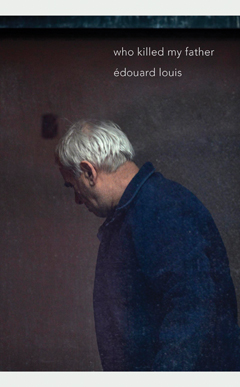 What does it mean for a book to provoke, to register on a visceral level like a disturbing movie scene that you can’t un-see? As I read Who Killed My Father by Édouard Louis I thought a great deal about provocation, its outcomes anger, sadness, frustration, a sense of reliving emotions to a boiling point. Louis’s vivid portrait of how the class system in France chipped away at his father’s body, mind, and spirit reminded me of the state of things for so many Americans who make $7.25 an hour in 29 states including Washington DC in the year 2019. I thought of members of my own family, told by dentists that there’s nothing to be done to save their teeth. I thought about foreclosures, health insurance, food stamps and the ways in which the poor are required to submit documented proof of near destitution over and over and over again. I thought about shame.
 Have you ever entertained the suspicion that vegetables are slightly demonic? Do you look at the carrot with forked roots and find it a little perverse? And how do you feel about the Boschian delights of asparagus? Have you looked into a jar of fruit preserves and wondered if it had a soul? Are you entranced by articles of clothing, absent their wearers?
 It has been a long time since a book has shocked and morbidly fascinated me as much as Hashish by Oscar A.H. Schmitz. Literary dandy Schmitz was held in high esteem by his contemporaries, but other decadent and fin de siècle writers like Edgar Allen Poe and Oscar Wilde have eclipsed his presence in modern mainstream consciousness. Thanks to Wakefield Press, however, this practically unknown collection of German tales has finally come out of the woodwork, available in English for the first time since its original 1902 publication. After a chance encounter with the alluring yet aging dandy Count Vittorio Alta-Carrara in a Parisian café, the narrator is invited along to a moody hashish club––red-tinged and candle-lit––where an eclectic assembly of travelers swap stories of extravagance, corruption, and debauchery. Alongside the Count and the narrator, the reader is swept up into a series of fantastical accounts of mistaken identity, Satanic rituals, and necrophilic love affairs. Gothic and grotesque, Schmitz’s novel delves into the dark and perverse undercurrents of dandyism, a lifestyle synonymous with refinement and elegance.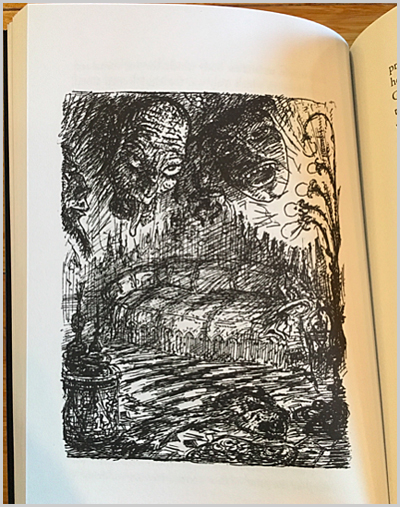

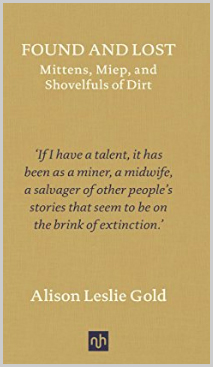 As a bookseller, I don’t take recommendations lightly, especially when a “recommendee” is seeking to soothe or be soothed after experiencing loss. Suggesting the wrong book to someone in pain feels like a lesser form of medical malpractice. Now when people come into the store asking for a title related to grief, I know just the book to place into their hands: Found and Lost by Alison Leslie Gold.