Celia recommends And China Has Hands by H.T. Tsiang:
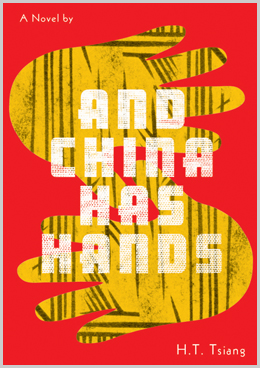 Here’s a book I was delighted to discover, reprinted in a lovely edition by Kaya Press: And China Has Hands, by H.T. Tsiang. It’s something of an unrecognized classic: written in 1937, it follows two Chinese Americans living in New York City. The heroes of the novel are Wong Wan-Lee and Pearl Chang (who Tsiang always refers to by their full names, never by a given name alone). Wong Wan-Lee is a recent immigrant from China in New York City, the son of a naturalized American citizen, who, having barely escaped an illegal deportation, buys the lease to a laundry business in order to try and pay off his legal fees. He’s a dreamer, a little bewildered by the country he’s immigrated to, but street smart in a gentle way. When a group of white school boys taunt him outside his laundry, he throws them some fruit and hopes to make friends. When various New York bureaucrats try to pressure him into paying bribes or protection money, he takes refuge in pretending that he doesn’t speak English. He can’t pay if he can’t understand, and he hopes this will protect him.
Pearl Chang, on the other hand, has grown up in the American South, the child of a Chinese father and a black mother. Having lived under segregation, she’s used to concealing her mixed-race heritage, in the hope of avoiding the worst anti-black sentiments thrown at her. She’s an outspoken would-be actress, and she and Wong Wan-Lee meet when she takes his side when he’s being harassed outside of his laundry. He quickly falls in a kind of love with her. It’s the 1930s, after all, when Chinese women were severely restricted from immigrating to the United States, a policy intended to prevent the Chinese men who came to build railroads or work in America’s cities from building communities and putting down roots in their adopted country.
As a result, Wong Wan-Lee barely knows any Chinese women in New York, and, lonely as he is, his feelings for Pearl Chang teeter between love and obsession. She likes him back for his gentleness, which is different from the white men she’s known, who have harassed her or treated her badly, and for the connection she feels with her father’s homeland, which she’s never been to. But while Wong Wan-Lee feels immediately connected with Pearl Chang, he’s also a little ashamed of her. She exoticizes him, imagining him as a foreign prince, and he takes her very American habits for evidence that she’s a bit of a fool. When they go out together, she sometimes teases him with the same racial slurs that his white customers use, and he refuses to hold her hand or walk beside her, lest anyone guess that they’re a couple.
Their elliptical, unsteady romance plays out against the backdrop of Depression-Era Manhattan, which seems at first to be a world in which anyone can make it—from laundry worker to millionaire, or waitress to movie star. But the game is rigged in ways that aren’t at first visible to the naked eye. Tsiang uses a light touch in painting the social and economic struggles that his heroes experience—he spends as much time on the intricacies of Wong Wan-Lee’s friendship with his cat as on his decision to make a deal with a loan shark—but slowly, the noose tightens, and Wong Wan-Lee and Pearl Chang descend into harder, more straightened circumstances.
Tsiang himself was a radical and a performer, a devoted Communist who worked as the secretary to the secretary of Sun Yat-sen, played bit parts in a dozen odd films, including the original Ocean’s Eleven, wrote and staged his own plays, and remained deeply involved with the leftist movement after immigrating to the United States. Having fled China in 1926, after his radical politics got him into trouble, he enrolled at Columbia University, only to face recurring problems with his student visa that nearly saw him deported under the Chinese Exclusion Act. In his original introduction to And China Has Hands, he credits the ACLU and the International Labor Defense with the legal aid that allowed him to remain in the United States.
Tsiang self-published a number of books before finally convincing a commercial publishing house to take a chance on And China Has Hands, a piece of autobiography that Tsiang turns into a good-natured joke on himself in one of the novel’s minor characters: a charming but rather hapless and self-absorbed “proletarian” novelist, who self-publishes his work and keeps getting kicked out of restaurants for trying to hand-sell copies of his book to pay his printing bill. Near the end, he finally secures a publisher—who, learning that he plans to attend a restaurant workers’ strike (at one of the restaurants that has tossed him out), keenly hopes that “the author would get his head clubbed so his picture would appear in the papers and, by-productingly, his books be mentioned.” Tsiang’s own publishers don’t seem to have taken offense, although they did, perhaps somewhat backhandedly, refer to his “[rather startling] artless habit of calling a spade by its given name” in their jacket copy for the original book.
Tsiang’s contemporary critics also seem to have not entirely known what to make of him. In his afterword to Kaya Press’s edition of And China Has Hands, Floyd Cheung quotes one reviewer’s assessment that Tsiang’s written English was “functional and surprisingly effective, though not always ‘correct.’” In reading Tsiang, I was pleasantly reminded of the prose of Barbara Comyns, another rather brilliant prose stylist whose writing was dismissively received in her time as a kind of naïve art—and who takes a similarly fresh, playful, irrepressibly hopeful tone even when describing situations of acute isolation and hardship.
The simplicity of Tsiang’s sentences is deceptive. Throughout the novel, the straightforward, declarative way that Tsiang writes out his characters’ hopes, fears and dreams conceals the careful eye with which he captures the wider social and political context of his world. Their lives are not only their lives, but the precious components of the collective to which Tsiang devoted his work as an activist. Excluded from power, their lives are still invisibly and inexorably shaped by the actions of the rich and powerful around them. If Tsiang’s hopes for a world that is more just to the poor, to immigrants, and to refugees have not yet been realized, his work remains all the more relevant today for the clarity with which it foresees the questions of justice and belonging that the United States is still struggling to address.
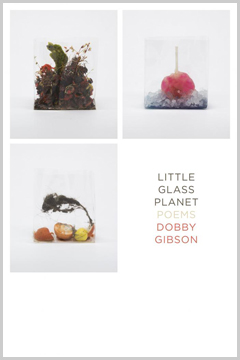 Poet Dobby Gibson is a gondolier, your most trusted confidante, a stern assistant principal who has taken you, a troubled student, under his wing. In Dobby’s poems, you can feel the tenderness with which he treats each line, examining each trinket and bauble of the world as though they were talismans, investigating every subject as if it were an injury on our collective body. He gives us the diagnosis, administers the salve and wrappings. In Little Glass Planet, Dobby writes as if we’re having a heart-to-heart with him, jocular at times, but never shirking the difficult conversation:
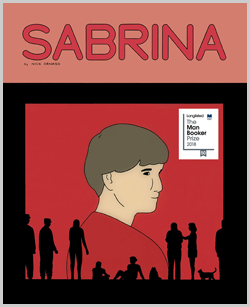 There doesn’t need to be another review of Nick Drnaso’s Sabrina; it was heaped with praise when it was published by Drawn and Quarterly in 2018. Zadie Smith said, “Sabrina is the best book—in any medium—I have read about our current moment.” And if you come across as many Zadie Smith blurbs as I do, you can spot the difference between a lukewarm this-certainly-wasn’t-the-worst-book-in-the-world Zadie Smith blurb and a glowing I-actually-loved-this-book Zadie Smith blurb. Sabrina also caught the attention of the Man Booker judges, becoming the first graphic novel to be longlisted for the prize. Suddenly, Sabrina was a book everyone wanted to read, and booksellers were forced to say “sorry, we’re sold out.”
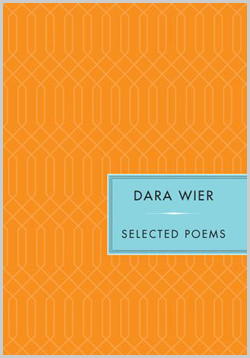 Dara Wier is a poet whose work transcends the evolving cycles of American poetry. This collection, her tenth, offers a cross-section of her poetry, and if you’re looking for an entry point into her work, Selected Poems is the book. In it, Wier doesn’t suppress a thing—we are met with the full force of her weirdness, poetry that explores an intensity of experience that is unpoliced, full of humor, longing, and human fragility.
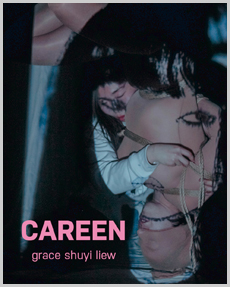 [Careen] captures the strangeness of our times, and the particular strangeness of being an Asian woman living in America. These poems are fierce. They are naked and unadorned, completely without fear even as they enter into the most unstable spaces of the mind, the body and the spirit. This book is a necessary handbook for all of us who are navigating the treacherous sociopolitical climate. It shows us how to remain human, even as we feel more and more alien in our own minds.
 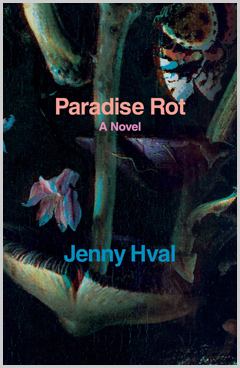 There’s a girl, you see. She’s away from home, in another country, in fact, where she’s a foreigner, a student, staying at a hostel where the mirror is cracked and she doesn’t know anyone. Things are normal, but dislocated. It’s her first semester studying abroad. She has to find an apartment, she has to find friends. She has to navigate how she might feel about adulthood, about sexuality, about what it means to go out and exist in the world. Sometimes men walk up to her and inform her that she looks like a lesbian, which isn’t a thing she’s thought about properly, and the suggestion, coming from outside of herself, with its undertone of prurient sexual interest, makes it impossible to think about. There is a woman that she likes, but mostly she’s a friend. It’s not like that. Things aren’t what they look like.