Staff Picks: The Corner that Held Them

Celia recommends The Corner that Held Them by Sylvia Townsend Warner:

It only takes a few pages for this book to bewilder you. The Corner that Held Them begins with Alianor de Retteville, a twelfth-century English noblewoman who is not, by any means, the novel’s heroine. Nevertheless, it is she who will set the events that follow in motion. She is, at the beginning, in bed with her adulterous lover, she is surprised by her husband, she watches as her lover is killed, she is spared, she grows old, she has children, she dies. All this occurs in the first six pages, and the procession of events is so shocking that I hesitate to even describe it. Here, look:

At the first start of waking Alianor did not move. Recumbent, stiffening in the posture of her sleep, she watched her lover being butchered. What would have been the use of moving? She could not save Giles and in a little while she would be dead herself. So she stayed as she was, her long arms and narrow hands spread out on either side as she had laid them for coolness, for the air, cooled with rain, to refresh her ribs and flanks. […] It was this immobility which saved her life. Turning to the bedside Brian de Retteville supposed that he would now kill the woman too. But seeing her lie there, so calm, so arrogantly still, his anger was arrested by the horror a man feels at a woman’s immodest individuality.

It’s a breathless passage, with all the commas scrubbed out, except for those few describing the air cooled by the rain, and Alianor, “so calm, so arrogantly still.” One reads it in a kind of stumbling, pauseless rush. And then after the moment of violence, life jerks back into motion, and within a few pages this woman we’ve just met has lived a complete, unhappy life, and is herself dead.

Because, with the murder out of the way, and having saved Alianor’s life through her own frozen indifference to her safety, the novel skips forward: Brian de Retteville will spend the next several decades taunting his wife and retelling the story of how he killed her lover to guests, and on her death, he’ll be inexplicably overcome with remorse and use her considerable fortune to found a Benedictine convent on one of her estates, called Oby. And with that, the novel hurtles forward in time, to pick up a cool hundred and fifty years later, just as the Black Death is making ground in England, and the convent at Oby is infected. This little moment of death, too, will pass, leaving its survivors to face other societal convulsions, a few months or a few decades in the future.

Alianor is, largely, forgotten by the community in whose honor she was founded. But those jarring first pages—and the question of “immodest individuality”—will be the cornerstone for what comes after. What Warner is most interested in is not the individual, but the life of an institution. The Oby convent is a community carved out of the church and the law’s general hostility towards women, not quite self-directed, but often without oversight, and the question of faith in the convent is always mixed with the question of independence: will the next Bishop keep the nuns on a shorter leash, will they be able to decide their own affairs, and will they have the money to do so?

When the Black Death strikes the convent, Warner sums up the situation like this: “the extravaganza of death that was sweeping their world away suggested no changes to them except the change from being alive to being dead.” Still the rents must be collected, noble legacies secured, the convent’s food and beer and cloth purchased, the chapel renovated and the priest’s salary paid. Often this must be done in opposition to the church hierarchy, which, as a rule, would like to place the nuns under stricter scrutiny and a tighter budget. While the nuns are pulling their daily living by inches out of the jaws of death, the ground is changing under them. Soon there may be no workmen, no farmers to pay the rent, no priest to take confession or deliver the last rites.

Personal faith, in this world, is both mandated and met with deep suspicion and hostility. Spiritual knowledge is one of the few avenues of power that can, theoretically, spring up in women as well as in men, among the poor as easily as the rich. And so, naturally, the structures of church and government want to be certain that the wisdom of God isn’t being unreasonably or inconveniently distributed, despite the advent of the plague that has turned the world upside down. One recurring motif in The Corner that Held Them is the knowledge and power of the outcast: the bastard clerk who, almost accidentally, claims the title of priest, from which he is excluded by his illegitimate birth, the ostracized nun who receives a vision from Saint Leonard instructing her to go and become an anchoress, the man appointed custodian of the convent, who finds unexpected beauty and grace in a visit to a leper colony.

It is the task of power to mediate (and disarm) these individual experiences of truth and beauty. When, for instance, the local bishop comes to evaluate the nun Lilias’s request to become an anchoress, he hears her story of being struck down at prayer by Saint Leonard and responds thus:

He told her of his sister, a nun at Barking, who had twice been addressed by heavenly voices. On the first occasion the voice warned her that the tap of a wine-cask had not been properly turned off, so that the wine was wasting. On the second occasion, when his sister had cracked a nut and found nothing inside it but dust and a fat white grub, a voice had rebuked her disappointment by exclaiming, “You should thank God for this picture of a good nun!”

The implied message is clear: it is not for a nun to seek spiritual insight, but to tend to the earthly tasks required to keep the convent running, and to not complain when she is served worms instead of nuts. The novel’s long view of history is frequently extremely funny, as with the madcap idea of angels descending from heaven to bully a nun for being sad about a walnut, but there’s a tyranny underlying the humor. To wit: it’s nearly impossible to find meaning in a world that is so relentlessly hostile to individual experience.

The tone of farce that the novel frequently adopts has a dark edge. History will wipe these women and all that they accomplish entirely from memory. It’s not quite a tragedy when the convent loses its altar vessels, or the old priest loses his mind, or the chaplain of lepers loses his house, because these things are common occurrences in the flow of the years. The final sum of all of these losses is a kind of winsome and rueful comedy. So the community mostly bumbles along, with everyone doing the tasks they’ve been assigned, and the small dissatisfactions that they feel are mostly quiet ones. Heavenly ecstasy and the terror of hell are, for the most part, private experiences, like bubbles in a piece of blown glass. If you crack the glass to get at them, they evaporate, and the vessel itself breaks. Warner handles her years delicately, but sometimes she lets some small catastrophe slip in, so that you look at the jagged edge of a day and ask, Is this what it was? Yes.
Staff Picks: The Musical Brain

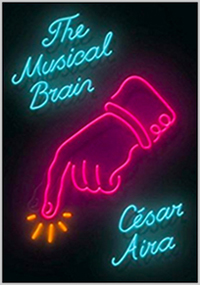
Claire recommends The Musical Brain by César Aira:

My first foray into the wild mechanics of Aira’s fiction, this collection of short stories feels like it has been spun out of the webby brainwaves of a mad scientist. Aira is known as the Latin American master of microfiction, having published ten short novels in nine years with New Directions. But there’s something wholly unexpected about the way these short stories read like experiments “approaching the edge of the chasm that separates an ending from a continuation.” (p. 331) His genius is beyond question, though its expression is so strange, that after reading any one of these stories, your brain may be full of nothing but questions, but also delight.
Are you looking for the kind of story that takes seriously the business of philosophy, human nature, high art, and the limits of the reasoning mind, with a plot that focuses on two men, one with hands the size of the rest of his body, and one with feet the size of the rest of his body? Look no further.

These are stories, yes, but they are also experiments in thought. Though the language is rich and heavily laden with the detailed imagery of surrealism, each story seems to operate by some mechanism other than plot, often implementing weird, unpredictable math, accumulating rapidly and beyond the limits of reason. It is clear that Aira is invested in “the art of thinking.” (p. 333) He writes himself into the corner of an irresolvable paradox over and over again, and the real pleasure in reading his work is to witness the otherworldly acrobatics of his seemingly unplanned escapes.

As you find yourself moving through the “only primates allowed” tea party thrown annually on God’s birthday, and suddenly reality is thrown out of whack by a single, interloping particle, swinging the party upside down in multiple dimensions at once, you may find yourself thinking, “There must be something in that tea.” (p. 211) There certainly is something in the tea of these stories, something delightful that makes you smarter even as it ushers you into a state of pure delirium.

As Aira investigates an imagined life of the titular avant-garde jazz pianist in the story “Cecil Taylor,” he describes Cecil’s free jazz style and it feels distinctly self-referential: “causation was operating at a higher level.” (p. 333) And as in avant-garde jazz, it feels at times in these stories as though Aira is intentionally “creating unbearable situations in thought.” (p. 331) If you push through the difficulty of reading these stories and enduring these momentarily unbearable thought experiments, you will be greeted somewhere over the hill by the rush of falling under his spell. In “A Thousand Drops” the paint of the Mona Lisa evaporates into droplets which each go on to live their own lives, exploring the world, getting into trouble, falling in love. And as if this concept wasn’t strange enough, the story takes a cosmic turn, delivering us into the conceptual quark-gluon plasmas of space, where we bear witness to a beautiful love story between Gravity and Perspective, the imagery of which has cast a lasting enchantment over me.

Here’s what I learned: To read César Aira is a challenging and sincere thrill, and to enter into these stories one must prepare herself to encounter the “inherent incongruence of the higher geometries.” (p. 336)

Staff Picks: Harbart

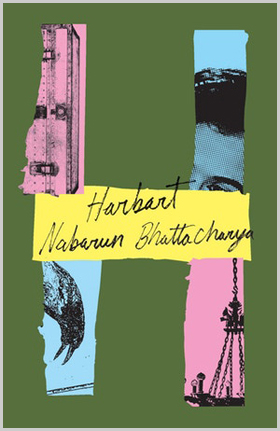
Celia recommends Harbart by Nabarun Bhattacharya:

Every ghost story is a story about how the past isn’t over yet. The murder that went unavenged is still felt, says the ghost, as is the last wish that went unfilled, the buried treasure left undiscovered, the inheritance that was stolen, the injustice that was covered up. Ghost stories insist that however much we might want to bury these things and leave them undisturbed, history returns, and insists on having its own say.
And so the ghost story is a fitting medium for someone like Nabarun Bhattacharya, the son of radical artists Mahasweta Devi and Bijon Bhattacharya. Critics who have examined Bhattacharya’s novel Harbart, recently translated from Bengali into English by Sunandini Banerjee and released by New Directions, have often commented on the incongruousness of Bhattacharya, a radical and (for a while, at least) hardline Communist, writing about a hero who claims to possess the ability to act as a medium between the living and the dead. But Harbart is a phantasmagoric novel in which the messages the dead leave are lost, misinterpreted, and outright ignored. Realism, says Bhattacharya, is insufficient for a world in which the past is so evidently not finished with us.

Orphaned as a child, the novel’s hero, Harbart (his name is a Bengalicized version of the English Herbert), is relegated to a life as a dependent of his extended family. His adult cousin Dhanna lets him stay in his house but treats him as a servant, keeping him in a shack on the roof and instructing him not to use the indoor bathroom. Dhanna reasons that any generosity he shows his young cousin will only be met with an increase in Harbart’s expectations from him. He gripes when Harbart’s aunt gives the boy a present of secondhand clothing, and he turns a blind eye when his sons beat Harbart up.

Intelligent but lonely, Harbart soon drops out of school to spend his days with the neighborhood boys or alone in his room, reading about ghosts and murders. He lies to a neighborhood girl he admires that he’s studying with a private tutor, but in truth he’s trying to educate himself, piecemeal and ineffectively. There’s not much room in his life even for a childish flirtation: a teenaged friend who passes a note to a crush is cornered and repulsed by her family, and soon after he’s found dead in a city pond, apparently from suicide. Looking at his body as it’s retrieved from the water, Harbart imagines his friend “coming back as an obedient school of fish.”

It’s a life of compression, without family, purpose, friendship or love. The fear that makes Dhanna deny his cousin all but the most basic elements of life—give, and more will be asked of you—is the fear that animates society more broadly. Success requires connections, money, and preferably an English-medium education. Others are useful but expendable.

Life and death are cheap, until Harbart reinvents himself as a medium, whose job is to explain (for a substantial donation) that his customers’ loved ones passed easily and without pain into death, that they remember their family still, that they are happy, and that their final wishes will be simple to carry out. Faced with despair and grief, Harbart stalls for time or mouths platitudes: his job is to draw a curtain over the terror and absence of death, not to reveal it. This career has an unhappy ending: Bhattacharya makes it clear from the novel’s first chapter that Harbart’s career will end in attempted suicide.

Despite the banality of Harbart’s business as a medium, however, the novel does not dismiss him as a simple fraud. Rather, the dead live on among the living, occupying the same houses, the rooftop terraces and the corners, as if behind a pane of glass. But the messages they carry are too far from what those alive most want to hear. In his first such vision, Harbart sees the ghost of Binu, a cousin who was kind to him in his childhood—and who was murdered by the police for his Naxalite sympathies. Emerging from a mountain of crows, Binu whispers the location of the diary he hid from the police while alive. The crows around him fall down dead, bury him, and he waits enigmatically, moves through them as if through water, smiles.

The diary is where Binu says it will be. But no one reads it. The mystery, as far as the Sarkar family is concerned, is not Binu, not his thoughts or his long-ago plans, but what his appearance in Harbart’s dream means for Harbart’s future. Soon after Harbart goes out to purchase a sturdy sign for his new business: Conversations with the Dead. Prop: Harbart Sarkar. Binu’s grieving father, a staunch Communist who recites revolutionary poetry at his son’s cremation instead of a funeral prayer, leaves town, torn between his lifelong atheism and the apparent reality of the message that Harbart has delivered from his son.

The diary remains unread. This is a mistake. Harbart adores Binu. As a young boy, he waits outside his hospital room as his cousin lies dying, the door guarded by the police who killed him. He goes in to witness his last words. He carries messages and money to Binu’s Communist contacts in the city. He burns his cousin’s incriminating books. And then, terrified by the sudden violence of his cousin’s death, he forgets. Twenty years later, his ambition is only to gain enough respect from his family that he can move from his own squalid rooftop shack into Binu’s old room, and sleep on his cousin’s sturdy bed.

An orthodox radical would say this: the dead do not speak. So say the English-speaking members of the Bengali Rationalist Society, who visit Harbart’s business in order to debunk him, humiliating him in the process with his inability to speak English. Harbart churns out charming platitudes for them: such-and-such a relative was moderately virtuous, died with religion in their thoughts, and is now inhabiting a reasonable corner of Paradise. But the dead do speak, Bhattacharya insists: not in the voice of well-off, English-medium comfort and rest, but in mad laughter and convulsions of violence and rage at the return of the unjust, unforgotten, redressless past. Harbart is, in the end, the imperfect medium for a dead man’s plan, without knowing what he’s laid his own hands to.

Staff Picks: The Word Pretty

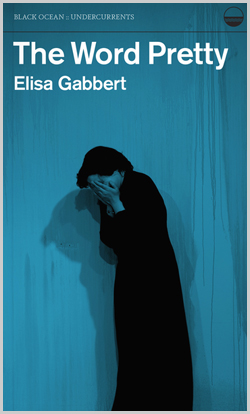
Julie recommends The Word Pretty by Elisa Gabbert:

Seasoned poet Elisa Gabbert flexes her sentence-making strength in her debut essay collection. Fun, witty, and filled with clear-eyed observations, her work approaches life and literature with as much poignancy as humor and aplomb. “Personal Data: Notes on Keeping a Notebook” tracks how notebooks, unlike journals or diaries, are home to inspired jottings that may, or may not serve a future purpose. She captures the eerie sensation of discovering old notebooks—abandoned after a few pages—and describes the odd process of decoding cryptic messages from selves past. Quite movingly, she includes a short list—from one of her more recent notebooks—of medical terminology related to her husband’s sudden and mysterious hearing-loss condition. “Variations on Crying” is an essay partly inspired by her attempt to remain unmoved by YouTube videos designed to be cathartic tearjerkers. By minute four of one video she openly sobs, and later admits to crying while watching the season finale of Top Chef. “I don’t believe in not believing in guilty pleasures,” she writes, “Guilt is good…” From an essay on digressions to a meditation on the word pretty, few subjects escape her rigorous intelligence and skillful craft. Readers will be impressed with how easily she toggles between a scholarly and conversational tone—these essays are smart, engaging, and deeply refreshing.
Fun fact: Gabbert gives some excellent book recommendations. She mentioned the work of Javier Marías, so I immediately went to the shelves and pulled out the copies we carry: All Souls; Heart So White; When I Was Mortal; Bad Nature, or With Elvis in Mexico; and While the Women Are Sleeping. (A few of these are currently out of stock.)

Staff Picks: The Milk Bowl of Feathers

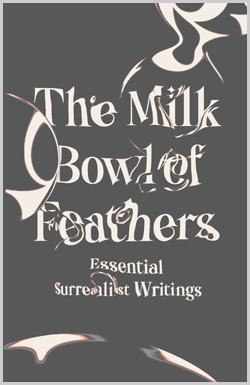
Claire recommends: The Milk Bowl of Feathers: Essential Surrealist Writings, edited, with an introduction, by Mary Ann Caws

The Milk Bowl of Feathers is Mary Ann Caws’ most recent addition to the surrealist catalogue, and though it is (delightfully) slim for an anthology, this volume manages to feature an unexpected cast of surrealist writers, and a good percentage of them are women.
Distinguished Professor of English, French, and Comparative Literature and Emerita and Resident Professor at the Graduate School of the City University of New York, Mary Ann Caws has translated and written on many Surrealists, so it is with a comprehensive knowledge of the canon that she has curated this treasury of often-overlooked female Surrealist artists, whose captivating work really takes the spotlight, even as it is presented alongside the usual suspects of André Breton, Tristan Tzara, and the like. The stellar female Surrealists included here are: Dora Maar, Joyce Mansour, Elsa von Freytag-Loringhoven, Claude Cahun, Leonora Carrington, Mina Loy, Alice Rahon, Gisèle Prassinos, Kay Sage, Meret Oppenheim, Alice Rahon, and Léona Delcourt.

As Caws expresses in her brief yet compelling introduction, Dada emerged as a globalizing artistic force post WWI. It was the Dada movement, not André Breton, that was the true forbear of Surrealism. Though many claimed sovereignty in the movement (“I am Surrealism” says Salvador Dalí on repeat), this collection is proof that Surrealism belongs to no one, despite how it is traditionally anthologized. More importantly, this collection is a reminder that Surrealism belongs to everyone.

In her introduction, Mary Ann Caws says: “Essential to Surrealist behavior is a constant state of openness, of readiness for whatever occurs, whatever marvelous object we might come across, manifesting itself against the already thought, the already lived.” Concisely, Caws conveys the importance of spontaneity to this formative movement, the unlimited potential that it holds for the creation of art. And in the work of these featured female artists, we can read a more complete spectrum of this openness to the subconscious, often expressed in enthralling pangs of obsession, wild emptiness, and desire.

Love, Caws reminds us, is the emotion that triumphs through Surrealist writings, experiencing the transcendent emotion “always for the first time” (Breton). Love in Surrealism is a kind of enchantment with consciousness, even its darker tributaries:

I love sliding I love upsetting everything

… writes Jaques-Bernard Brunius in his poem “I Love”. A stunning and complex specter of love steps through in Dora Maar’s poem, “I Rested In The Arms Of My Arms”:

An eternal shivering of thoughts
Fear love Fear love
Close the window open the window
You’ll see you’ll see
The hummingbird motionless as a star

Among the diverse cast of writers is Claude Cahun, a non-gender-conforming writer who lived and wrote well before the term non-binary came into the nomenclature. Born Lucie Renee Mathilde Schwob, Claude Cahoun was a chosen name. A French photographer, sculptor and writer, Claude’s self-portraits often depict doubles of the artist which result in a kind of visual twinning, and reveal their deep investigation of identity and social constructs. Within Claude’s short piece in The Milk Bowl of Feathers, I found one of my favorite passages of the collection:

Only with the very tip would I wish to sew, sting, kill. The rest of the body, what comes after, what a waste of time! Only ever travel in the prow of myself.

Cahoun is not widely translated into English, and their titles in translation are currently out of print, so it is a rare treat to come across this piece in Caws’ collection. (any translators out there looking for a new project?).

Léona Delacourt, a name many people may not have come across, also finds its way into this collection. Léona was the dedicatee of Andre Breton’s infamous novel, Nadja, in which she is obsessed over and exoticized beyond recognition. Though her pieces here are very short, and are themselves drafts of letters to Breton, they lend humanity and a frantic voice back to the person who had been all but lost to history within the heroine, Nadja:

—my soul is troubled—and turns in all directions to find the fire—

Joyce Mansour was a prolific Jewish-Egyptian Surrealist poet whose work hasn’t seen much translation into English, but who authored 16 books of poetry during her lifetime. Her apartment was fabled to be a favored meeting place for Surrealist rendezvous. Her poetry is wrenched by deep bodily sensations, known for her brazen use of erotic imagery, but also for diving deep into the sensations of the mind’s surf:

Shining with a thousand quivers
Consumed by ecstatic mad inertia

Discovered by André Breton at age 14, Gisèle Prassinos is yet another female Surealist whose image has traditionally been cast in the light of a femme enfant, a young muse, objectified by male artists. But it is apparent that Gisèle was something of a prodigy; her words absolutely slice through the page in her intellectual and freaky prose:

I know that by taking on generally the superiority of prophetic organization, your heart will never dare to claim mine.

So, by fixing upon you curtsies and spinnings, I moan these words at you, as a hoax: ‘let’s fear the senses.’

If you like what you read of Gisèle Prassinos in The Milk Bowl of Feathers, check out her full collection of stories, The Arthritic Grasshopper (Wakefield Press, 2017) on the shelves at Malvern Books.

The Milk Bowl of Feathers also includes a range of writings done by visual artists, including a story by everybody’s favorite British expat painter, Leonora Carrington. Carrington’s stories (check out this great collection put out by Dorothy Project, also on the shelves at Malvern Books) feel like stepping into one of her paintings—they’re populated by bizarre humanoid creatures whose incoherent foibles mimic free association. For example, in her story “The Sand Camel,” two young boys fashion a camel out of butter and sand, and this weird pet animates, and goes on to hold their grandmother upside-down as a kind of makeshift umbrella.

The Milk Bowl of Feathers is a fresh salute to the Surrealist spirit, which is as relevant now as ever in its openness to possibility; in reaching beyond the rational, we push against capitalism, nationalism, and against a hierarchy of meaning that can create toxic frameworks, such as the phallocracy that dominates our understanding of Surrealism. I think we could all benefit from an injection of receptivity, and a more inclusive exploration of art and life that exists in a sheer state of exuberance.

Staff Picks: A King Alone

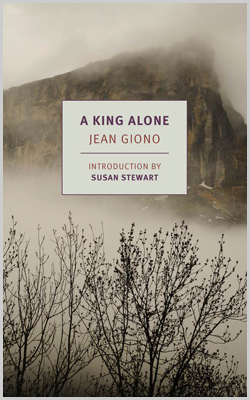
Celia recommends A King Alone by Jean Giono:

I slid into this novel first through its language. So: “Everything piles up on us; nothing moves. Green at first, the light turns the color of hare innards, then an extraordinary black that, black as it is, has shadows of deep purple.” Or else: “How can such perfection not have a consciousness, when all it takes is a puff of wind, an unfortunate shift of evening light, an odd tilt to its leaves for its beauty, defeated, to lose all its power to awe?”

Like much of Jean Giono’s other work, A King Alone takes place in an isolated community, both embraced and menaced by the natural world. There’s a beech tree in the mountains, a remote village, an unnamed Monsieur V. whose descendant once read Nerval while sitting under the hollyhocks of his mother’s farm, long after the events with which the novel deals were over, a “big illustrated book about Cartouche and Mandrin and werewolves with their different snouts all portrayed in it”—a jumble of innocent-sounding commonplace details, in other words, that, over the course of the novel, become less innocent and more and more sinister. There’s a formal severity to Giono’s chatty narrator, with his encyclopedic knowledge of the villages around him. He sees everything—or, if he doesn’t see it, he’s heard of it. But the reasons for things, the interior lives of those he watches, are often beyond him. The mystery, in this novel, is never what has happened, but rather why.

So, here is the what: it is 1843, and the people of a small mountain village have begun to disappear. One young woman vanishes into the fog and is never seen again. A second man is gripped from behind and nearly carried off, a scarf wrapped over his head. He gets free but never sees his assailant. A seasoned hunter disappears, leaving his breakfast cold on the table. All that’s found is blood on the snow—and, at one point, a pig is attacked with a razor, leaving it covered in cuts that “looked like the alphabet of some unknown, barbaric language.” Some villagers catch sight of the murderer, but he’s elusive. They see him from behind or in the dark or disappearing into fog, and for a while it seems that he’s the devil himself, or a spirit of bloody nature, a werewolf (remember those snouts in the novel’s opening!), a creature that rejects human sensibility.

Summoned to deal with this scourge is Inspector Langlois, but only after a year has passed. The beast takes people in winter, when the mountain roads are hardest and most dangerous to travel. In spring, the villagers enjoy an illusion of safety. Langlois arrives in the winter of 1844. He will not solve the mystery until the next year, long after the moment when he feels that he has most completely failed. And what is this solution, exactly? A name. A house. A human. Not an explanation for why what happened has happened, but a moment of convulsive violence, without apparent cause.

The true story happens on the fringes of the narrative, in the moments of calm that occur in the interval before death and blood. When a man named Frederic walks out in the morning mist, and witnesses yet another murder, the conflict that ensues is not one of strength or wits, but simply with his own endurance and memory. Will he be brave enough to follow the man to his destination? Will he trust his own memory of what he saw?

Then there is the innkeeper the villagers call Sausage, a former prostitute who strikes up a friendship with Langlois and who remains the best, although reluctant, historian of his time in the village. She’s a liminal character who, by the novel’s end, I thought had become its heart. In the beginning, the villagers know her only as the fat woman with whiskers and a checkered past who runs the inn, and slowly we see her revealed, in a way that few characters in this novel are. She attends a wolf hunt, in which the villagers, under Langlois’s supervision, band together to drive out a creature that might almost be the desperate reincarnation of their phantasmal killer. She helps Langlois find a wife. And she blames herself because, despite her friendship, she ultimately can’t save him.

What people need saving from, in this mystery, is not the murderer under the bed or the wolf at the window, but rather the unknown interior of things—the question, that is, of how to go on in a world that defies explanation.