 A few years ago, my friend Tim and I set ourselves the task of reading the bible and blogging about it. We only made it as far as the first Book of Samuel—it’s quite a task, poking fun at every burning dove and talking ass you come across—but I learned a lot along the way. For example, did you know that every rainbow is an apology from God? Mopping up after the great flood, God saw that it was muddy, and he was ashamed, so he made a solemn vow to Noah (Genesis 9:12):
I establish my covenant with you: never again will all life be cut off by the waters of a flood; never again will there be a flood to destroy the earth. This is the sign of the covenant I am making between me and you and every living creature with you, a covenant for all generations to come: I have set my rainbow in the clouds, and it will be the sign of the covenant between me and the earth.
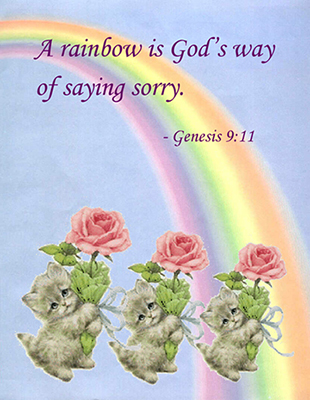
So every time you look up in the sky and see a rainbow, it’s a reminder of God’s great promise—a promise to never again try and destroy you! Sweet! If you run a Christian supplies store, you might consider stocking this awesome celebratory poster I made:
The bible is gloriously batty, and I highly recommend it for your next book group (I’m pretty sure it’s Oprah-approved). Here’s our take on Deuteronomy 22-24, in which Moses declares a bunch of minor laws (it will make more sense if you read the real deal first):
Oh Moses, you gorgeous madman, on and on you go. You’ve said all there is to say about idolatry and warfare, and now you’re dishing out God’s holy oddments. First up, be kind to cows. If a cow gets lost, help it to find its way home again. Be kind to donkeys, too. If a donkey stumbles under a heavy load and falls into a ditch, don’t laugh at it or call it a great gray fool. Don’t poke it with a stick. Join forces with your neighbors and get that poor ass back on its feet.
Men, don’t be wearing lady costumes. And gals, let the men wear the pants. The Lord doth hate a transvestite:
The woman shall not wear that which pertaineth unto a man, neither shall a man put on a woman’s garment: for all that do so are abomination unto the LORD thy God.
If you come across a bird’s nest in a tree or on the ground, feel free to eat the eggs, or kill any little baby birdies, but don’t mess with the mother bird:
Let her go free, and the LORD will bless you with a long and successful life.
Not a day goes by without some idiot falling off a roof. The Lord is heartily sick of this nonsense. If your house has a flat roof, could you please build a wall around the edge. Thanks.
Girlfriend, keep an eye on that husband of yours. If he grows tired of you, he may try to ruin your honor by claiming you weren’t a virgin when you married. If this happens, there’s only one thing for it: your parents must show the town’s leaders the sheets you bloodied on your wedding night. If you threw away those sheets, or maybe washed them, then I’m afraid your husband’s accusation will stand, and you’ll be stoned to death, you wee scallywag.
Surely the women of Israel are incensed by this law? After all, they’ve read every issue of Twelve (the lower life-expectancy Seventeen), and they know it’s, like, totally easy to accidentally bust your hymen whilst climbing a tree, or riding a donkey, or pulling a donkey out of a ditch. That doesn’t mean you’re not a virgin! “Leading a lost cow home through a field, I slipped and sacrificed my maidenhead to a fencepost… are you telling me I deserve a good stoning?” She asks a fair question, Mo, but I can’t imagine you have much sympathy. Perhaps you stare down at your sandals, blushing, as you advise all women to remain as still as possible until they get married. Mind your hymens, ladies!
Men, don’t think your genitals have escaped God’s pervy eye. If your private parts have been cut off, or even if they’re just a bit squishy, I’m afraid God doesn’t want to know you:
He that is wounded in the stones, or hath his privy member cut off, shall not enter into the congregation of the LORD.
Soldiers, keep your camp clean. If the Lord’s told you once, he’s told you a thousand times: don’t shit on the grass. When thou wilt ease thyself abroad, for heaven’s sake dig a hole. If the Lord pops by for a visit and there are great big steaming piles of turd lying around all over the place, well, he won’t be staying for a cup of tea.
Have you been cautioned against wet dreams, that uncleanness that chanceth upon you by night? They create a lot of unnecessary bother, so try not to have them. Don’t be cruel to runaway slaves. Don’t visit temple prostitutes. And would you please stop kidnapping one another, you ratbags!
If you lend money to a fellow Israelite, you mustn’t charge him any interest. It’s okay to take something of his as a guarantee that he’ll pay you back, but don’t keep anything he really needs. If you take his only coat, for instance, you mustn’t keep it overnight. Give it back before the sun goes down, so the poor chap won’t freeze to death. It will be hugely time-consuming and inconvenient, having to visit all your debtors twice a day to collect and return their coats. This is not the Lord’s problem.
When you harvest your grain or pick your olives, don’t be too thorough about it; make sure you leave a few scraps behind for poor people. Poor people enjoy a good scavenge; it takes their minds off the hunger.
And on and on and on it goes. Are the children of Israel listening, Moses? Does God still speak to you, or are you just making this shit up?




Oh, that Arctic light, how concisely it delineates the world, with what unprecedented clarity: the sharp, rugged mountains against the clear blue sky, the green of the slopes, the small boats chugging in or out of the harbor, and onboard, the huge codfish from the depths, with their grayish-white skin and yellow eyes staring vacantly, or on the drying racks, where they hung by the thousands, slowly shriveling for later shipment to the southern lands. Everything was as sharp as a knife.

 I thought the Kindle might help—I’ll trick myself into reading by putting my book on a tiny screen!—but the Kindle is such an appalling device that mostly I just end up ranting instead of reading. I know, I know, a bricks-and-mortar bookstore dissing the Kindle—quelle surprise! But seriously, what a daft piece of technology. It looks like it was ripped from the dashboard of a 1982 Lada. The user interface was designed with someone other than a human being in mind (an excitable squirrel, perhaps?); it’s awkward to hold in bed, where all the best reading is done; and even with the font set at its tiniest size, it takes about three seconds to read a single page, meaning that every three seconds you have to jab at that dim little screen and hope the very next page comes up. Sometimes the very next page does come up; sometimes you jab a little too far to the left and the previous page comes up—ah, previous page, what happy memories of three seconds ago!—and sometimes the Kindle gets all whimsical and skips gleefully to an entirely random page, at which point you realize it was never intended to be used as an e-reader, but rather was designed to be a challenging electronic game called Find My Page! You can try to find your page by selecting “Go To” and then the chapter, but this is no help if you don’t remember the name of the chapter you were just reading, or if the chapters are hundreds of pages long. Or you can “go to” a Loc (location) in your book, but alas this is impossible, because you don’t know your location. Why would you? It’s an entirely meaningless number; a long book has thousands of locations; and memorizing the location at the bottom of each tiny, stupid page would take longer than reading the tiny, stupid page itself. So you’re screwed! Silly you! Pick a location at random, go back, pick another one, and now get ready to jab at that tiny, stupid screen eighty-three times until you reach the very next page. See? Ranting, not reading.
 I am talking, of course, about Coronation Street, the world’s greatest television program, and a show as mysterious to most Americans as cricket and Vegemite. I’ve been trying to introduce my boyfriend to the many joys of the Street, which mostly involves him asking me a series of urgent questions: “But why did that man blow up that van? Why are they pretending the tortoise is alive? Why is that blonde woman hiding all those onions? Is that her sister or her mother? What does ee-oop mean? What does any of it mean?!”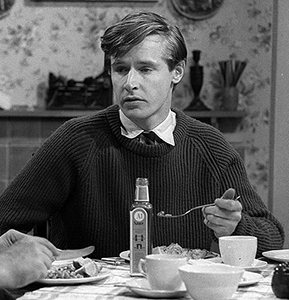

 The best characters on the show are stong-willed women. Ask a long-time fan to list the most iconic residents of Weatherfield, and you’re going to hear about a bunch of stroppy women with gloriously British names: Ena Sharples, Elsie Tanner, Hilda Ogden (pictured at right and above in her rollers), Bet Lynch, Blanche Hunt.
 You can enjoy hating Gail (née Potter; currently McIntyre; and previously Tilsley, Platt, and Hillman). Everyone hates Gail. Poor Gail. Husband #3 tried to kill her and her children by driving them into a canal; husband #4 drowned while attempting to fake his own death by drowning, the great twit. (Gail was charged with his murder, naturally.)
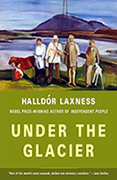 It’s strange that all birds don’t fly in the same way. After all, the air’s just the same at the same place and the same time. I’ve heard that the wings of aeroplanes all conform to the same formula, whereas birds each conform to a formula of their own. It has undeniably required more than a little ingenuity to equip so many birds each with their own formula, and no expense spared, either. Nevertheless, there has perhaps never been a bird that flies as correctly as an aeroplane; yet all birds fly better than aeroplanes if they can fly at all. All birds are perhaps a little wrong, because an absolute once-and-for-all formula for a bird has never been found, just as all novels are bad because the correct formula for a novel has never been found.
 The second time I cried in an art gallery, it was at the Whitney in 2010, and I was with my roommates. We’d gone to see something else—three young men dressed like vagrants, playing harps and shouting, maybe?—and after we’d had enough of that, we wandered through the rooms until we came across