
Olfactory Entertainments

PerfumesA quick GO READ THIS from me today: go read Perfumes: The A-Z Guide, by Luca Turin and Tania Sanchez. And before you can say, “But Tracey, I am a Profound Person! I read books about war, incest, and ennui—not smells,” let me reassure you that Perfumes is no mere collection of lady mag fragrance piffle (“you’ll drive your man wild with this fruity concoction,” etc). It’s an “exemplary” blend of “technical knowledge and evocative writing” (The New Yorker said so), chock-full of erudite, passionate, and hilarious criticism.

The book comes with a sweet-as-Prada-Candy back-story: once upon a time, Tania Sanchez, prolific American fragrance blogger, left a comment on the perfume blog of Luca Turin, European scholar of smells (and the subject of Chandler Burr’s The Emperor of Scent), which led to a correspondence, which led to a working relationship (Sanchez provided Turin with editorial input on one of his earlier books, in exchange for a few rare perfumes), which led, two years later, to marriage.

And they’re a perfect match. Sanchez is whip-smart and funny—her one-liners are the best—and her descriptions of fragrances read like tiny, perfect narratives. Turin, also a very good writer, provides the musings of an esteemed olfactory nerd. Here he is explaining how perfumes are made up of atoms that come from “the Upper East Side of the periodic table, a nice, safe neighborhood”:

Citing a lack of passion for “data entry,” Turin and Sanchez forgo the lengthy lists of notes that occupy so much space in most fragrance reviews, preferring to focus on the impressions those notes create. And they’re fantastic at impressions:

[Ormonde Woman] has the haunting, outdoors witchiness of tall pines leaning into the night—a bitter oakmoss inkiness, a dry cedar crackle, and a low, delicious, pleading sweet amber, like the call of a faraway candy house. Lulling and unsettling in equal measure, and truly great.

[Lancôme’s Magie] brings to mind a pouting model, hands on hips in opera gloves, wearing a hat, a Spencer jacket, and a pencil skirt, with her feet at right angles to each other as if she were going up a ski slope.

[Estée Lauder’s White Linen] is a canonical expression of the American ideal of sex appeal: squeaky clean, healthy, depilated and exfoliated, well rested and ready for the day… the whole thing is comfortable and well lit, like a warm spot on the floor where the cat sleeps…it reminds me of Thomas Pynchon describing the smell of breakfast floating over World War II-era London as “a spell against falling objects.”

But the bad reviews are the most fun:

Givenchy’s Very Irrésistible Fresh Attitude: Hilariously misconceived and loud…if you can ask for it by name without laughing, you’re the ideal guy for it.

Lancôme’s O Oui!: This is a fresh floral in which every blindingly powerful aromachemical has been harnessed to induce a remarkable sensation of bone pain that rises from the roof of your mouth to your forehead, similar to what happens when you eat ice cream too quickly. Chiefly of neurological interest.

Estée Lauder’s Spellbound: Powerfully cloying and nauseating. Trails for miles. Frightens horses. Gets worse.

Benetton’s Sport: Reviewing masculine sport fragrances is a bit like trying to write short stanzas about individual matches in a matchbox.

Calvin Klein’s cK IN2U His: IM IN UR BOTTLE BORIN UR GF.

Poetry, C & D

And now for the second installment in Malvern Books’ arbitrary and occasional Poetry Month A-Z series…

C is for Coleridge, and also constipation

The ice was here, the ice was there,
The ice was all around:
It cracked and growled, and roared and howled,
Like noises in a swound!

At length did cross an Albatross,
Thorough the fog it came;
As if it had been a Christian soul,
We hailed it in God’s name.

ColeridgeWere you forced to memorize lengthy bits of the dead albatross saga in school? Has this experience left you with less-than-fluffy feelings toward Samuel Taylor Coleridge? Let me offer you a little fecal schadenfreude (a phrase with exactly zero google results—until now!) by sharing with you poor Mr. Coleridge’s bowel tribulations.
Coleridge’s addiction to opium inspired some of his most famous poetry (like Kubla Khan, another poem you may have learned by rote), but it also caused terrible constipation. Here’s Coleridge’s diary account of a particularly gruesome bout, which occurred on a sea voyage from Gibraltar to Malta aboard the Speedwell:

Tuesday Night, a dreadful Labour, & fruitless throes, of costiveness—individual faeces, and constricted orifices. Went to bed & dozed & started in great distress.

The following day, “a day of horror,” the captain of the Speedwell had to flag down a passing ship and request that the ship’s surgeon come on board to tend to Coleridge:

The Surgeon instantly came, went back for Pipe & Syringe & returned & with extreme difficulty & the exertion of his utmost strength injected the latter. Good God!—What a sensation when the obstruction suddenly shot up!… At length went: O what a time!—equal in pain to any before. Anguish took away all disgust, & I picked out the hardened matter & after a while was completely relieved. The poor mate who stood by me all this while had the tears running down his face.

Lawks-a-lawdy! Alas, the enemaand its attendant humiliationwas to become a regular occurrence in Coleridge’s life. He knew the constipation was a side effect of his opium use, but he couldn’t kick the habit, and thus he came to see his rectal misfortunes as a punishment for his addiction.

To weep & sweat & moan & scream for parturience of an excrement with such pangs & such convulsions as a woman with an Infant heir of Immortality: for Sleep a pandemonium of all the shames and miseries of the past Life from earliest childhood all huddled together, and bronzed with one stormy Light of Terror & Self-torture. O this is hard, hard, hard.

D is for Davis, Olena Kalytiak

From the ridiculous to the sublime: I can’t say enough good things about the poetry of Olena Kalytiak Davis, and in particular her first collection, And Her Soul Out of Nothing, which won the 1997 Birmingham Prize in Poetry. Her poems are funny, brutal, and brilliant, and she manages that trick of conjuring universal meaning from something deeply idiosyncratic.

In Defense of Marriage

Marry the black horse stuck
Dumb in her humble corral.

Marry the white fences; marry the fenceless
Moon and the defenceless sky.

Marry the feedlot and the threshing
Floor. Like the northern heaven to the southern

Stars, marry the kitchen table, its three strong
Legs. Marry the gate and the small intricate

Cuts on the key and the view spreading
Outback. The streetlamp

Weds the morning light, like that, take the
Nomad. Promise to forsake. Give in

To the cistern full of asters.
To the way the beloved

Story goes: her body from a bone.
And her soul out of nothing.

In a slowly spoiling month find out
You have married the house worn

Blue on the yellowing hill: each of its
Slow budding bedrooms. Marry one or two

Or three varieties of light, in three or four
Different lifetimes. I meant, windows.

Mate, be forsaken.

I married the way moths marry.
I married hard.

A Brief Introduction to Speaking Kiwi

NZ StampFirst up, you have to master the New Zealand accent. You must sound pleasant, earnest, and a bit dim, and you should probably mumble, because you are at all times discreetly dissolving that giant lump of mutton at the back of your throat. You should also speak with a rising inflection, so that everything you say sounds like a question. (Certainty is terribly impolite.) And keep your lips as close together as possible when you talk; remember, you are trying to keep the flies from entering your mouth.

This man’s excellent impression of Prime Minister John Key will give you the idea:

Selecting an appropriate topic of conversation is important. You may talk about rugby, the road toll, mangrove swamps, birds, pig dogs, and the rain. And speaking of rain, you should memorize “Rain,” the nation’s most beloved poem.

Finally, you need to learn the vocabulary. If you are fluent in Kiwi, you will be able to parse a sentence like this with ease:

When Bruce and Tasha hooned it up the boohai, their ankle-biter got crook and chundered in the chilly bin each time they went over a judder bar, which made Bruce throw a wobbly.

(Translation: When Bruce and Tasha drove quickly and recklessly to a remote place in the middle of nowhere, their small child became sick and vomited in the cooler each time they went over a speed bump, which made Bruce lose his temper.)

Also note: in America, something is “quite nice” if it is very nice indeed, while in New Zealand “quite nice” is a gentle way of saying that something is not very nice at all. If a Kiwi tells you your banana cake is “quite nice, eh?,” I’m afraid your banana cake is rubbish.

And never mention toilet paper in polite company. Call it skindywoo, as in “I just had an epic chunder in the back of your van, mate. You got any skindywoo?”

Poetry, A & B

It’s April, which means it’s National Poetry Month. It’s also National Anxiety Month and National BLT Sandwich Month (“the second most popular sandwich in the United States”), and this trinity of nationwide awareness can be no coincidence—so let’s fix ourselves a bacon sarnie, crack open the Xanax, and settle in for the first installment in Malvern Books’ arbitrary and occasional Poetry A-Z series.

A is for Aubade

troubadourIf a serenade is an evening love song, an aubade is its early bird equivalent. Aubades often recount tales of adulterous lovers who must part company as the sun comes up, and they were quite the thing in the freaky Middles Ages, when troubadours roamed the world, playing their annoying fiddles and reciting aubades to anyone who would listen. The aubade then passed out of fashion for a while—sixteenth-century poets preferred to bang on about unrequited love, which meant very little romping at dawn—but the form enjoyed a brief revival in the seventeenth century, with John Donne’s “The Sun Rising,” in which the poet chastises the “busy old fool, unruly Sun” for disturbing two lovers in bed. Now that reciting poetry under someone’s window at 5am is likely to get you arrested, the aubade has lost much of its appeal. Still, the marvellous Mr. Larkin gave it a go; here’s an excerpt from his “Aubade”:
Slowly light strengthens, and the room takes shape.
It stands plain as a wardrobe, what we know,
Have always known, know that we can’t escape,
Yet can’t accept. One side will have to go.
Meanwhile telephones crouch, getting ready to ring
In locked-up offices, and all the uncaring
Intricate rented world begins to rouse.
The sky is white as clay, with no sun.
Work has to be done.
Postmen like doctors go from house to house.

A is also for Auden, W. H.

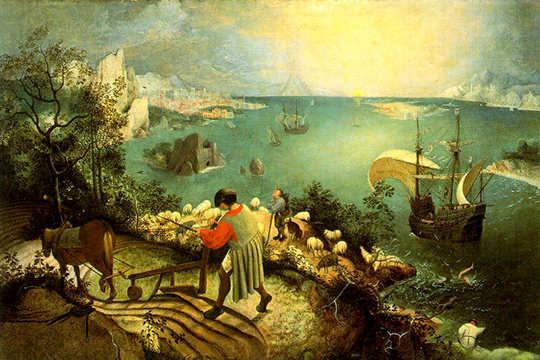
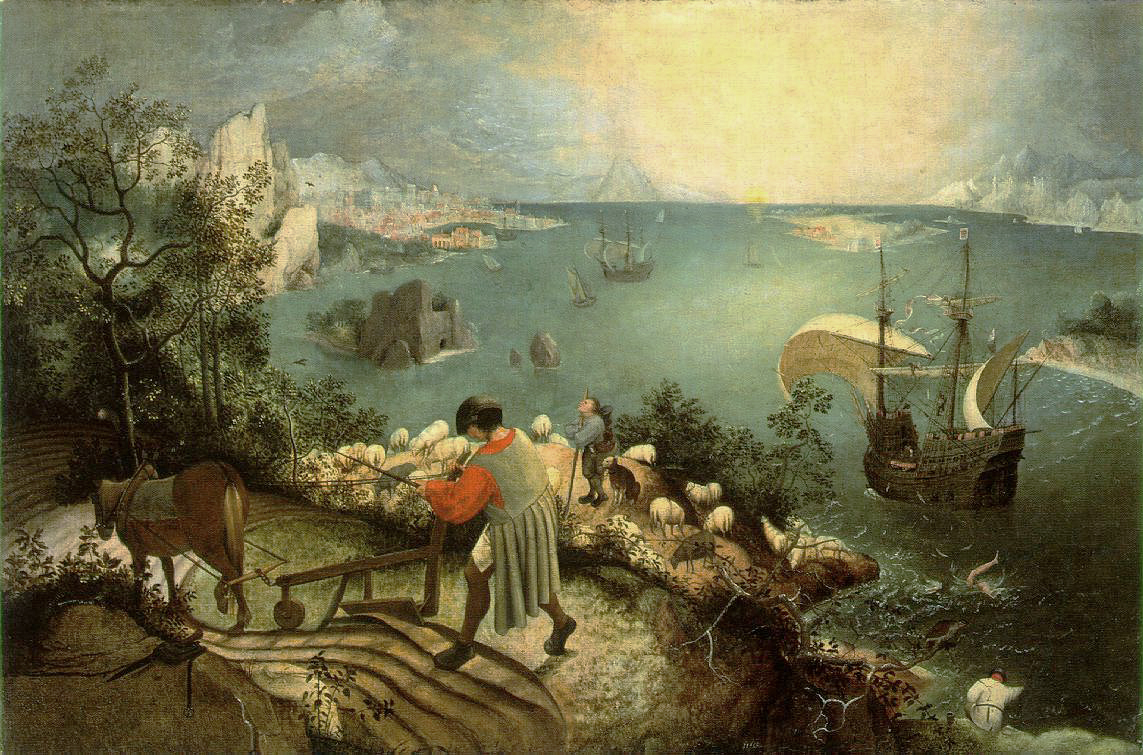
Creative writing teachers love the “poem about a painting” exercise, in which you take your class to an art museum, dump ’em in front of a Jackson Pollock, and then chortle to yourself as they spend the next twenty minutes trying to come up with synonyms for drip. In “Musée des Beaux Arts,” Auden stares hard at Brueghel’s Landscape with the Fall of Icarus and shows us how ekphrasis should be done:

IcarusAbout suffering they were never wrong,
The Old Masters; how well, they understood
Its human position; how it takes place
While someone else is eating or opening a window
or just walking dully along;
How, when the aged are reverently, passionately waiting
For the miraculous birth, there always must be
Children who did not specially want it to happen, skating
On a pond at the edge of the wood:
They never forgot
That even the dreadful martyrdom must run its course
Anyhow in a corner, some untidy spot
Where the dogs go on with their doggy life and the torturer’s horse
Scratches its innocent behind on a tree.
In Breughel’s Icarus, for instance: how everything turns away
Quite leisurely from the disaster; the ploughman may
Have heard the splash, the forsaken cry,
But for him it was not an important failure; the sun shone
As it had to on the white legs disappearing into the green
Water; and the expensive delicate ship that must have seen
Something amazing, a boy falling out of the sky,
had somewhere to get to and sailed calmly on.

B is for Bly, Robert

I know, I know. Robert Bly. Mr. Iron John. He’s just so… embarrassing. Whenever I hear his name, I picture a gaggle of chubby accountants standing in a circle in a moonlit forest, howling pointlessly at the moon. After a while they grow tired, these lardy, booming babies, so they lie down in the mud and share tales of man-sadness. Now that I no longer kill wildebeests with my bare hands, my life has lost all meaning! Now that my wife has been promoted to Head of Marketing at Zappos, my penis has stopped working! They are sheepish at first, ashamed, but after a while they grow bold. They are men, damn it! They paint their faces with mud and admire one another’s terrifying pubic hair. DUMB. Still, men’s movement nonsense aside, Robert Bly writes some lovely poems. He’s very good at birds and seals and weather. Here’s an excerpt from “August Rain”:

The older we get the more we fail, but the more we fail the more we feel a part of the dead straw of the universe, the corners of barns with cow dung twenty years old, the belt left hanging over the chair back after the bachelor has died in the ambulance on the way to the city. These objects ride us as the child who holds on to the dog’s fur; these objects appear in our dreams; they are more and more near us, coming in slowly from the wainscoting; they make our trunks heavy, accumulating between trips; they lie against the ship’s side, and will nudge the hole open that lets the water in at last.

I recommend Eating the Honey of Words, a collection spanning fifty years of his work. Just ignore the icky title, and skip all poems featuring spirit horses.

What’s Your Emergency?

People ring the emergency police number for the daffiest reasons. For example, this woman troubled the good folk at the Avon and Somerset Constabulary with her concerns regarding a hungry squirrel:

And that brings us, ever so tangentially, to an item of literary news: you should go read Corwin Ericson’s new book, Checked Out OK, a baffling and hilarious compilation of hundreds of police log items from small towns in Western Massachusetts:

9:55 a.m. – A Rolling Green Drive resident told police that his girlfriend has been receiving poems at her Hadley workplace from a 60-year-old man. Amherst police advised the man to contact Hadley police about the problem.

12:51 a.m. – Police assisted people who were observing the salamanders crossing Henry Street.

Other reported concerns include people licking the road and ducks behaving oddly.

How Do I Get My Book Published?

Yes indeed, that is a link-bait title: How do I get my book published? is the webbernet’s third most googled inquiry, after How do I get vomit out of my shoe? and HOW DO I TURN OFF CAPSLOCK? So, following on from our somewhat unhelpful “Should I Get an MFA?”, we present a guide to getting that creepy manuscript of yours into the hands of unsuspecting shoppers.

First up, ask yourself if you have written a good book. You probably haven’t; most books aren’t good. Of course, some books that are not good still get published.

Bad Book

But unless you are recounting that one time you were shot in the face by your husband’s frolicsome teenage lover, you should probably assume your book needs to be good in order to be published. Here are some signs your book is not good:

  • It contains the sentence “As they were resting, Mariuccia prepared a delicious stew with the lukewarm placenta.”
  • Your book is called Peas: The Hidden Menace.
  • You find the whole you’re/your thing so darn confusing.
  • There is only one female character in your book, and her name is Antigone Bean. She wears smudgy blue eyeliner and a dirty denim jacket. She has a tragic past, but cannot speak about it. She draws willows in notebooks. She is irresponsible and irresistible!
  • You would describe your book as being about “finding” something—love; self; self-respect. (Unless that something is your keys, in which case I am very curious how those 80,000 words are going to play out, Nicholson Baker.)
  • You wept a lot while writing it.

So far, so maybe not not-good? Great! Show your book to several cruel and clever friends, and ask them to be brutal. Make sure one of them has a talent for proofreading, since almost any manuscript with a mistake on the first page will be rejected. Do not think “But it doesn’t have to be perfect! The publisher will fix it!” Most people who work in publishing love words, and endeavor to use them well; if you don’t demonstrate a similar love of language, they’re going to think you’re a clodpate. Also, please remember that publishers drink heavily from 11am onwards, and the drink makes them cruel. They are looking for reasons to laugh at you. Don’t give them the satisfaction!

Note that you will need to send this potentially not-utterly-shit book to an appropriate publisher. This is a tricky step for many people. I used to work for a company that published cookbooks—that was all we published: muffins; sausages; quick and easy meals for two—and yet we received many, many submissions from memoirists, children’s book authors, and poets. Dear Sir [my vagina has already condemned you to the dustbin, you dickwizzle!], I have written a children’s book entitled Lester The Giraffe Goes To The Crematorium. It is a confronting tale for children aged 3-5. Would you be interested in publishing it? No! No! Unless Lester the Giraffe can be turned into a nice casserole in twenty minutes and served with a side of blanched escarole, no! What is wrong with you? This step is not difficult. Here we go:

Identify the type of book you have written. Go to a bookstore. Find a book of the same type. Now take out a pen and write down the name of the company that published that book. Bingo!

Finally, the submission itself. Some publishers will only accept submissions that have been vetted by an agent, in which case you’ll need to find an agent. Good luck with that. Other publishers are happy to glance at any old tat that shows up in their slush pile. Some agents and publishers only want to see a query letter, while others prefer to receive the entire manuscript. It’s a crapshoot. If google won’t help you discover the particular requirements of your prospective agent or publisher, I’d just go for broke and send ’em the entire thing.

Your manuscript should be presented in the dullest font imaginable. If you insist on using a whimsical, curlicued font—it’s just so me!—let me save you some money on postage and tell you to promptly throw your manuscript into a pond. Also, do NOT bind your manuscript into some kind of book facsimile. Nothing makes a publisher laugh harder than evidence that you took a trip to the printing department at Kinkos. (Also, everyone knows that the printing department at Kinkos is situated in the midsection of Satan’s fiery rectum.) Here is a conversation that has taken place nowhere ever:

“So, Robert, shall we publish A Fiery Fondness or Make Mine a Mochachino?”
“I like the second one, Jemima. The manuscript has been thoughtfully bound to look quite like a book, and therefore I think it would be more suitable as a book. You see, because I possess no imagination, or indeed any basic cognitive abilities, I appreciate that the author has taken the time to show me that this manuscript could indeed be successfully formed into a book shape.”
“Great, Bobby! Me too!” [High fives.]

No sir, you will not fool anyone into thinking you have written a book just by making it look like a book.

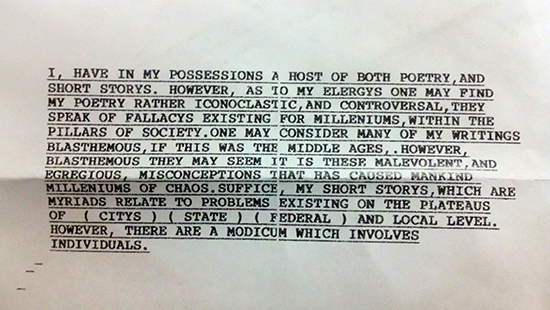
You’ll need to include a cover letter. Don’t make it odd. Here is an example of an odd cover letter we once received:

Cover Letter

Don’t do that. In your cover letter, do not state that your chiropractor enjoyed the book, or that you once had a short story published in the online journal Sunny Summer Tuesdays. No one cares. Do not use fancy paper; you are not inviting the publisher to a garden party. Also, please be aware that writing “I retain all copyright to my work”—or drawing a little © on every page of your manuscript—will instantly reveal you to be nuts; writers who are paranoid about their ideas being stolen are the maddest of the mad. No one is going to steal your daft idea—and if they did, writing “I retain all copyright to my work” in your cover letter is not going to make a blind bit of legal difference in your awesome lawsuit against Bob’s Rectangular Books Inc. Do not mention the possibility of an advance, you gauche bastard. And do not mention that writing the book has healed you in any way. That’s just gross. (As Maya Angelou once said, “Your eczema? Your business!”)

You should also include a one-page synopsis of your book. Make it interesting. If you cannot write an interesting synopsis of your book, I’m afraid you will need to write another book.

I hope this has been helpful. And fear not—if you find you have no talent for writing, you can glue an empty Fresh Direct box to a fox carcass, title it Darling Hunter: Mind Waves III, and call yourself The Mighty Stan. The world of conceptual art will welcome you.