Concordia

Malvern Books recently spent some time in Concord, Massachusetts, and I can highly recommend it as a vacation spot for lit-nerds (and also grape aficionados).

First up, you should plant your feet firmly on the North Bridge, site of the first proper battle of the Revolutionary War, and recite the opening lines of Ralph Waldo Emerson’s “Concord Hymn”:

By the rude bridge that arched the flood,
Their flag to April’s breeze unfurled,
Here once the embattled farmers stood
And fired the shot heard round the world.

From the bridge it’s a very short walk to The Old Manse, which was built by Emerson’s grandfather in 1770. As a young boy, Emerson’s father was able to observe those first few shots of the revolution from an upstairs window, which must have made for quite an exciting morning.
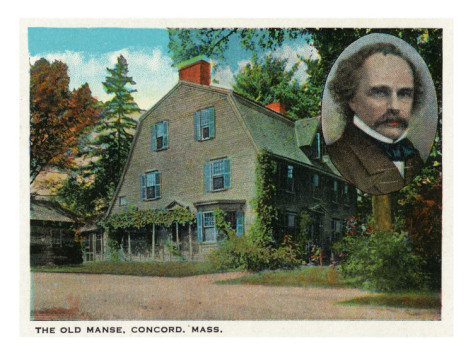
The Old Manse

In 1834, Ralph Waldo Emerson (1803-1882) moved to the Manse, and he wrote the draft of his famous essay “Nature” there, which puts forth the foundations of transcendentalism. Emerson married the following year and bought a house nearby, which he named, oddly, Bush. He lived there for the rest of his life.
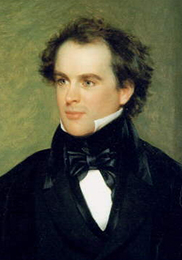
Nathaniel HawthorneIn 1842, newlyweds Nathaniel Hawthorne (1804-1864) and his wife Sophia rented the Manse for $100 a year. Since brushed chrome toasters and Le Creuset cookware had not yet been invented, their pal Thoreau planted a vegetable garden for them as a wedding gift. Nathaniel and Sophia were batty about each other, and on a tour of the Manse you’ll see the poems they wrote for each other etched into the Manse’s windowpanes with Sophia’s diamond ring. You’ll also meet Longfellow, Hawthorne’s spooky stuffed owl, which he would hide around the house to frighten his wife. Alas, after three happy years at the Manse (during which Hawthorne wrote a tribute to the house called Mosses from an Old Manse), the Hawthorne’s were evicted for not paying rent.

And speaking of Mr. Thoreau: yes, his famous pond is not far away. Henry David Thoreau (1817-1862) did his deliberate living at Walden from July 1845 to September 1847, on land owned by Emerson (and you thought the Austin literary world was incestuous!). Emerson agreed to let Thoreau conduct his “experiment in simplicity” and build a house on the land, in exchange for Thoreau clearing the woods. Thoreau’s one-room cabin is no longer intact (there’s a replica near the car park, and Concord Museum has the cabin’s bed, chair, and desk on display), but the foundations are still there, on the northern shore of the pond. If you’re a raging hippie you can visit the site, say a prayer to the gods of self-reliance, and add another rock tribute to this pile of rocks:
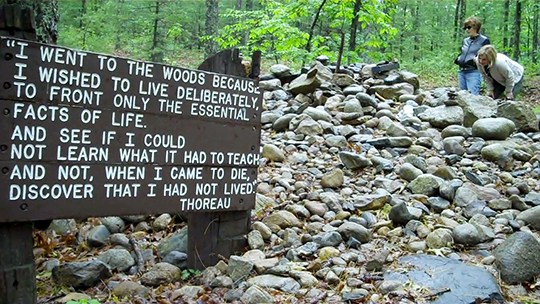
Walden

If you’re a cynic, you can sneer at the railway tracks that run behind the cabin (they were there in Thoreau’s day, too), and point out that Emerson and also Thoreau’s parents lived a mere twenty-minute walk away. (To be fair to Thoreau, he does make it clear in Walden that he was not living out in the wopwops.) After his time in the woods, Thoreau moved in with the Emersons at Bush.
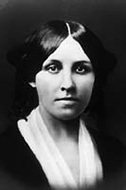
Louisa May AlcottThe next two stops on your whirlwind tour should be the Concord homes of Louisa May Alcott (1832-1888) and her family. When Alcott was a child, she lived briefly at Fruitlands, near Harvard, an agrarian commune founded by her somewhat hapless father, who admired his friend Emerson’s back-to-nature philosophies. Sadly, Fruitlands lasted only seven months—none of the resident transcendentalists turned out to have much of a knack for farming—and the family returned to Concord. In 1845, with the help of a loan from Emerson, they bought a home they called The Hillside; many of the incidents in Little Women are based on Alcott’s childhood there. However, Louisa May’s father was unable to support his family, and in 1852 they were forced to sell the home to Hawthorne, who renamed it The Wayside (Hawthorne had moved up in the world; The Scarlet Letter had been published in 1850, and was an immediate best seller).

The Alcotts moved to Boston for a few years, before returning to Concord in 1858 to purchase the adjacent Orchard House, where Louisa May Alcott wrote Little Women in her room on a tiny half-moon desk built for her by her father.
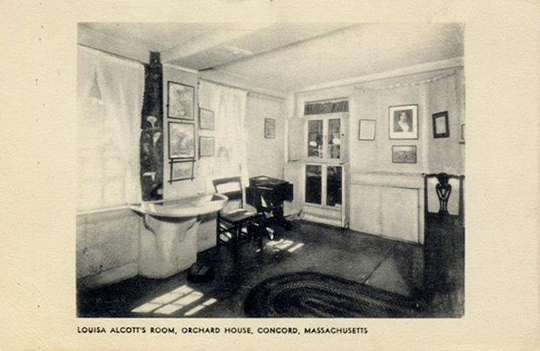
Orchard House

The book was an instant commercial and critical success, and Louisa May Alcott was able to make good on at least two of the three promises she recorded in her diary at age fifteen: “I’ll be rich and famous and happy before I die, see if I won’t!” She died of a stroke at age fifty-five, and is buried in Concord’s Sleepy Hollow Cemetery, on a hillside near Emerson, Hawthorne, and Thoreau.

If you need a rest after all this literary sightseeing, you can check in at the terribly old (1716) and supposedly haunted Colonial Inn, where Thoreau lived from 1835 to 1837 while he attended Harvard. Have a stiff drink in the wood-paneled bar, and reflect on how Concord’s mid-nineteenth-century literary scene seems a lot like today’s literary scene: it’s a tiny, tiny world where everyone knows everyone else, and for every jammy bastard who strikes it rich—you go, Louisa May!—there are a hundred impoverished scribblers who have no choice but to gift their newlywed friends a bunch of shitty vegetables.

Poetry, F

And now for the fourth installment in Malvern Books’ arbitrary and occasional Poetry Month A-Z series…

F is for Frame, Janet

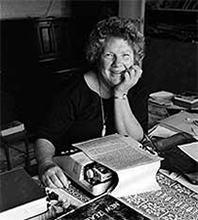
Janet FrameJanet Frame (1924-2004) is New Zealand’s most acclaimed author. She wrote eleven novels and four short story collections (I recommend her novels Owls Do Cry and Living in the Maniototo, and also Prizes: The Selected Stories of Janet Frame), and was a nominee for the Nobel Prize in Literature. And she’s also pretty well known for being the big ol’ ginger weirdo in Jane Campion’s film, An Angel at My Table, an adaptation of Frame’s autobiographical trilogy of the same name. (Frame’s personal history makes for harrowing reading/viewing: she was wrongly diagnosed with schizophrenia, received over two-hundred electroshock treatments, and was days away from a scheduled lobotomy when news came through that her first published short story collection had won a major literary prize.)

But Frame-the-poet gets less attention, though poetry was very dear to her. She referred to it as “the highest form of literature,” and in a 1979 interview she said, “Poetry is my first love.” However, Frame’s belief that a poem must be perfect—“you can have no dead wood in a poem”—made it difficult for her to ever declare a verse finished, and she published just one poetry collection in her lifetime (The Pocket Mirror, 1967). After her death, her niece, Pamela Gordon, and two fellow poets, Denis Harold and Bill Manhire, released The Goose Bath, a selection of over a hundred of Frame’s unpublished poems (the title comes from the old garden fountain in which she kept her not-quite-finished work). Frame might not have considered her poetry entirely “real” or “successful,” but the work in The Goose Bath is beautiful nonetheless, full of rich imagery, a sense of mischief, a novelist’s inventiveness (we are addressed by a brain tumor, the Guggenheim, a piano), and a profound love of the natural world (birds and cats abound).

I Take Into My Arms More Than I Can Bear To Hold

I take into my arms more than I can bear to hold
I am toppled by the world
a creation of ladders, pianos, stairs cut into the rock
a devouring world of teeth where even the common snail
eats the heart out of a forest
as you and I do, who are human, at night

yet still I take into my arms more than I can bear to hold

* * *

from “Tenant”

No, he didn’t bath. He never turned the radio up loud.
He came from somewhere the back of beyond
where they sit under lemon trees, and ask
riddles of giant vermilion cattle with white faces.

One thing in his life—there was a tortoise.
Like a crude brooch worn across his heart, it sat
brown and flat and quiet—except
it sparkled when he spoke to it.

Thursday Three #2

Today’s happy threesome is themed for your convenience, and that theme is the weekend’s nationwide bookish events.

First up, if you’re in Houston on Saturday you really should stop by the sixth annual Houston Indie Book Festival. According to the press release, “the event serves as a spotlight on the writers, artists, journals, presses, independent bookstores, and organizations that are committed to preserving and promoting the arts and humanities within Houston, Austin, Louisiana, and the entire Gulf Coast region.” There’ll be a ton of literary journals and indie press books for sale, plus live music and OMG FOOD TRUCKS. And best of all, we’ll be there, wearing our Host Publications hat (similar to this), to take part in a panel discussion with Grey Gecko Press, JoSara MeDia, and Write Bloody Publishing. We’ll be chatting about what makes small presses so special (and so challenging), and there’ll be a Q & A afterwards, so please do stop by the tent on the eastern lawn of the Menil building at 1.30pm to heckle us fondly.

The Last BookstoreNext, let’s check out The Last Bookstore in downtown LA, for the Los Angeles Times Festival of Books After Party, starting at 7pm on Saturday. The event is open to the public, and alcohol will be served, which means you can get a little tipsy and make awkward small talk with the good people from Granta and Bookforum. You should also explore the bookstore itself, which is an amazing, cathedral-like space; it was recently listed as one of the twenty most beautiful bookstores in the world.

Finally, after a good night’s sleep, let’s pomade our outlandish mustaches and head east for the Brooklyn Zine Fest, which will be held on Sunday from 11am to 6pm at Public Assembly in Williamsburg. More than eighty zine creators (zineators? ziners?) will be displaying their wares, including artist Chris Piascik, whose Typostruction zine features a combination of cool typography, whimiscal illustrations, and… cats.

Chris Piascik

Home Sweet Home

My dears, the lease has been signed—and all 3,487 pages lovingly initialed—which means Malvern Books has officially found a home.

Lease signed613 W. 29th Street, to be exact. It’s a great location, not far from UT Austin, and with wonderful neighbors (why, hello there, Vulcan Video, “voted best video store in Austin by the Austin Chronicle for the past millionty years”). The site itself used to be home to a branch of Dreamers, an Austin chain that specializes in meeting all of your, ahem, adult needs. We trust that we, too, can meet your adult needs, assuming your need is for AWESOME BOOKS.

We’ve met with an architect, and we will shortly begin turning this…

Before

… into a beautiful and welcoming bookstore and community space (fear not, that grotty carpet will be dying a horrible death). Stay tuned for regular how-to-build-a-bookstore updates and plenty more before and after pictures. And don’t forget to let us know what you’d like to see between these four walls!

Thursday Three #1

Welcome to our first Thursday Three, a round up of a trio of odds and sods*, old and new, that have fancied our tickle here at Malvern this week.

First up, a movie recommendation: you really should see Beyond the Hills, the new film from Cristian Mungiu, director of the brilliant 4 Months, 3 Weeks and 2 Days:

Set in grimmest Romania in the depths of winter, Beyond the Hills is the story of two friends, Voichita and Alina, who grew up together in a bleak and seedy orphanage (is there any other cinematic kind?), and who are reunited at the beginning of the film after some years apart. The troubled Alina has been working as a barmaid in Germany (this is possibly a euphemism for something kind of gross), and she returns to Romania to persuade Voichita to come and join her. Voichita, however, has found God: she’s now a novice at a remote and austere Orthodox convent, and she refuses to leave. It’s clear the two girls were once extremely close—it’s hinted that they were lovers, though it’s possible the intensity of their relationship has taken on an exaggerated significance in the mind of poor Alina—and Alina is heartbroken to find that her role in Voichita’s life has been usurped by God, and by his representative on earth, the convent’s formidable priest, whom the novices call “Papa.” Stuck in the middle of nowhere, with a distant friend who offers biblical homilies in place of real comfort, Alina becomes increasingly unstable—there’s a seizure, an attempted suicide, and a little light arson thrown in for good measure. Not to give too much away, but if I tell you the movie was inspired by the real-life case of an exorcism gone awry, you’ll see where this is heading.

It’s a long and meandering film, full of lingering, meticulously composed shots, and it’s as austere as the place it portrays: there’s no music, and many seemingly crucial plot details are left vague. What makes the film so riveting is Mungiu’s refusal to take sides: this is not an anti-religious screed, but rather a complex portrait of a murky moral world, where confused and frightened people do whatever they can to hold on to what is dear to them. You’ll want to see it with a friend, so you can have someone to argue about it with afterwards.

Next up, the Michel Houellebecq interview in The Paris Review is maddening and hilarious and well worth a read. Here’s an excerpt:

INTERVIEWER

You’ve said that you possibly had an American side to you. What is your evidence for this?

HOUELLEBECQ

I have very little proof. There’s the fact that if I lived in an American context, I think I would have chosen a Lexus, which is the best quality for the price. And more obscurely, I have a dog that I know is very popular in the United States, a Welsh Corgi. One thing I don’t share is this American obsession with large breasts. That, I must admit, leaves me cold. But a two-car garage? I want one. A fridge with one of those ice-maker things? I want one too. What appeals to them appeals to me.

And finally, here’s a short and charming clip about a Norwegian man who has been dubbed “the most easily scared guy in the world,” and who should also be declared “the best-natured guy in the world”:

* Do Americans say “odds and sods”? I’ve lived here for seven years now, and I still find myself asking “do you say this?” on a near daily basis.

Poetry, E

And now for the third installment in Malvern Books’ arbitrary and occasional Poetry Month A-Z series…

E is for Eady, Cornelius

Remember Susan Smith, the shitty mom from Union, South Carolina? On October 25th, 1994, she told police she’d been carjacked by a stranger, who forced her out of her Mazda Protegé and drove away with her two young sons still in the back. She appeared on television, pale and twitchy, begging for their safe return: “I would like to say to whoever has my children, that they please, I mean please, bring them home.” But she failed repeated polygraphs—that little blue line always stuttered when they asked, “Do you know where your children are?”—and nine days after she reported the crime, she was arrested: Susan Smith had rolled the car into a lake with her kids inside, and left them to drown.

Susan Smith

So Susan Smith was a Very Bad Mom, and the media loves a bad mom—the story was front page news for weeks. The case prompted a few peculiar strangers to make YouTube tribute videos in honor of her dead children, and the videos all come with a string of comments that pretty much blur into one: “She needs to rot in hell for what she did to those sweet innocent boys.” But keep scrolling down and you find: “A curse to these devils, always placing blame on other races for their own shit… they need to worry about their own race, devils devils devils.” Yes, Susan Smith had been very clear: her imaginary carjacker was an African American, a dark man dressed in a dark shirt and wearing a knit cap. “A black man did it”: the racial hoax. In 70% of cases where someone commits a crime and blames it on a fabricated transgressor of another race, the real criminal is white, and their invented assailant is black.

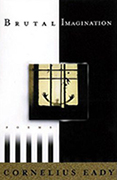
Brutal ImaginationIn his 2001 collection, Brutal Imagination, poet Cornelius Eady addresses the role of the black man in white America. In the collection’s second cycle, “Running Man,” Eady’s poems draw on the libretto for his 1999 music-drama of the same name (and for which he was nominated for a Pulitzer Prize). But it’s the first, eponymous cycle of the collection that directly addresses the Susan Smith case and the concept of the racial hoax, with Eady adopting the persona of Smith’s imaginary black attacker.

How I Got Born

Though it’s common belief
That Susan Smith willed me alive
At the moment
Her babies sank into the lake

When called, I come.
My job is to get things done.
I am piecemeal.
I make my living by taking things.

So now a mother needs me clothed
In hand-me-downs
And a knit cap.

Whatever.
We arrive, bereaved
On a stranger’s step.
Baby, they weep.
Poor child.

This character, referred to as Mr. Zero, acts as a kind of guide, leading us through this all-too-familiar scenario, where “everything they say about me is true.” The narrator also recalls being summoned by Charles Stuart, the Boston man who shot and killed his wife, then told the police the murderer was a young, black male:

I sat with Charles the way I sit
With Susan; like anyone, and no one,
Changing clothes,
Putting on and taking off ski caps,
Curling and relaxing my hair,
Trying hard to become sense.

In the cycle’s final poem, “Birthing,” words from Susan Smith’s handwritten confession (in italics) are interwoven with the narrator’s voice:

When I left my home on Tuesday, October 25, I
was very emotionally distraught

I have yet
to breathe.

I am in the back of her mind,
Not even a notion.

A scrap of cloth, the way
A man lopes down the street.

Later, a black woman will say:
“We knew exactly who she was describing.”

* * *

I felt I couldn’t be a good mom anymore, but I didn’t want
my children to grow up without a mom.

I am not me, yet.
At the bridge,
One of Susan’s kids cries,
So she drives to the lake,
To the boat dock.

I am not yet opportunity.

* * *

I had never felt so lonely
and so sad.

Who shall be a witness?
Bullfrogs, water fowl.

The poems were written to be performed; this first cycle was adapted for an award-winning off-Broadway play. The language in Brutal Imagination is plain and straightforward, almost disarmingly serene. It’s a powerful collection, unabashedly political, but never preachy: the narrator, this conjured scapegoat, delivers his message in a voice so calm, so quiet, so resigned—it’s utterly chilling.

If you decide to wash your car,
If you decide to mail a letter,

I might tumbleweed onto a pant leg.
You can stare, and stare, but I can’t be found.
Susan has loosed me on the neighbors,
A cold representative.
The scariest face you could think of.

In an interview, Eady says of Brutal Imagination:

It’s an examination of what the stereotypes are made of, the elements that we’ve used to make those characters what they are, our belief system. One thing that fascinated me about the story was how easy it was for Susan Smith to tap into that. She just pulled it out of the ether. I know when it happened. Between the time she sees the car’s taillights go under the lake and when she’s walking from the lake across the highway toward the first house she finds. In that little space of time, she’s thinking, Who did this? Someone’s got to have done this. Someone’s got to be blamed for this. It’s a black guy, and he’s wearing a cap, and he pushed me out of the car. She’s thinking this as she’s walking toward the house. It’s just so easy because it’s plausible. That was the scariest part, how easy it was for her.