In today’s Thursday Three, our weekly assortment of oddities in triplicate, we give you a brief introduction to three of the best writing guides.
1. Perfectionism your problem? Scared to ruin that astounding paragraph in your head by daring to write it down? Silly fool! Anne Lamott has this to say to you:
Perfectionism is the voice of the oppressor, the enemy of the people. It will keep you cramped and insane your whole life, and it is the main obstacle between you and a shitty first draft. I think perfectionism is based on the obsessive belief that if you run carefully enough, hitting each stepping-stone just right, you won’t have to die. The truth is that you will die anyway and that a lot of people who aren’t even looking at their feet are going to do a whole lot better than you, and have a lot more fun while they’re doing it.
Lamott’s Bird by Bird: Some Instructions on Writing and Life is the perfect kick in the pants for those of us who have trouble with the actual writing-stuff-down part of writing. Lamott is down to earth and inspiring, and her humor, compassion, and good-natured crankiness somehow make the pen-to-paper business feel less like torture and more like fun—urgent, essential fun.
2. In The War of Art, Steven Pressfield suggests that writerly procrastination can be blamed on a force he calls Resistance:
Resistance cannot be seen, touched, heard, or smelled. But it can be felt. We experience it as an energy field radiating from a work-in-potential. It’s a repelling force. Its aim is to shove us away, distract us, prevent us from doing our work … Resistance will tell you anything to keep you from doing your work … Resistance has no strength of its own. Every ounce of juice it possesses comes from us. We feed it with power by our fear of it.
This all sounds rather dramatic, but Pressfield’s notion of Resistance will feel familiar to many aspiring writers—and viewing one’s mundane daily struggle to write as a minor skirmish in an epic, ongoing battle against Resistance is… kind of fun. The final third of the book gets a bit mystical and dippy (“I plan on using terms like muses and angels. Does that make you uncomfortable?” Why yes, yes it does!), but the first two-thirds of The War of Art may just make a writing warrior out of you.
3. John Gardner’s The Art of Fiction is for those of you who have conquered perfectionism and procrastination and are now going about the messy business of making sentences. Gardner sees fiction as the creation of a dream in the reader’s mind:
We may observe, first, that if the effect of the dream is to be powerful, the dream must … be vivid and continuous—vivid because if we are not quite clear about what it is we’re dreaming, who and where the characters are, what it is that they’re doing or trying to do and why, our emotions and judgements must be confused, dissipated, or blocked; and continuous because a repeatedly interrupted flow of action must necessarily have less force than an action directly carried through from its beginning to its conclusion.
Drawing on examples from Homer to Updike, Gardner demonstrates the various ways in which writers have created these dreams in the minds of readers. He addresses practical issues of craft, including point of view, sentence structure, voice, and rhythm, and his chapter on common errors—mistakes that “snap” the reader out of the fictional dream—should be essential reading for all would-be novelists. He’s particularly harsh on writers who use fancy-pants Latinate terms where Anglo-Saxon ones would do; if your story features an “inhospitable abode” instead of, say, a desert of rocks and sand, well, there’s probably no hope for you.
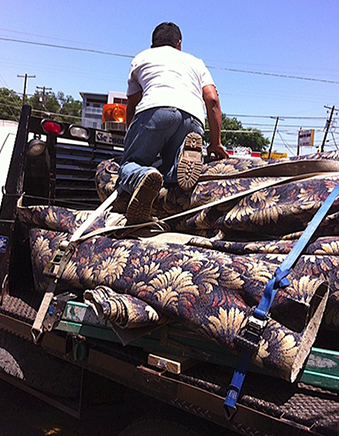
A glorious day here at Malvern Books! Remember the carpet? The terrible, terrible carpet? Well, it’s gone!
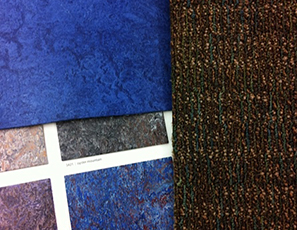
Good riddance, oh chunderous tapestry of doom! The place is looking a little bare now, but we’ve already picked out some snazzy new flooring, and we very much look forward to celebrating its installation in the customary way: by taking off our socks and shoes and running madly around the room, crying, “Eeeee! So soft! So clean!” For those of you who enjoy the word swatches, here is the word swatches, and also (again!) swatches of our imminent flooring:
With the floor taken care of, it’s now time to raise our eyes to the roof. The good people of Austin take roof accessorizing very seriously. Here, for example, is the friendly chap who lives above the nearby Wheatsville Co-op:
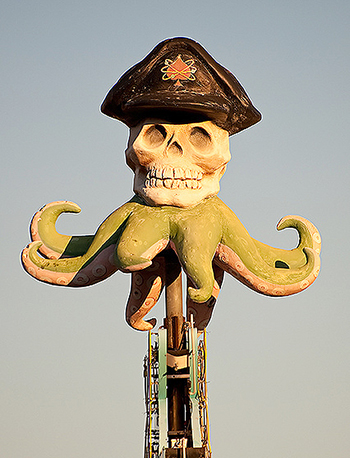
And not to be outdone in the stuff-of-nightmare stakes, Atomic Tattoo crown their store with this octopus/dead guy combo:
We want to do our bit to keep the Austin skyline spooky, so we’re thinking we’ll go with a sculpture of a giant pterodactyl, wearing glasses, reading a book, while perched upon a globe. What say you, Malvernians?
Poetry Month is officially over (it’s now Short Story Month, apparently), but that’s no reason to abandon our arbitrary and occasional Poetry A-Z series…
American poet Louise Glück isn’t the cheeriest duck in the pond—loneliness, divorce, and rejection are her favored themes—but she can shoulder the weight of myth like no one else, and her spare, intimate, unflinching voice is utterly compelling. If you’re new to Glück, her Pulitzer-Prize-winning collection, The Wild Iris(1993), is a great place to dive in, and the more recent Averno (2007) is also wonderful. Here’s a poem from Averno to get your weekend off to a hellishly good start:
A Myth of Devotion
When Hades decided he loved this girl he built for her a duplicate of earth, everything the same, down to the meadow, but with a bed added.
Everything the same, including sunlight, because it would be hard on a young girl to go so quickly from bright light to utter darkness
Gradually, he thought, he’d introduce the night, first as the shadows of fluttering leaves. Then moon, then stars. Then no moon, no stars. Let Persephone get used to it slowly. In the end, he thought, she’d find it comforting.
A replica of earth except there was love here. Doesn’t everyone want love?
He waited many years, building a world, watching Persephone in the meadow. Persephone, a smeller, a taster. If you have one appetite, he thought, you have them all.
Doesn’t everyone want to feel in the night the beloved body, compass, polestar, to hear the quiet breathing that says
I am alive, that means also you are alive, because you hear me, you are here with me. And when one turns, the other turns—
That’s what he felt, the lord of darkness, looking at the world he had constructed for Persephone. It never crossed his mind that there’d be no more smelling here, certainly no more eating.
Guilt? Terror? The fear of love? These things he couldn’t imagine; no lover ever imagines them.
He dreams, he wonders what to call this place. First he thinks: The New Hell. Then: The Garden. In the end, he decides to name it
Persephone’s Girlhood.
A soft light rising above the level meadow, behind the bed. He takes her in his arms. He wants to say I love you, nothing can hurt you
but he thinks this is a lie, so he says in the end
you’re dead, nothing can hurt you which seems to him a more promising beginning, more true.
Time for a quick update on the progress of the soon-to-open Malvern Books! As you might remember, we signed the lease a couple of weeks ago, and May Day saw us officially take possession of our new home. It doesn’t look much like a bookstore yet:
In fact, it currently looks like the armpit of a moth-eaten cardigan. But we’re getting there. The power is on, the water is running, and we’re ready to start RIPPING STUFF UP. Doesn’t that sound fun? Especially as it applies to floor coverings.
But what to do with all that room (1900 square feet, to be exact)? Our architect came up with a plan that looked smashing on paper, but when we went to the store and marked things out with bits of tape, we realized that our imaginings had been rather off. The staff breakroom that we’d envisaged as a spacious, cat-swingable kind of place turned out to be about as roomy as a bag of kibble when we stood within its marked out boundaries. So we went back to the drawing board and will soon put Plan #2 to the tape-on-carpet test.
And as for the future décor? At the moment we’re leaning toward a pirates/crucifixes/lions theme (one of Martha Stewart’s favorites, I believe; rumor has it her Newport estate is riddled with marble statues of plundering seafarers), but all that might change once the new carpet/shelves/lights are in place. One thing we know for sure: when selecting wall art, the former tenant’s rather saucy bathroom poster will not make the final cut—I’m sure LeRouge Boutique’s Free Thong Club (“Buy 6 Thongs and Get 1 Free!”) is an excellent and cost-effective scheme for thong collectors, but we’ll probably just go with a nice portrait of Wallace Stevens.
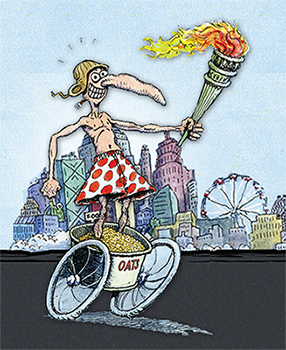
And as we spend more time on site, we’ll also be getting to know our new neighbors, including the venerable Oat Willie’s, Austin’s first head shop. Their slogan is “Onward, Thru The Fog” and their mascot is this guy:
Do bongs and poetry readings go together like tuna and mayonnaise? We couldn’t possibly comment. But we definitely need to come up with a mascot to go cycling with Mr. Willie. Suggestions, anyone?
A twenty-two-second video of a cat vomiting on a turtle is clearly the internet’s raison d’être, but sometimes you long for something a little more…substantial. In today’s Thursday Three, our weekly assortment of randomness in triplicate, we take a quick look at three artful and arts-full aggregators.
1. Longform is really two sites: the original Longform, which offers a collection of non-fiction, old and new, and their sister site for fans of make-believe, Longform Ficton. They have an impressive list of writers, from A. M. Homes to ZZ Packer (they index authors by first name, oddly), and they source their essays and short stories from a wide range of publications. I recently read—and heartily recommend—Zadie Smith’s essay on her uneasy relationship with Facebook and Mac McClelland’s account of her “brief, backbreaking, rage-inducing, low-paying, dildo-packing time inside the online-shipping machine” (i.e. why you should buy your books from a bricks-and-mortar bookstore and not that other place).
By the way, if you hate reading lengthy articles on your cumbersome computer screen, you can always sign up for a free service like Instapaper, which lets you save web content to read later—so when you’re on the bus and you’re sick of playing Hearts against computer avatars with 1950’s barbershop hair, you can pull up a saved essay about pro-level Ultimate Frisbee and feel just that little bit smarter.
2. Videosift is my go-to for kitten vids, but for documentaries, there’s always Watch Documentary. You have to sift through some less-than-exquisite films (the BBC’s My Big Breasts and Me unsurprisingly ranks high in the Most Watched category), but there’s plenty of good stuff to see, and it’s free. In the Arts & Artists section, for example, there’s Exit Through the Gift Shop, Annie Leibovitz: Life Through a Lens and an Al Jazeera doco about death row art in Texas. Best of all, they have the entire A History of Britain series, narrated by Simon Schama, the dapper and delightful narrative historian. You don’t have to be an Anglophile to enjoy the series; Schama is a wonderful writer and an engaging (and occasionally sarcastic) host, and his approach is to focus on characters and cultures, and not on the usual boring lists of royal Richards.
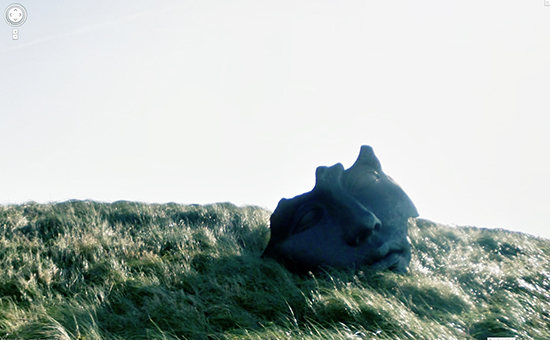
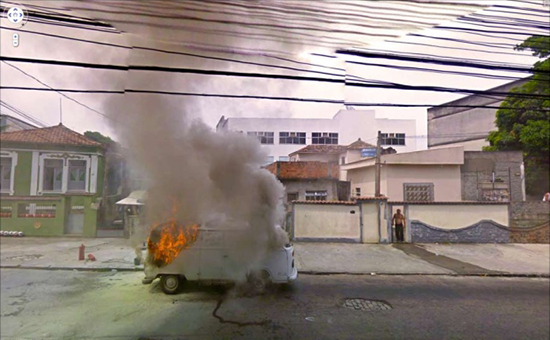
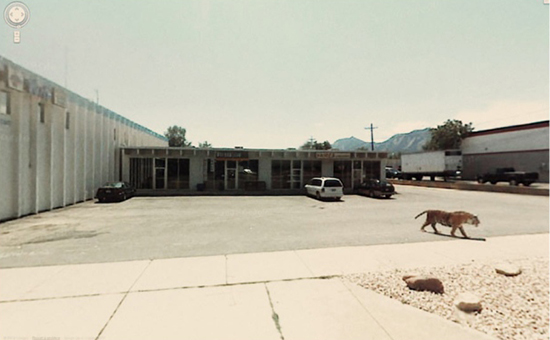
3. If you’d rather stare at a few frozen pixels, check out 9-Eyes, artist Jon Rafman’s compilation of images sourced from Google Street View’s cameras. Rafman combs through the millions of pictures to find the most beautiful and bizarre snapshots of our world. And it’s a truly weird place, full of naughty children and errant tigers; car crashes and prostitutes; mysterious forests and men in white masks. It’s silly, sinister, and beautiful—and best of all, you’re living in it.
Today’s Thursday Three, our weekly assortment of oddities in triplicate, falls on April 25th, which is Anzac Day down under—a national day of remembrance. The acronym ANZAC stands for Australia and New Zealand Army Corps, whose members fought for the Allies in the First World War. And the date marks the start of the (disastrous) Battle of Gallipoli, the first major campaign in which the Anzac forces took part. (In total, 100,444 New Zealanders would serve in the war—roughly 10% of our population at the time—and we suffered one of the highest death rates per capita of any country involved.)
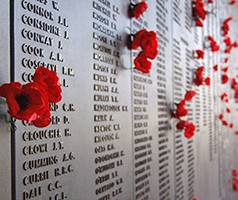
Following the Second World War, Anzac Day’s commemorative scope was broadened, and it became a day of general remembrance for all those lost in battle. Every year on April 25th, people all over New Zealand and Australia don red poppies, attend dawn services, and trade stories about great-uncles who never made it home. So, if you’ll forgive this soppy antipodean disruption to our regular services, let’s do our bit with an Anzac Day Three.
1. When I was a kid, the BBC sitcom Blackadder was my favorite TV program, and my father and I watched every episode together (my mother found it too silly). For those of you unfamiliar with the show, it follows the exploits of Edmund Blackadder, a cynical and cowardly chap who attempts to improve his lot in life through a variety of “cunning schemes.” Each series was set in a different historical period: Blackadder first does his wheeling and dealing in the English royal court at the end of the Middle Ages; in the next series he reappears (as the great-grandson of the original Blackadder) as a Lord during the reign of Queen Elizabeth; and then he pops up again as the Prince of Wales’ butler during the Regency period. Finally, for the show’s fourth season, poor Blackadder must serve as a Captain during the First World War.
This last series starts off much like the rest: finding himself in a bit of a pickle (i.e. in a trench in Flanders), the wily Blackadder employs various farcical schemes in order to achieve his objective, which in this case is to land himself a cushy military desk job as far from the front line as possible. The series parodied the conditions of life on the Western Front, but it never strayed too far from the show’s typical ribald silliness—it was business as usual, comedy-wise, with the familiar daft jokes about weasels and willies and potatoes. (As you’ll see in the clip below, Blackadder takes constant delight in mocking the last name of his nemesis, the upper-class twit Captain Kevin Darling.)
So imagine me and my dad sitting down to watch the very final episode, excited to see how Blackadder will once and for all escape the battlefield. A cunning plan involving a pigeon and a cigarette, perhaps? Or will Captain Darling return to England’s posh green fields and let Blackadder take over his job as the General’s chief pajama folder? Nope, not going to happen. Blackadder’s luck runs out, and in the show’s closing scene the cackles on the laugh track become hesitant, then trail off. The jaunty theme tune slows to a funereal dirge. And my dad and I had to keep swallowing the lumps in our throats as we watched the final moments of Captain Blackadder:
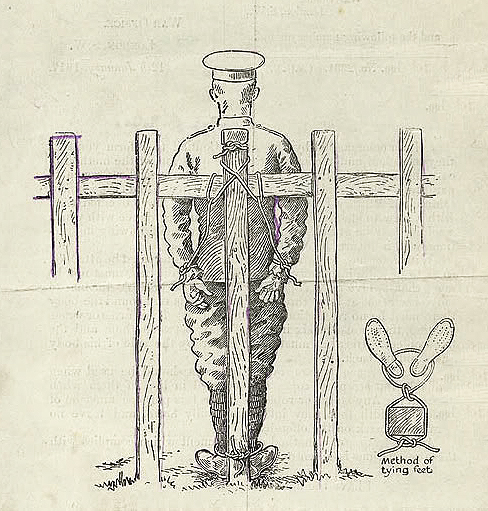
2. Conscientious objectors didn’t fare much better. New Zealand pacifist Archibald Baxter (1881-1970) refused to serve during the First World War—he claimed “all war is wrong, futile, and destructive alike to victor and vanquished”—but they sent him to the Western Front anyway, where he was beaten and tortured by army officers in an effort to get him to cooperate. He steadfastly refused to obey military orders, and was eventually subjected to Field Punishment Number One, also known as “the crucifixion,” an ordeal he recalls in his autobiography, We Will Not Cease:
[The sergeant] took me over to the poles, which were willow stumps, six to eight inches in diameter and twice the height of a man, and placed me against one of them. It was inclined forward out of perpendicular. Almost always afterwards he picked the same one for me. I stood with my back to it and he tied me to it by the ankles, knees and wrists. He was an expert at the job, and he knew how to pull and strain at the ropes till they cut into the flesh and completely stopped the circulation. When I was taken off my hands were always black with congested blood. My hands were taken round behind the pole, tied together and pulled well up it, straining and cramping the muscles and forcing them into an unnatural position. Most knots will slacken a little after a time. His never did. The slope of the post brought me into a hanging position, causing a large part of my weight to come on my arms, and I could get no proper grip with my feet on the ground, as it was worn away round the pole and my toes were consequently much lower than my heels. I was strained so tightly up against the post that I was unable to move body or limbs a fraction of an inch…
A few minutes after the sergeant had left me, I began to think of the length of my sentence and it rose up before me like a mountain. The pain grew steadily worse until by the end of half-an-hour it seemed absolutely unendurable. Between my set teeth I said: “Oh God, this is too much. I can’t bear it.” But I could not allow myself the relief of groaning as I did not want to give the guards the satisfaction of hearing me. The mental effect was almost as frightful as the physical. I felt I was going mad. That I should be stuck up on a pole suffering this frightful torture, a human scarecrow for men to stare at and wonder at, seemed part of some impossible nightmare that could not continue.
Baxter’s autobiographywas required reading when I was at high school, and for that it got filed in the BORING BOOKS section of my brain. But picking it up again as an adult, I’m amazed by Baxter’s courage and resilience. He recounts his experiences with incredible humility, and he makes a point of recording the many acts of kindness shown to him by the ordinary soldiers. His plain, straightforward prose reveals no bitterness, only sadness and bewilderment. It’s a moving account of the consequences of dissent.
I remember before I reached the front meeting men who had been there and thinking they looked hard and strange. Their faces had a drawn look and they seemed to have eyes like eagles. Now that I was amongst them I did not notice this. They seemed ordinary, but new arrivals looked as gentle as sheep.
3. And what do we do on Anzac Day? On Anzac Day we search the house for war memorabilia. There’s a box of medals in the drinks cabinet; no one can remember who the Star of Burma belongs to. There are also letters from my great-uncle Eric, who served with the Auckland Mounted Rifles during the First World War. He spent most of 1915 in Turkey, his horse tethered to a tree. He writes to his mother:
I forgot to tell you in my last letter that we had seen quite a number of swallows; the first we saw was on New Year’s Day, and we have seen them on several occasions since.
We are all hoping and living for the day we shall be in the thick of it, and it shouldn’t be long now—there are hundreds of our infantry boys to be avenged, some battalions were almost wiped out. But you needn’t worry too much about us, Mater, as there is a ten to one chance in our favour, and things are not quite what the papers say. Don’t believe all you read in them.
He was killed at Gallipoli a few weeks later.
My grandfather’s records from the Second World War are kept in the writing desk, beneath the Christmas wrapping paper. He would never talk about the war, and there isn’t much to go on; just an army logbook and a bundle of pay slips. He served in the Pacific for 796 days, and for this he received £39.16. He took with him to war a pocket-size New Testament and a photo of his wife.
His brother Harold also fought in the Second World War, in Tunisia, and tucked inside the logbook is a letter to their mother from Harold’s Company Commander:
Dear Mrs Hill,
I saw your son killed. It happened during an attack on a strong enemy position in front of the village of El Hamma, in the Mareth Line. He was with 2nd Lt. Friend (since wounded), his Platoon Commander, and his section, mopping up German pockets of resistance. He was endeavouring to get some Germans out of the bottom of a trench, but was shot through the head at very close range. He died instantaneously.
On Anzac Day we wear crepe-paper poppies and thank our lucky stars.
Perfectionism is the voice of the oppressor, the enemy of the people. It will keep you cramped and insane your whole life, and it is the main obstacle between you and a shitty first draft. I think perfectionism is based on the obsessive belief that if you run carefully enough, hitting each stepping-stone just right, you won’t have to die. The truth is that you will die anyway and that a lot of people who aren’t even looking at their feet are going to do a whole lot better than you, and have a lot more fun while they’re doing it.
Resistance cannot be seen, touched, heard, or smelled. But it can be felt. We experience it as an energy field radiating from a work-in-potential. It’s a repelling force. Its aim is to shove us away, distract us, prevent us from doing our work … Resistance will tell you anything to keep you from doing your work … Resistance has no strength of its own. Every ounce of juice it possesses comes from us. We feed it with power by our fear of it.
We may observe, first, that if the effect of the dream is to be powerful, the dream must … be vivid and continuous—vivid because if we are not quite clear about what it is we’re dreaming, who and where the characters are, what it is that they’re doing or trying to do and why, our emotions and judgements must be confused, dissipated, or blocked; and continuous because a repeatedly interrupted flow of action must necessarily have less force than an action directly carried through from its beginning to its conclusion.

 American poet Louise Glück isn’t the cheeriest duck in the pond—loneliness, divorce, and rejection are her favored themes—but she can shoulder the weight of myth like no one else, and her spare, intimate, unflinching voice is utterly compelling. If you’re new to Glück, her Pulitzer-Prize-winning collection,
 1. Longform is really two sites: the original
 Following the Second World War, Anzac Day’s commemorative scope was broadened, and it became a day of general remembrance for all those lost in battle. Every year on April 25th, people all over New Zealand and Australia don red poppies, attend dawn services, and trade stories about great-uncles who never made it home. So, if you’ll forgive this soppy antipodean disruption to our regular services, let’s do our bit with an Anzac Day Three.
 [The sergeant] took me over to the poles, which were willow stumps, six to eight inches in diameter and twice the height of a man, and placed me against one of them. It was inclined forward out of perpendicular. Almost always afterwards he picked the same one for me. I stood with my back to it and he tied me to it by the ankles, knees and wrists. He was an expert at the job, and he knew how to pull and strain at the ropes till they cut into the flesh and completely stopped the circulation. When I was taken off my hands were always black with congested blood. My hands were taken round behind the pole, tied together and pulled well up it, straining and cramping the muscles and forcing them into an unnatural position. Most knots will slacken a little after a time. His never did. The slope of the post brought me into a hanging position, causing a large part of my weight to come on my arms, and I could get no proper grip with my feet on the ground, as it was worn away round the pole and my toes were consequently much lower than my heels. I was strained so tightly up against the post that I was unable to move body or limbs a fraction of an inch…