Habits & Habitats

A few bits and bobs for your midweek delectation…

  • Frames, we got ’em! Yep, Malvern Books is coming along nicely: stick on some wood, slap on some paint, bung up some shelves, and Bob’s your bookstore! (Can you tell we’re getting excited now?)

Frames

  • Today on everyone’s favorite tote-bag peddling radio stationLeonard Lopate chatted with author Mason Currey about his new book, Daily Rituals, which takes a look at the quotidian habits of creative types. Highlight #1: Apparently Beethoven believed that the perfect cup of coffee required exactly sixty beans, and he would count them out one by one. (If you find this sort of thing intriguing, Brain Pickings has a lengthy post on rituals from the book.) Highlight #2: As always, there was a call-in from a batty rich lady with artistic aspirations. Today’s caller was an über-mom who demanded Currey provide her with a morning writing routine that would give her some “me time” while taking into account her child’s “needs.” She insisted that she was not willing to get up early, did not believe in “the nanny culture”, and refused to let lil’ Augustus watch TV. In other words, you can find her heartrending memoir, Yoga Ate My Brain!, on a shelf near you in July two-thousand-and-never.
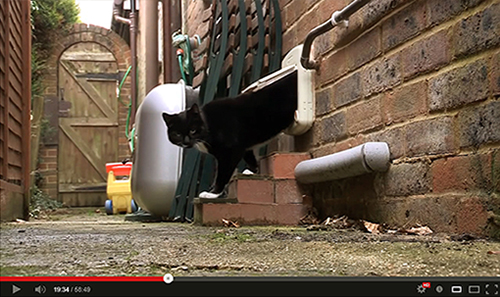
  • Have you seen the BBC’s much talked about kitty-cat documentary, The Secret Life of the Cat? You can watch the whole thing online…

Cats

    … but let me save you the time. A bunch of “cat scientists” descend upon a charming Surrey village, attach GPS units to fifty of the village’s finest fluffies, and then track their comings and goings for a week in order to reveal that… cats do pretty much exactly what you thought: they sleep, they steal food, and they engage in the odd territorial skirmish. Yes, my British chums, your television licence fee is going toward SCIENCE. On the plus side, the cats themselves were jolly nice to look at; I’ve never seen such absurdly plump, fluffy, whiskery specimens. Their salon blowouts were impeccable.

Poetry, H

Poetry Month is officially over (June is National Bathroom Reading Month, apparently), but that’s no reason to abandon our arbitrary and occasional Poetry A-Z series…

H is for Hai Zi

Hai ZiHai Zi is the pen name of poet Zha Haisheng, who was born to a peasant family in a rural Chinese province in 1964. A precocious child, Hai Zi was offered a place at the prestigious Peking University at the age of fifteen, and he graduated with a law degree four years later. He was shortly afterwards appointed professor at China University of Political Science and Law, where he edited the school’s journal and taught classes in aesthetics. It was while at university that Hai Zi decided to devote his energies to poetry. He read widely from classical and contemporary literature, and often sat at his desk working on a poem from dusk till dawn. During these productive years, he also began to exhibit signs of mental illness; he experienced hallucinations, and came to believe that certain people around him were intent on doing him harm. In March 1989, on or near his twenty-fifth birthday, Hai Zi committed suicide by lying down on a railroad track at the eastern end of the Great Wall.

A prolific writer, Hai Zi produced around 250 short poems, several poetic plays, and a number of long poems totaling over 400 pages. His work was not widely recognized during his lifetime (although his students often asked him to recite his poetry for them), but since his death numerous volumes of his selected works have been published, and he is now considered one of the most important Chinese poets of the twentieth century. He came of age during the turmoil of the Cultural Revolution, and his poems display a deep affection and nostalgia for the vanishing agricultural landscape of his youth. He writes without irony, and he celebrates nature and explores spiritual matters with utmost sincerity. It’s a voice that might seem a little hokey to those of us wearing our cynical britches, but when you consider the personal and cultural context in which the poems were written, it’s hard not to be moved by his bravery and vulnerability: at a time when the world around him revered uniformity, industry, and subservience, Hai Zi wrote openly about his personal suffering, and was unafraid to eulogize a more authentic, traditional way of life.

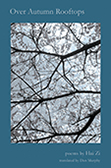
Over Autumn RooftopsIn 2010, Host Publications (Malvern Books’ publishing arm) released Over Autumn Rooftops, a bilingual collection of Hai Zi’s verse, translated by Dan Murphy. Murphy first encountered Hai Zi’s poetry scrawled on the bathroom wall of a Beijing bar and was instantly enamored: early the next morning he rode his bicycle to the nearest bookstore, bought the selected works, and returned to his tiny apartment to begin translating. In his introduction to Over Autumn Rooftops, Murphy writes of the process:

It is not just the words that we translate, but rather that which is pointed to. I do not believe that “poetry is what gets lost in translation.” Literary translation should not be a reduction from the original, not a second-best copy, not a reflection in an imperfect mirror. The translator must create a new poem from the same thin vein of beauty as the original.

Here are three of Hai Zi’s poems as translated by Murphy, their beauty utterly intact:

The Shades of the Night

in the shades of the night
I suffer three times: roam, love, exist
I have three types of contentment: poetry, throne, sun

* * *

Autumn

use our bones laid on the earth
on the beach write: youth. Then shoulder a decrepit father
this time is endless      direction severed
animal-like terror filling up our poetry

whose voice can arrive at autumn’s midnight      permanently
    reverberating
covering our bones laid on the earth—
autumn comes
without a particle of forgiveness or tenderness: autumn comes

* * *

For the Pacific

my wedding dyes the Pacific red
my bride—the Pacific
Asia is also my sad and serene bride
your blood dyes red the sky of sorrow inside you

God’s sad bride, your blood dyes
the sky red, your sea of solitude
your beautiful hair
like dusk on the Pacific

She Real Cool

BrooksPoet Gwendolyn Brooks was born on this day in Topeka, Kansas, in 1917. Brooks published more than twenty poetry collections, as well as a novel and two volumes of autobiography. She was the first African American author to receive a Pulitzer Prize, which she was awarded for her second collection, Annie Allen (1949). Her most famous poem is “We Real Cool” (she reads it wonderfully here), which originally appeared in the September 1959 edition of Poetry. I’m especially fond of “The Rites for Cousin Vit,” a sonnet from Annie Allen:

The Rites for Cousin Vit 

Carried her unprotesting out the door
Kicked back the casket-stand. But it can’t hold her,
That stuff and satin aiming to enfold her,
The lid’s contrition nor the bolts before.
Oh oh. Too much. Too much. Even now, surmise,
She rises in sunshine. There she goes
Back to the bars she knew and the repose
In love-rooms and the things in people’s eyes.
Too vital and too squeaking. Must emerge.
Even now, she does the snake-hips with a hiss,
Slaps the bad wine across her shantung, talks
Of pregnancy, guitars and bridgework, walks
In parks or alleys, comes haply on the verge
Of happiness, haply hysterics. Is.

Thursday Three #6

James WrightThis week’s assortment of stuff in triplicate is devoted to one of my favorite poets, James Wright (1927-1980). I first discovered Wright’s words on the forearm of a friend: he had a few lines of Wright’s poetry tattooed in a tidy cursive from elbow to wrist. They were beautiful lines, and I wanted to read more from their author, so I picked up Wright’s Collected Poems and immediately fell in love with his contemplative, compassionate voice—a voice that Wright, born and raised in a shitty midwestern steel mill town, simply referred to as his “Ohioan.” Below, three of Wright’s best:

1. Wright’s most well-known poem is probably “A Blessing,” aka the pony poem. One of the few poems he was able “to get … finished in almost nothing flat,” Wright wrote it after a drive in the Minnesota countryside with his friend Robert Bly. In his essay, “James Wright and the Slender Woman,” Bly recalls the occasion:

James saw two ponies off to the left and said, “Let’s stop.” So we did, and climbed over the fence toward them. We stayed only a few minutes, but they glowed in the dusk, and we could see it. On the way to Minneapolis James wrote in his small spiral notebook the poem he later called “A Blessing.” … In a few passages [in the poem] we feel too much idealization. The two ponies are just ponies, and probably would have bit one of us if we had stayed much longer without giving them sugar. 

The poem may overstate the charms of roadside ponies, but this anthropomorphism also demonstrates one of Wright’s greatest strengths as a poet: his ability to evoke nature as a path to the metaphysical or divine.

A Blessing

Just off the highway to Rochester, Minnesota,
Twilight bounds softly forth on the grass.
And the eyes of those two Indian ponies
Darken with kindness.
They have come gladly out of the willows
To welcome my friend and me.
We step over the barbed wire into the pasture
Where they have been grazing all day, alone.
They ripple tensely, they can hardly contain their happiness
That we have come.
They bow shyly as wet swans. They love each other.
There is no loneliness like theirs.
At home once more,
They begin munching the young tufts of spring in the darkness.
I would like to hold the slenderer one in my arms,
For she has walked over to me
And nuzzled my left hand.
She is black and white,
Her mane falls wild on her forehead,
And the light breeze moves me to caress her long ear
That is delicate as the skin over a girl’s wrist.
Suddenly I realize
That if I stepped out of my body I would break
Into blossom.

2. Wright pays terrific attention to rhythm. In a Paris Review interview, he says, “I wouldn’t say that I’m a frustrated musician, but I love music and I think this is why I usually begin a poem that way. Music has given me a much greater sense of the possibilities of quantity in poetry.” So why read when you can listen? Here’s Wright reciting “Lying in a Hammock at William Duffy’s Farm in Pine Island, Minnesota.”

3. My favorite of Wright’s collections is Shall We Gather at the River (1969). In the Paris Review interview, Wright has this to say about the book:

I was trying to move from death to resurrection and death again, and challenge death finally. Well, if I must tell you, I was trying to write about a girl I was in love with who has been dead for a long time. I tried to sing with her in that book. Not to recreate her; you can’t recreate anybody, at least I can’t. But I thought maybe I could come to terms with that feeling which has hung on in my heart for so long. The book has been damned because it is so carefully dreamed.

“To the Muse,” the poem whose last three lines are etched on my friend’s forearm, is the final poem in the collection:

To the Muse

It is all right. All they do
Is go in by dividing
One rib from another. I wouldn’t
Lie to you. It hurts
Like nothing I know. All they do
Is burn their way in with a wire.
It forks in and out a little like the tongue
Of that frightened garter snake we caught
At Cloverfield, you and me, Jenny
So long ago.

I would lie to you
If I could.
But the only way I can get you to come up
Out of the suckhole, the south face
Of the Powhatan pit, is to tell you
What you know:

You come up after dark, you poise alone
With me on the shore.
I lead you back to this world.

Three lady doctors in Wheeling open
Their offices at night.
I don’t have to call them, they are always there.
But they only have to put the knife once
Under your breast.
Then they hang their contraption.
And you bear it.

It’s awkward a while. Still, it lets you
Walk about on tiptoe if you don’t
Jiggle the needle.
It might stab your heart, you see.
The blade hangs in your lung and the tube
Keeps it draining.
That way they only have to stab you
Once. Oh Jenny.

I wish to God I had made this world, this scurvy
And disastrous place. I
Didn’t, I can’t bear it
Either, I don’t blame you, sleeping down there
Face down in the unbelievable silk of spring,
Muse of black sand,
Alone.

I don’t blame you, I know
The place where you lie.
I admit everything. But look at me.
How can I live without you?
Come up to me, love,
Out of the river, or I will
Come down to you.

The Voynich Enigma

The Voynich manuscript is a fifteenth-century document consisting of 240 pages of very peculiar drawings and screeds of incomprehensible text. It comes from Europe, most likely northern Italy, and radiocarbon testing has established that the manuscript’s vellum dates from between 1404-1438. No one knows who wrote and illustrated the book; it takes its name from antiquarian Wilfrid Voynich, who rediscovered it in the library of a Jesuit college near Rome in 1912. Over the centuries the manuscript has had a number of documented owners, including Roman Emperor Rudolph II and a seventeenth-century Bohemian alchemist called Georg Baresch, but by the time Voynich found it, it had been missing for nearly 250 years.

Voynich

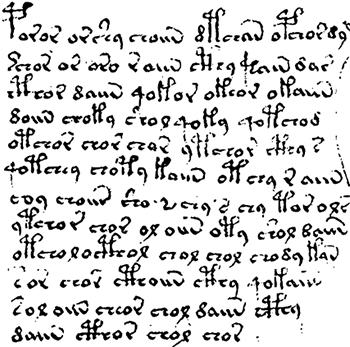
No one has ever been able to read the manuscript: the text does not match any known language, and scholars have never found any other instances of the script. Statistical analysis shows that the text has patterns similar to those of known languages, but there are some intriguing differences: for example, unlike most languages, “Voynichese” has very few two-letter words, and the words that appear most frequently are on the longer side (and yet, also unusually, there are no words longer than ten glyphs).

Voynich Text

The inscrutability of the text has given rise to countless theories. Some scholars suggest the manuscript is written in code, but no one can determine what language it might be based on (Hebrew and Latin are popular contenders), and no one has ever been able to crack the code. Other Voynich boffins claim it’s a straightforward text written in a ‘lost’ language, with early Welsh and Nahuatl, a language of the Aztecs, being just two of the candidates. There’s also the possibility that the entire document is an elaborate prank—a sixteenth-century Sokal-type hoax designed to poke fun at the alchemical texts of the time. Finally, it wouldn’t be a properly spooky mystery without a few nutbars insisting on alien involvement.

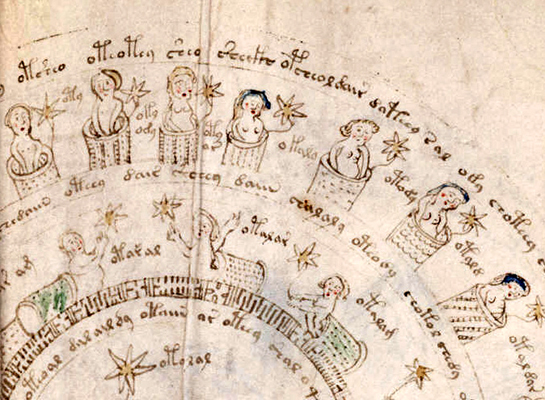
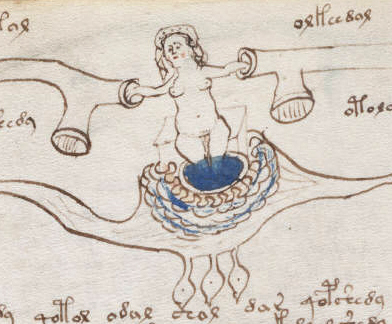
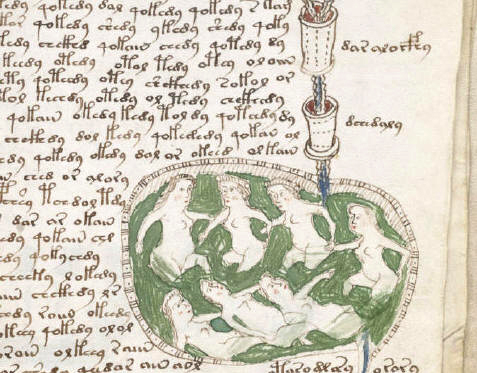
The artwork is as odd as the text. There are 113 drawings of unidentified plant species; numerous diagrams of a seemingly astronomical nature; and, most bizarrely, lots of sketches of little ladies, including “nude females emerging from pipes or chimneys” and “a biological section containing a myriad of drawings of miniature female nudes, most with swelled abdomens, immersed or wading in fluids and oddly interacting with interconnecting tubes and capsules.”

Voynich Picture

Yup. WEIRD. I love how so much of it looks so sensible. The plants look like plants that must surely exist… but they don’t. And the script looks so familiar—maybe if you squinted your eyes just so, it would all become utterly legible? And yet: TINY LADIES INTERACTING WITH TUBES.

Voynich Picture

Hmm. Your guess is as good as mine. A language lost to time? An impenetrable cipher? Or just some bored Renaissance prankster with a thing for botany and nudey pics? I’m going to bet my whimsical nickel on a Lost World theory—it’s an ancient Lonely Planet guide to some island that has long since sunk into the sea, an island where the flora was lush and the womenfolk liked to gallivant in giant tubs of green goop.

Voynich Pictures

The original document is currently housed in Yale’s Beinecke Library, and the entire manuscript has been made available online. If you enjoy amateur cryptography—or just like looking at old pictures of plants and naked people—it’s well worth checking out.

And on a somewhat related note, if you like mysteries involving codes, one of the most compelling is Australia’s 1948 ‘Tamám shud’ case, which features an unidentified man found dead on an Adelaide beach with a cryptic message hidden in his pocket; the possibility of poison; a little Cold War intrigue; and a rare New Zealand copy of The Rubaiyat. There’s a fascinating account of the story here.

Stocking Up

Please pardon our brief silence here at Malvern Books, but we’ve been terribly busy making lists. You see, while it’s possible to fill the shelves of your soon-to-open store by asking a friendly book distributor to send you their “starter kit”—presumably a bunch of bog standard* best sellers they ship to every new retailer—we decided we wanted to pick each and every title ourselves…

bookshelfYep. Every single book. Spreadsheets at the ready, book nerds! Making a list of thousands of awesome indie and small press books is immensely fun, of course (and there’s so much good stuff to choose from), but it’s also rather time-consuming. And we’re hoping to finalize most of our selections before we head to next week’s BookExpo in New York.

In the meantime, I heartily recommend you check out these fantastic presses we’ve encountered on our Excel(lent) adventures: Calamari Press for irreverent contemporary fiction; Ugly Duckling Presse for beautiful poetry in beautiful packages; Pushkin Press for classics from around the world; and Tam Tam Books for “lost masterpieces.”

* I was curious about the origins of this idiom and whether Americans use it, so I googled it and found myself at the website of this excellent campaign. Whoever came up with the name for this, ahem, movement deserves a medal.