
Poetry, L

Poetry Month is officially over, but that’s no reason to abandon our arbitrary and occasional Poetry A-Z series…

L is for Larkin, Philip

Philip Larkin. Sigh. What do we do about Philip Larkin? I want to devote the letter L to Larkin, whose poetry I adore, and yet there’s just so much… awfulness.
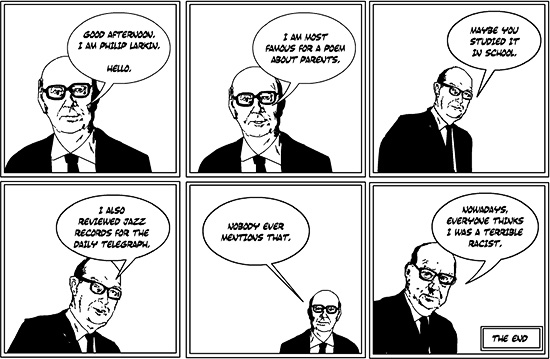
Larkin cartoon

Larkin was never an especially lovable geezer—gloomy, grumpy, and looking, as he described it, “like a balding salmon”—but prior to the publication of his Selected Letters, it was still possible to feel somewhat fond of ol’ Phil. He was just your standard British bachelor-curmudgeon-librarian, keen for a quiet life, fond of rain and queues and animals. Describing his daily routine to the Paris Review in 1982, he wrote:

My life is as simple as I can make it. Work all day, cook, eat, wash up, telephone, hack writing, drink, television in the evenings. I almost never go out. I suppose everyone tries to ignore the passing of time: some people by doing a lot, being in California one year and Japan the next; or there’s my way—making every day and every year exactly the same. Probably neither works.

The man liked to put on his egg-stained cardigan and watch a spot of telly. Nothing wrong with that! And although his most famous poem addresses the horrors of family life, there’s nothing especially strange or sinister in questioning the cycle of generational misery: the popularity of This Be the Verse suggests we all know exactly what he’s talking about.

But with the publication of the Selected Letters in 1992 and Andrew Motion’s biography, Philip Larkin: A Writer’s Life, the following year, it became clear that Larkin was not just playing the role of the cantankerous old fogey who liked to insist “I loathe abroad.” The letters made plain his rabidly right-wing political views, his misogyny, and his racism: he calls for the “stringing up” of striking miners, for instance, and adds that “the lower-class bastards can no more stop going on strike now than a laboratory rat with an electrode in its brain can stop jumping on a switch to give itself an orgasm.” He also writes of a “terrifying” future in which “we shall all be cowering under our beds as hordes of blacks steal anything they can lay their hands on.”

It was repulsive stuff indeed, and people were quick to take sides. There was a lot of quotes-at-dawn carry on. One critic insisted that Larkin couldn’t possibly be a racist because he once wrote this:

The American Negro is trying to take a step forward that can be compared only to the ending of slavery in the nineteenth century. And despite the dogs, the hosepipes and the burnings, advances have already been made towards giving the Negro his civil rights that would have been inconceivable when Louis Armstrong was a young man. These advances will doubtless continue. They will end only when the Negro is as well-housed, educated and medically cared for as the white man.

And another immediately countered with Larkin at his most vile:

We don’t go to [cricket] Test matches now, too many fucking niggers about.

Poet and critic Tom Paulin described the Letters as a “revolting compilation which imperfectly reveals the sewer under the national monument that Larkin became” and Professor Lisa Jardine referred to Larkin as a “casual, habitual racist and an easy misogynist” and noted that “we don’t tend to teach Larkin much now in my department of English. The Little Englandism he celebrates sits uneasily within our revised curriculum.” Others made excuses. Martin Amis, whose father was great pals with Larkin, suggested the letters merely reveal “a tendency for Larkin to tailor his words according to the recipient.” In his letters to Amis père, Larkin always signed off with some variation of the word bumC. H. Sisson bum; Penguin Book of Contemporary British Poetry bum—but it’s rather a leap to suggest that adding an impish bum to the end of a letter is akin to chucking about a few n-words. Yes, we all write things in confidence that we would never say in public, but I’m pretty sure most of us have never written a letter to anyone (not even to Racist Aunt Gladys) in which we refer to “hordes” or “lower-classes.” Some might insist that such sentiments were commonplace back then, to which I would gleefully reply, well, then fuck the lot of them, the mid-century toerags. In any case, this it was different back then stuff is a load of nonsense—the language Larkin used may have read as slightly less shocking at the time, but there’s no denying that his remarks were considered racist by his contemporaries. Many of Larkin’s friends were horrified by the opinions he expressed in private, and Motion says that Larkin was “very unrepentant about his attitudes” and made no special effort to avoid discussing them, even when it was clear they offended the listener.

Philip LarkinSo, what to make of it all? Do we simply dismiss Larkin as a hateful racist? Or do we ignore the personal (“hey, he wasn’t as bad as Pound!”) and concentrate on the poetry? Motion writes that “the beautiful flower of art grows on a long stem out of often murky material,” and this kind of uneasy admission is perhaps the best we can do. And yet—it doesn’t seem quite enough to say “Okay, yes, Larkin was a bit of a racist; now here are some lovely poems!” Much of Larkin’s appeal comes from his ability to capture the oppressive, dreary pointlessness of life in a post-war England that has lost its faith—that is, ordinary life, lived by ordinary people. As poet X. J. Kennedy states in the New Criterion, Larkin gives us “a poetry from which even people who distrust poetry, most people, can take comfort and delight.” But who are these ordinary people Larkin writes for and about? If he’s racist, misogynistic, and a snob, are his “ordinary people” all middle-class white men? Is he writing for me, too? Do I really want to read a “deeply moving” poem by someone who perhaps suspects that significantly more than half the population is incapable (or undeserving?) of being moved? When I picture Kingsley Amis and Larkin writing sniggery, right-wing, posh-voiced bums to each other, I want to punch them both hard in their ruddy little noses. And yet—

Here I am joining the “Larkin was a bit of a racist; now here are some lovely poems!” chorus, and feeling, yes, very uneasy about it. The best I can do to mitigate the queasiness is present the two Mr. Larkins side by side:

If you skip to the 43:50 mark of Life and Death in Hull (a mildly interesting doco), you can listen to Larkin and his girlfriend singing a little Larkin ditty. If you hear this and still wish to defend Larkin on the grounds that this was done in private (but recorded, do note), or that it’s just meant to be, you know, funny, well, you might not want to invite me to your next dinner party, because I’m not going to laugh at your jokes.

And now here’s the other Larkin, the one I like very much. I’ll leave it to you to try and reconcile the two.

Next, Please

Always too eager for the future, we
Pick up bad habits of expectancy.
Something is always approaching; every day
Till then we say,

Watching from a bluff the tiny, clear,
Sparkling armada of promises draw near.
How slow they are! And how much time they waste,
Refusing to make haste!

Yet still they leave us holding wretched stalks
Of disappointment, for, though nothing balks
Each big approach, leaning with brasswork prinked,
Each rope distinct,

Flagged, and the figurehead with golden tits
Arching our way, it never anchors; it’s
No sooner present than it turns to past.
Right to the last

We think each one will heave to and unload
All good into our lives, all we are owed
For waiting so devoutly and so long.
But we are wrong:

Only one ship is seeking us, a black-
Sailed unfamiliar, towing at her back
A huge and birdless silence. In her wake
No waters breed or break.

* * *

The Trees

The trees are coming into leaf
Like something almost being said;
The recent buds relax and spread,
Their greenness is a kind of grief.

Is it that they are born again
And we grow old? No, they die too. 
Their yearly trick of looking new
Is written down in rings of grain.

Yet still the unresting castles thresh
In fullgrown thickness every May.
Last year is dead, they seem to say,
Begin afresh, afresh, afresh.

* * *

Aubade

I work all day, and get half-drunk at night.
Waking at four to soundless dark, I stare.
In time the curtain-edges will grow light.
Till then I see what’s really always there:
Unresting death, a whole day nearer now,
Making all thought impossible but how
And where and when I shall myself die.
Arid interrogation: yet the dread
Of dying, and being dead,
Flashes afresh to hold and horrify.

The mind blanks at the glare. Not in remorse
—The good not done, the love not given, time
Torn off unused—nor wretchedly because
An only life can take so long to climb
Clear of its wrong beginnings, and may never;
But at the total emptiness for ever,
The sure extinction that we travel to
And shall be lost in always. Not to be here,
Not to be anywhere,
And soon; nothing more terrible, nothing more true.

This is a special way of being afraid
No trick dispels. Religion used to try,
That vast moth-eaten musical brocade
Created to pretend we never die,
And specious stuff that says No rational being
Can fear a thing it will not feel, not seeing
That this is what we fear—no sight, no sound,
No touch or taste or smell, nothing to think with,
Nothing to love or link with,
The anaesthetic from which none come round.

And so it stays just on the edge of vision,
A small unfocused blur, a standing chill
That slows each impulse down to indecision.
Most things may never happen: this one will,
And realisation of it rages out
In furnace-fear when we are caught without
People or drink. Courage is no good:
It means not scaring others. Being brave
Lets no one off the grave.
Death is no different whined at than withstood.

Slowly light strengthens, and the room takes shape.
It stands plain as a wardrobe, what we know,
Have always known, know that we can’t escape,
Yet can’t accept. One side will have to go.
Meanwhile telephones crouch, getting ready to ring
In locked-up offices, and all the uncaring
Intricate rented world begins to rouse.
The sky is white as clay, with no sun.
Work has to be done.
Postmen like doctors go from house to house.
Thursday Three #9

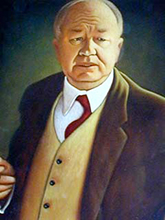
American poet Theodore Roethke died fifty years ago today. He had a heart attack at the age of fifty-five while swimming in a pool on Bainbridge Island, across Puget Sound from Seattle. Legend has it he’d lined the poolside with mint juleps and was rewarding himself with a drink after each lap. Let’s dedicate today’s Thursday Three—our weekly assortment of literary loveliness in triplicate—to three of his best poems.

Roethke1. Roethke’s father was a market gardener in Saginaw, Michigan, and much of Roethke’s childhood was spent mucking about in his father’s twenty-five-acre greenhouse, which sounds rather idyllic, if you like humidity and gardening. Many years later, Roethke published a series of poems known as “the greenhouse poems” (found in his second collection, The Lost Son and Other Poems, 1948), and this series came to be regarded by critics as Roethke’s artistic breakthrough. Roethke himself said that his first collection was “too wary,” and that the greenhouse poems were intended to have “greater intensity and symbolic depth.” The poems are distinguished from your usual soppy nature poems by their celebration of human effort—beauty is not always something that happens by chance—and by their wonder at even the most mundane and repellent of natural processes.

Big Wind

Where were the greenhouses going,
Lunging into the lashing
Wind driving water
So far down the river
All the faucets stopped?—
So we drained the manure-machine
For the steam plant,
Pumping the stale mixture
Into the rusty boilers,
Watching the pressure gauge
Waver over to red,
As the seams hissed
And the live steam
Drove to the far
End of the rose-house,
Where the worst wind was,
Creaking the cypress window-frames,
Cracking so much thin glass
We stayed all night,
Stuffing the holes with burlap;
But she rode it out,
That old rose-house,
She hove into the teeth of it,
The core and pith of that ugly storm,
Ploughing with her stiff prow,
Bucking into the wind-waves
That broke over the whole of her,
Flailing her sides with spray,
Flinging long strings of wet across the roof-top,
Finally veering, wearing themselves out, merely
Whistling thinly under the wind-vents;
She sailed until the calm morning,
Carrying her full cargo of roses.

2. Roethke avoided the tedium of office work—he dropped out of law school to study literature–but institutions were familiar to him: he was hospitalized on several occasions for bipolar disorder. “Dolor” (also from The Lost Son) reminds me of Larkin, who was surely rather familiar with the sadness of pencils.

Dolor

I have known the inexorable sadness of pencils,
Neat in their boxes, dolor of pad and paper-weight,
All the misery of manilla folders and mucilage,
Desolation in immaculate public places,
Lonely reception room, lavatory, switchboard,
The unalterable pathos of basin and pitcher,
Ritual of multigraph, paper-clip, comma,
Endless duplicaton of lives and objects.
And I have seen dust from the walls of institutions,
Finer than flour, alive, more dangerous than silica,
Sift, almost invisible, through long afternoons of tedium,
Dropping a fine film on nails and delicate eyebrows,
Glazing the pale hair, the duplicate grey standard faces.

3. “The Far Field” is the title poem from Roethke’s final collection, published posthumously in 1964. A year before his death, Roethke told a friend that The Far Field would probably be his final book, and the collection does have “a strange air of unconscious preparation” and a greater sense of mysticism than his earlier work. I especially love the final stanza, a calm and tender catalog of “finite things.”

The Far Field

1
I dream of journeys repeatedly:
Of flying like a bat deep into a narrowing tunnel,
Of driving alone, without luggage, out a long peninsula,
The road lined with snow-laden second growth,
A fine dry snow ticking the windshield,
Alternate snow and sleet, no on-coming traffic,
And no lights behind, in the blurred side-mirror,
The road changing from glazed tarface to a rubble of stone,
Ending at last in a hopeless sand-rut,
Where the car stalls,
Churning in a snowdrift
Until the headlights darken.

2
At the field’s end, in the corner missed by the mower,
Where the turf drops off into a grass-hidden culvert,
Haunt of the cat-bird, nesting-place of the field-mouse,
Not too far away from the ever-changing flower-dump,
Among the tin cans, tires, rusted pipes, broken machinery,—
One learned of the eternal;
And in the shrunken face of a dead rat, eaten by rain and ground-beetles
(I found it lying among the rubble of an old coal bin)
And the tom-cat, caught near the pheasant-run,
Its entrails strewn over the half-grown flowers,
Blasted to death by the night watchman.

I suffered for birds, for young rabbits caught in the mower,
My grief was not excessive.
For to come upon warblers in early May
Was to forget time and death:
How they filled the oriole’s elm, a twittering restless cloud,
      all one morning,
And I watched and watched till my eyes blurred from the bird shapes,—
Cape May, Blackburnian, Cerulean,— 
Moving, elusive as fish, fearless,
Hanging, bunched like young fruit, bending the end branches,
Still for a moment,
Then pitching away in half-flight,
Lighter than finches,
While the wrens bickered and sang in the half-green hedgerows,
And the flicker drummed from his dead tree in the chicken-yard.

—Or to lie naked in sand,
In the silted shallows of a slow river,
Fingering a shell,
Thinking:
Once I was something like this, mindless,
Or perhaps with another mind, less peculiar;
Or to sink down to the hips in a mossy quagmire;
Or, with skinny knees, to sit astride a wet log,
Believing:
I’ll return again,
As a snake or a raucous bird,
Or, with luck, as a lion.

I learned not to fear infinity,
The far field, the windy cliffs of forever,
The dying of time in the white light of tomorrow,
The wheel turning away from itself,
The sprawl of the wave,
The on-coming water.

3
The river turns on itself,
The tree retreats into its own shadow.
I feel a weightless change, a moving forward
As of water quickening before a narrowing channel
When banks converge, and the wide river whitens;
Or when two rivers combine, the blue glacial torrent
And the yellowish-green from the mountainy upland,— 
At first a swift rippling between rocks,
Then a long running over flat stones
Before descending to the alluvial plain,
To the clay banks, and the wild grapes hanging from the elmtrees.
The slightly trembling water
Dropping a fine yellow silt where the sun stays;
And the crabs bask near the edge,
The weedy edge, alive with small snakes and bloodsuckers,— 
I have come to a still, but not a deep center,
A point outside the glittering current;
My eyes stare at the bottom of a river,
At the irregular stones, iridescent sandgrains,
My mind moves in more than one place,
In a country half-land, half-water.

I am renewed by death, thought of my death,
The dry scent of a dying garden in September,
The wind fanning the ash of a low fire.
What I love is near at hand,
Always, in earth and air.

4
The lost self changes,
Turning toward the sea,
A sea-shape turning around,— 
An old man with his feet before the fire,
In robes of green, in garments of adieu.

A man faced with his own immensity
Wakes all the waves, all their loose wandering fire.
The murmur of the absolute, the why
Of being born fails on his naked ears.
His spirit moves like monumental wind
That gentles on a sunny blue plateau.
He is the end of things, the final man.

All finite things reveal infinitude: 
The mountain with its singular bright shade
Like the blue shine on freshly frozen snow,
The after-light upon ice-burdened pines;
Odor of basswood on a mountain-slope,
A scent beloved of bees;
Silence of water above a sunken tree:
The pure serene of memory in one man,—
A ripple widening from a single stone
Winding around the waters of the world.

Let’s Talk About Book Club

The impossible has happened: I’ve joined a book club. I’ve always been of the firm and sensible opinion that Clubs = EW!, but when someone in my giant apartment complex sent out an email asking if anyone would be interested in starting a book group, I decided to ignore my sophisticated knee-jerk reaction (HA! HA! HA! FIDDLE WHILE ROME BURNS, YOU MIDDLE-CLASS FOOLS! DON’T YOU MEAN YOUR KINDLE GROUP, HA HA HEE HAW HOOOO) and instead do the grown-up thing: I made a Pros and Cons list.

Book Club

Reasons not to join Book Club:

  • We’ll have to discuss books. I hate discussing books. I’m terrible at it. I can give you a decent description of the cover—”The cover depicts a middle-aged woman enjoying some fruit”—but that’s about it. Themes, metaphor, symbolism, I’m rubbish at the lot. Especially symbolism. I’m symbolism-blind. Show me a giant mythological bird emerging from a heap of feathery ashes and I’ll say, “Gosh, that owl’s bum must be hot!” In part, this is because I am dim. In another part, this is because symbolism is stupid. True story: I once heard a Very Famous Author scream at a Very Earnest Student because the student wanted to know why the kitchen cupboards in the VFA’s story were yellow. “They’re yellow because they’re yellow!!!” the VFA bellowed. This has become my standard response in all discussions concerning symbolism—“They’re yellow because they’re yellow!!!” I bellow—and I fear that such a remark at Book Club will be upsetting to all present.
  • We’ll have to discuss not-books. We’ll have to discuss food coloring, curtain whatsits, Mark Bloody Bittman, toddlers, plants, and whatever creepily smooth rectangle Apple has released that minute. I am rubbish at all these conversations. I’m very good at the What Kinds Of Strange Noises Can You Make With Your Mouth? conversation—you should hear my Fshhhhheshsh!—but the only other people who seem to enjoy this conversation are my boyfriend’s ten-year-old nephew and my cats. (Tracey! You are wrong about the types of things that cats are!)
  • The books will be awful. I’ll have to read Wally Lamb. I’ll have to read a touching story about a woman who moves back home to Ballsack, Iowa, after her father carks it in a grain elevator incident. I’ll have to read a touching story about a man who loses his right arm to wasps but learns to love again (but not wasps, obv). I’ll have to read a touching story about a businessman who decapitates a vagrant.
  • When it’s my turn to host Book Club, people will find out I have three cats. Any social progress I have made in the giant apartment complex will be immediately undone. Also, one of the cats is fat and known to be ruthless in her pursuit of pastries. What if this cat blinds one of my guests? Awk.
  • What if I have to do a poo at Book Club? Will I be able to do this in a stranger’s home? Or can I excuse myself—“I think I left the gas on!” (metaphor?)—go home, toilet myself, and then return without raising suspicion?
  • What if I have to bake a pie? What if someone asks me to bring a rice pilaf? I hate cooking. Hate it. Also, my eating disorder (we’ll call it fusspotexia) means there are only three items on my Foods I Can Eat list—rolled oats, Eggo Drizzlers, and bananas—and these delicious foods are seldom served at social gatherings (except at my house, because I know how to party). When I receive an invitation to a potluck dinner, I respond, “Thank you for inviting me to your upcoming potluck dinner. I will not be bringing any food to your potluck dinner, but I also will not be eating any of the food at your potluck dinner, so I believe we will be even vis-à-vis food. See you soon, my friend!” All in all, it is better if I stay inside my home.

Reasons to join Book Club:

  • Maybe someone will finally be able to tell me, once and for all, if it’s true that the security guard sometimes does a wee in the recycling room.
  • Might make a friend? I’ve recently noticed that many of my dearest friends live very far away (coincidence?). Also, I’ve started treating my cats like my dearest friends. In some ways this is not so strange—many people talk to their pets about the day’s events, no?—but in some other ways this is very strange indeed. For example, it is possibly very strange to tell people that one of your cats has signed up for a night class on How To Use Human Cutlery. Long story short: I could probably use a few new pals, especially now that The Colonel will be out on Wednesday evenings.

So I came up with more Cons than Pros, but that final Pro is a pretty big deal: even oat-eating, fur-covered dingbats need a few chums nearby. And thus I find myself responding SURE, I GUESS to Book Club. I will turn up empty-handed, wearing a Nil By Mouth sticker, and ready to offer such bon mots as, “Well, um, I quite liked it.” I will leave in the middle for about ten minutes and return with a relieved smile. “Gas crisis averted!” I will say (metaphor?). And I will try not to make strange noises with my mouth. I expect it will all be quite marvelous.

Shiny New Things

Hope your Monday is merry, Malvernians! I’m sure you’re all anxious to hear news of the impending royal sprog (boy? girl? otter? named Harold? Diana? Steve McTits?). Allow me to distract you with birth news of a non-icky, non-inbred sort: Malvern Books recently gave birth to a page. (Okay, still kind of ew.) Yes, this amenable little blog has slid quietly over to the right to make way for a new home page. The home page might be looking rather… homely at the moment, but we’re working on it, and once the store is open you’ll find all sorts of useful info there, including the boring stuff (our location, hours, and rules concerning the use of remote control helicopters) and the really interesting stuff (new books in store, staff recommendations, events).

And speaking of events, we have a page for that, too. Be sure to check the calendar for details of all our upcoming shenanigans—or, better yet, sign up for our weekly newsletter; the sign up form is over there in the sidebar, waiting patiently to take your email address (which, of course, we will guard with our lives and use only for sensible newsletter purposes). Events are going to be a Very Big Deal at Malvern Books, and we plan on hosting a reading most nights of the week. If you’d like to get in touch with us regarding staging your own performance (preferably of a literary nature, though you’re welcome to try us on your nude yodeling shtick), please do email us. It’s never too early to begin planning your Malvern debut.

Malvern Stage

And an events page needs an events stage! The stage area (pictured above, with the mushroom wood walls) is pretty much done. And no, we haven’t opted for that ironic papery flooring all the kids are pinteresting—we’re just protecting our nice bamboo and marmoleum* while we continue to slap on the feisty blue paint (let’s call the color Malvern at Midnight).

* Marmoleum is the perfect name for a baby otter. Just saying.

Thursday Three #8

In today’s Thursday Three, our weekly assortment of oddities in triplicate, please allow me to recommend to you (forcefully, but with love) three splendid short story collections. And for those of you about to head off on summer vacation, may I also point out that a volume of short stories makes for better holiday reading material than a novel. After all, beachy book time is always less plentiful than you imagine—there are naps to be napped, and so many drowning children to be rescued—and even if you manage to secure for yourself seventeen peaceful minutes, your concentration will be pretty much ruined by the constant urge to scratch at the mosquito bites on your ankles. You’re never going to get through a doorstopper like The Marriage Plot (you’re not missing much), but you can always sneak in a couple of short stories between spells of wilty heatstroke.

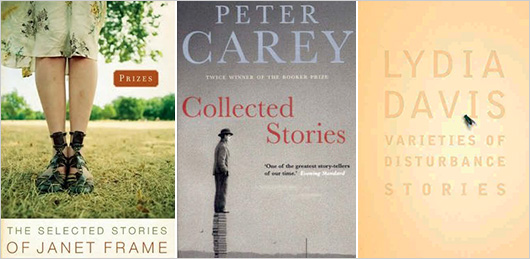
Short Stories

1. Prizes: The Selected Stories of Janet Frame. That cover! Lawks-a-lordy, what tosh! Apparently the design process went something like this:

Cover designer: Who do we have here? Janet Something? It’s a lady! Rightio. Ladies get pictures of shoes and legs. Add a dress and some feisty black sandals and we’re done!
Sensible person: Er, but Janet Frame isn’t exactly chick lit. She’s, like, a serious writer. People talked about her as a Nobel Prize contender.
Cover designer: Oh dear. I am completely at a loss now. Possibly I will have to abandon my tired old ways and completely rethink my approach to—oh wait, I’ve got it! I’ll make her legs a bit dirty and wrinkle her dress. Who’s a serious young lady now, hmm?

Ah well, I’ve seen worse. And although the cover may be a tad shite, the stories inside are brilliant. Here’s the opening paragraph of “Prizes,” which first appeared in a 1962 issue of the New Yorker:

Life is hell, but at least there are prizes. Or so one thought. One knew of the pit ahead, of the grownups lying there rewarded, arranged, and faded, who were so long ago bright as poppies. One learned to take one’s own deserved place on the edge, ready to leap, not to hang back in a status-free huddle where bodies were warm together and the future darkness seemed less frightening. Therefore, one learned to win prizes, to be surrounded in sleep by a dream of ordinal numbers, to stand in best clothes upon platforms in order to receive medals threaded upon black-and-gold ribbons, books “bound in calf,” scrolled certificates. One’s face became, from habit, incandescent with achievement.

Wonderful, yes? Israeli writer Etgar Keret, himself no slouch in the story-writing department, is a big Frame fan: he nominated her “My Last Story” for his Recommended Reading pick. Frame’s strange, beautiful stories are laced with gloomy nostalgia and the slyly hilarious observations of a weirdo genius. Perfect holiday reading if you’re going on a cruise with a bunch of relatives whom you loathe and feel superior to.

2. Peter Carey’s Collected Stories. One reviewer likens reading Carey’s stories to “being shot by a firing squad of angels,” and that’s a pretty apt description. As an example of death-by-beauty, here’s the final paragraph of “The Chance”:

But I, I’m a crazy old man, alone with his books and his beer and his dog. I have been a clerk and a pedlar and a seller of cars. I have been ignorant, and a scholar of note. Pock-marked and ugly I have wandered the streets and slept in the parks. I have been bankrupt and handsome and a splendid conman. I have been a river of poisonous silver mercury, without form or substance, yet I carry with me this one pain, this one yearning, that I love you, my lady, with all my heart. And on evenings when the water is calm and the birds dive amongst the white-bait, my eyes swell with tears as I think of you sitting on a chair beside me, weeping in a darkened room.

Carey has mastered the essential sci-fi writers’ trick: he presents his unlikely worlds with utter confidence, and we never think to question his logic or doubt his details. He shows us an America where shadows are sold in lavish boxes, and introduces us to an unhappy shepherd who must keep alive a flock of suicidal horses. And in my favorite story in the collection, “Do You Love Me?,” we meet the Cartographers, whose job it is to document a disappearing world where unloved people and places begin, quite literally, to fade away, “like the image on an improperly fixed photograph.”

3. Lydia Davis’ Varieties of Disturbance. Or any Lydia Davis short story collection. Take your pick. They’re all brilliant, funny, moving, and sublime. I picked Varieties of Disturbance because it has a fly on the cover, and because it contains the excellent “Kafka Cooks Dinner” (for Milena, naturally), the best Kafka story Kafka never wrote:

I know beet salad would be better. I could give her beets and potatoes both, and a slice of beef, if I include meat. Yet a good slice of beef does not require any side dish, it is best tasted alone, so the side dish could come before, in which case it would not be a side dish but an appetizer. Whatever I do, perhaps she will not think very highly of my effort, or perhaps she will be feeling a little ill to begin with and not stimulated by the sight of those beets. In the case of the first, I would be dreadfully ashamed, and in the case of the second, I would have no advice—how could I?—but just a simple question: would she want me to remove all the food from the table?

It ends with “Someone once said that I swim like a swan, but it was not a compliment.” (You can read the entire story online here.)

It would be impossible for me to overstate how much I admire and envy Lydia Davis’ prose. She is the best. She is just the best. If a literary genie jumped out of a gin bottle and offered me the chance to write like anyone alive, I would say, “Oh, make me Lydia Davis, please!” (And then I would sit down at my desk and write a devastating prose poem entitled “Paul Auster’s Hair.”) Here are two of her stories in their entirety, one funny (because she is the best at funny), and one sad (because she is the best at sad):

The Good Taste Contest

The husband and wife were competing in a Good Taste Contest judged by a jury of their peers, men and women of good taste, including a fabric designer, a rare-book dealer, a pastry cook, and a librarian. The wife was judged to have better taste in furniture, especially antique furniture. The husband was judged to have overall poor taste in lighting fixtures, tableware, and glassware. The wife was judged to have indifferent taste in window treatments, but the husband and wife both were judged to have good taste in floor coverings, bed linen, bath linen, large appliances, and small appliances. The husband was felt to have good taste in carpets, but only fair taste in upholstery fabrics. The husband was felt to have very good taste in both food and alcoholic beverages, while the wife had inconsistently good to poor taste in food. The husband had better taste in clothes than the wife though inconsistent taste in perfumes and colognes. While both husband and wife were judged to have no more than fair taste in garden design, they were judged to have good taste in number and variety of evergreens. The husband was felt to have excellent taste in roses but poor taste in bulbs. The wife was felt to have better taste in bulbs and generally good taste in shade plantings with the exception of hostas. The husband’s taste was felt to be good in garden furniture but only fair in ornamental planters. The wife’s taste was judged consistently poor in garden statuary. After a brief discussion, the judges gave the decision to the husband for his higher overall points score.

* * *

Head, Heart

Heart weeps.
Head tries to help heart.
Head tells heart how it is, again:
You will lose the ones you love. They will all go. But even the earth will go, someday.
Heart feels better, then.
But the words of head do not remain long in the ears of heart.
Heart is so new to this.
I want them back, says heart.
Head is all heart has.
Help, head. Help heart.

Poetry, K

Poetry Month is officially over, but that’s no reason to abandon our arbitrary and occasional Poetry A-Z series…

K is for Kaminsky, Ilya

Ilya KaminskyIlya Kaminsky was born in Odessa, former Soviet Union, in 1977. Although his early years were fairly peaceful (largely because his wealthy father was able to secure his family’s safety by bribing state officials), life in Odessa became increasingly difficult following the dissolution of the Union of Soviet Socialist Republics in 1991. Political unrest, galloping inflation, and the outbreak of war in neighboring Moldova prompted the family to apply for political asylum in the United States. In 1993, the U.S. approved their application, and sixteen-year-old Ilya and his parents moved to Rochester, New York. Kaminsky’s father died the following year.
When he was a child, Kaminsky had written short prose articles for Odessa newspapers, but after his father’s death he found himself drawn to poetry as a way to make sense of the loss. Although he claims he “hardly knew the English alphabet” when he first arrived in the United States, he began to write poems in English. In an interview with the Adirondack Review, he explains this decision:

My father died in 1994, a year after our arrival to America. I understood right away that it would be impossible for me to write about his death in the Russian language, as one author says of his deceased father somewhere, “Ah, don’t become mere lines of beautiful poetry!” I chose English because no one in my family or friends knew it—no one I spoke to could read what I wrote. I myself did not know the language. It was a parallel reality, an insanely beautiful freedom. It still is.

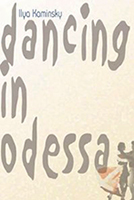
Dancing in OdessaKaminsky’s first poetry collection, Dancing in Odessa, was published by Tupelo Press in 2004. It earned accolades from assorted fancy folks—Anthony Hecht proclaimed the volume “the start of a brilliant career,” while Robert Pinsky praised the poems’ “glorious tilt and scope”—and was named Poetry Book of the Year by ForeWord magazine. Following the book’s publication, Kaminsky also received the Whiting Writer’s Award, the Ruth Lilly Fellowship from Poetry magazine, the American Academy of Arts and Letters’ Metcalf Award in Literature, and a Lannan Literary Fellowship.

Kaminsky lost his hearing when he was four (a rare complication of mumps), and he sees a link between his deafness and his desire to be heard: “I speak against silence, and again, against silence, knowing that silence moves me to speak.” In Dancing in Odessa, he speaks not only for himself, but for all those who have suffered dislocation and loss. His poetry is deft, musical, and passionate: it engages with the world and is unashamedly sincere. He is often considered a “political” poet, but Kaminsky simply sees himself as an attentive observer of the world, and is quick to shrug off questions concerning his agenda:

I write about life and death. Some people call that politics. Other people call that life and death. I don’t know why in [the United States] we need to ask each other these questions. Writers in Russia or South Africa or Poland or China don’t, since the answer seems self-explanatory.

Yes, poetry is poetry, an art of language. And, yes, we live in the larger world; our job as human beings is to pay attention to that world. As human beings we are all responsible, as Dostoevsky suggests: “Not everyone is guilty, but everyone is responsible.”

Kaminsky currently teaches English and Comparative Literature at San Diego State University, and is working on his second collection, tentatively titled Deaf Republic (Poetry has published a selection of these not-quite-done poems). Meanwhile, here are two of my favorite (finished) Kaminsky poems:

Elegy for Joseph Brodsky

1.
In plain speech, for the sweetness
between the lines is no longer important,
what you call immigration I call suicide.
I am sending, behind the punctuation,
unfurling nights of New York, avenues
slipping into Cyrillic—
winter coils words, throws snow on a wind.
You, in the middle of an unwritten sentence, stop,
exile to a place further than silence.

2.
I left your Russia for good, poems sewn into my pillow
rushing towards my own training
to live with your lines
on a verge of a story set against itself.
To live with your lines, those where sails rise, waves
beat against the city’s granite in each vowel,—
pages open by themselves, a quiet voice
speaks of suffering, of water.

3.
We come back to where we have committed a crime,
we don’t come back to where we loved, you said;
your poems are wolves nourishing us with their milk.
I tried to imitate you for two years. It feels like burning
and singing about burning. I stand
as if someone spat at me.
You would be ashamed of these wooden lines,
how I don’t imagine your death
but it is here, setting my hands on fire.

* * *

We Lived Happily During the War*

And when they bombed other people’s houses, we

protested
but not enough, we opposed them but not

enough. I was
in my bed, around my bed America

was falling: invisible house by invisible house by invisible house.

I took a chair outside and watched the sun
                                                        in the sixth month
of a disastrous reign in the house of money

in the street of money in the city of money, in the country of money,
our great country of money, we (forgive us)

lived happily during the war.

* from I Go to the Ruined Place, an anthology of poetry in defense of global human rights