Remembering Bodom

Today Malvern’s metal connoisseur, Adam, introduces us to…

Children of BodomChildren of Bodom is one of the most musically eclectic bands in the genre of heavy metal. The lead attraction of this band is the combination of the frenzied, technical guitar solos of vocalist/guitarist Alexi Laiho with the sophisticatedly complex keyboard solos of keyboard player Janne Wirman. The other members of this quintet are Roope Latvala on rhythm guitar, Henkka Seppala on bass guitar, and Jaska Rattikainen on drums. The band has incorporated many different musical styles, including melodic death metal, power metal, thrash metal, black metal, and even old school neoclassical metal. They were formed in Espoo, Finland, in 1993 and have nine albums to their name as of this date. They are also one of Finland’s best-selling artists of all time, having sold more than 250,000 records there alone.

Children of Bodom’s name derives from a series of violent murders that occurred in Finland during the 1960s at a location called Lake Bodom. The murders were soon to be dubbed the Lake Bodom murders. Lake Bodom is a lake by the city of Espoo, about 14 miles west of the country’s capital, Helsinki. In the early hours of June 5, 1960, four teenagers were camping on the shores of Lake Bodom. Between 4am and 6am, an unknown person or persons murdered three of them with a knife and blunt instrument, and wounded the fourth. The sole survivor, Nils Willhelm Gustaffason, led a normal life until 2004, when he became a suspect and was subsequently charged. In October 2005, a district court found Gustafsson not guilty of all charges against him. The murder victims in this case were Maili Irmeli Björklund, 15 years old, Anja Tuulikki Mäki, also 15 years old, and Seppo Antero Boisman, 18 years old.

Children of Bodom have stirred up quite a deal of controversy over their name. The band’s members maintain that their name is not meant in any way to glorify or admire the horrific acts that transpired at Lake Bodom, but is an homage and tribute to the memory of the victims who tragically lost their lives. Whether one likes their name or not, however, one thing that cannot be disputed is the band’s extraordinary talent at combining heavy, aggressive sounding rhythms and vocal patterns with intricate and melodic musical pieces.

Their most notable album is still to this day their third album, which is entitled Follow the Reaper. With classic songs such as “Hate Me,” “Bodom After Midnight,” and the highly memorable “Everytime I Die,” Children of Bodom succeed in creating a musical masterpiece with this album.

“Everytime I Die” portrays a rather dark side of the lead singer Alexi Laiho. Laiho is known to have had a difficult life growing up. He was apparently physically abused by people at his school as well as his father. He at one point developed a serious addiction to alcohol and pills, which almost cost him his life. It was suspected that he might have been trying to commit suicide when this occurred by ingesting a large concoction of pills with a bottle of Vodka. The song “Everytime I Die” seems to be a portrayal of the painful emotions Laiho felt as he was being forced to endure mistreatment and was suffering from a serious addiction to pills and alcohol. A memorable passage from the song that serves as the chorus says:

Another night, another demise
Cadaverous wind blowing cold as ice
I’ll let the wind blow out the light
Because it gets more painful every time I die

Needless to say, Laiho was saved and as a result went on to create the legendary heavy metal band Children of Bodom. The lyrics of his songs portray the despair and pain he felt throughout his life in a clear way. Since the release of Follow the Reaper, Children of Bodom has gone on to record six more albums. The band still tours and is planning on putting out another album in the near future. The metal music world can do nothing but wait in intense anticipation for this exceptionally talented metal quintet’s next release.

Christ on Toast

ToastA few years ago, my friend Tim and I set ourselves the task of reading the bible and blogging about it. We only made it as far as the first Book of Samuel—it’s quite a task, poking fun at every burning dove and talking ass you come across—but I learned a lot along the way. For example, did you know that every rainbow is an apology from God? Mopping up after the great flood, God saw that it was muddy, and he was ashamed, so he made a solemn vow to Noah (Genesis 9:12):

I establish my covenant with you: never again will all life be cut off by the waters of a flood; never again will there be a flood to destroy the earth. This is the sign of the covenant I am making between me and you and every living creature with you, a covenant for all generations to come: I have set my rainbow in the clouds, and it will be the sign of the covenant between me and the earth.

So every time you look up in the sky and see a rainbow, it’s a reminder of God’s great promise—a promise to never again try and destroy you! Sweet! If you run a Christian supplies store, you might consider stocking this awesome celebratory poster I made:

rainbow

The bible is gloriously batty, and I highly recommend it for your next book group (I’m pretty sure it’s Oprah-approved). Here’s our take on Deuteronomy 22-24, in which Moses declares a bunch of minor laws (it will make more sense if you read the real deal first):

Oh Moses, you gorgeous madman, on and on you go. You’ve said all there is to say about idolatry and warfare, and now you’re dishing out God’s holy oddments. First up, be kind to cows. If a cow gets lost, help it to find its way home again. Be kind to donkeys, too. If a donkey stumbles under a heavy load and falls into a ditch, don’t laugh at it or call it a great gray fool. Don’t poke it with a stick. Join forces with your neighbors and get that poor ass back on its feet.

Men, don’t be wearing lady costumes. And gals, let the men wear the pants. The Lord doth hate a transvestite:

The woman shall not wear that which pertaineth unto a man, neither shall a man put on a woman’s garment: for all that do so are abomination unto the LORD thy God.

If you come across a bird’s nest in a tree or on the ground, feel free to eat the eggs, or kill any little baby birdies, but don’t mess with the mother bird:

Let her go free, and the LORD will bless you with a long and successful life.

Not a day goes by without some idiot falling off a roof. The Lord is heartily sick of this nonsense. If your house has a flat roof, could you please build a wall around the edge. Thanks.

Girlfriend, keep an eye on that husband of yours. If he grows tired of you, he may try to ruin your honor by claiming you weren’t a virgin when you married. If this happens, there’s only one thing for it: your parents must show the town’s leaders the sheets you bloodied on your wedding night. If you threw away those sheets, or maybe washed them, then I’m afraid your husband’s accusation will stand, and you’ll be stoned to death, you wee scallywag.

Surely the women of Israel are incensed by this law? After all, they’ve read every issue of Twelve (the lower life-expectancy Seventeen), and they know it’s, like, totally easy to accidentally bust your hymen whilst climbing a tree, or riding a donkey, or pulling a donkey out of a ditch. That doesn’t mean you’re not a virgin! “Leading a lost cow home through a field, I slipped and sacrificed my maidenhead to a fencepost… are you telling me I deserve a good stoning?” She asks a fair question, Mo, but I can’t imagine you have much sympathy. Perhaps you stare down at your sandals, blushing, as you advise all women to remain as still as possible until they get married. Mind your hymens, ladies!

Men, don’t think your genitals have escaped God’s pervy eye. If your private parts have been cut off, or even if they’re just a bit squishy, I’m afraid God doesn’t want to know you:

He that is wounded in the stones, or hath his privy member cut off, shall not enter into the congregation of the LORD.

Soldiers, keep your camp clean. If the Lord’s told you once, he’s told you a thousand times: don’t shit on the grass. When thou wilt ease thyself abroad, for heaven’s sake dig a hole. If the Lord pops by for a visit and there are great big steaming piles of turd lying around all over the place, well, he won’t be staying for a cup of tea.

Have you been cautioned against wet dreams, that uncleanness that chanceth upon you by night? They create a lot of unnecessary bother, so try not to have them. Don’t be cruel to runaway slaves. Don’t visit temple prostitutes. And would you please stop kidnapping one another, you ratbags!

If you lend money to a fellow Israelite, you mustn’t charge him any interest. It’s okay to take something of his as a guarantee that he’ll pay you back, but don’t keep anything he really needs. If you take his only coat, for instance, you mustn’t keep it overnight. Give it back before the sun goes down, so the poor chap won’t freeze to death. It will be hugely time-consuming and inconvenient, having to visit all your debtors twice a day to collect and return their coats. This is not the Lord’s problem.

When you harvest your grain or pick your olives, don’t be too thorough about it; make sure you leave a few scraps behind for poor people. Poor people enjoy a good scavenge; it takes their minds off the hunger.

And on and on and on it goes. Are the children of Israel listening, Moses? Does God still speak to you, or are you just making this shit up?

Wonders of Weatherfield

It’s hard for me to concentrate today, because I’m worried about the fire. Karl tried to burn down the pub on Monday night, and Stella and Sunita were trapped inside. Sunita is probably going to die, and I really don’t care about that (she has become rather horrible of late, and people who become horrible generally die), but I love Stella, dear Stella, with her sad seen-it-all eyes and her incredible blonde hair—what a project, that hair!—and nothing must happen to Stella.

HildaI am talking, of course, about Coronation Street, the world’s greatest television program, and a show as mysterious to most Americans as cricket and Vegemite. I’ve been trying to introduce my boyfriend to the many joys of the Street, which mostly involves him asking me a series of urgent questions: “But why did that man blow up that van? Why are they pretending the tortoise is alive? Why is that blonde woman hiding all those onions? Is that her sister or her mother? What does ee-oop mean? What does any of it mean?!”
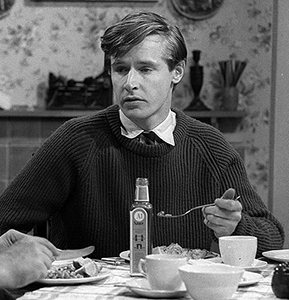


So here’s a primer: Coronation Street is a British soap opera set in the fictional Manchester town of Weatherfield. It was first broadcast in December 1960 and is still going strong, making it the world’s longest-running TV soap opera. One character, Ken Barlow, played by William Roache, has been on the show since the very first episode. This is him as a young ’un, wearing a tie to breakfast and looking all embarrassed about being working class:

corrie ken1

And this is him now, at 80 (he’s had a busy life):

corrie ken2

Can you imagine it, your entire life played out on a TV show? And he’s not the only long-standing cast member: there are countless others—Vera, Audrey, Rita—who have knocked about on the Street for decades. Every so often, one of these older actors drops dead off camera, and their character abruptly disappears. “Where’s Maude?” someone asks. “Maude has gone to live in Spain,” someone else explains, and no one is the least bit surprised. Everyone goes to live in Spain eventually.

The action centers around the local pub (the Rovers Return; the absence of an apostrophe is upsetting, yes), the knicker factory (called, awesomely, Underworld), and the newsagents, The Kabin. There’s also a corner shop, a hairdressers, a greasy spoon, and a fancy new joint, Nick’s Bistro (at the pub, you ask for a pint; at the bistro, you ask for a bottle of the red. No further beverage clarification is required.)

Coronation Street screens on Monday, Thursday, and Friday in England, and the time period of each episode mirrors the real world: when it’s Monday in Upper Shittlesthorpe, it’s Monday on the Street. And when it’s Christmas Day in Fudgepack upon Humber, it’s Christmas Day in Weatherfield, which means you and Ken Barlow can open your boxes of Quality Street together and then you and Ken Barlow’s long-suffering wife Deidre can go outside and stand side by side under the same relentless gray sky, smoking a festive cigarette.

There are many, many reasons why you should watch Coronation Street. Here are a few of them:

  • It’s a respite from rampant ambitiousness. Unlike most American soap operas, in which an oil tycoon and a pediatrician drive a Ferrari to a country club to murder a plastic surgeon, Coronation Street is staunchly working class. The characters aspire to a packet of biscuits from M&S, a holiday in the Canaries, maybe putting down a deposit on a nice flat. You are judged only on the things that really matter: are you kind to the post-op transsexual who runs the diner? Did you put in a pound for the midday pastry run? Did you visit Rita in the hospital after she almost died when the restaurant exploded, destroying the viaduct, sending that passing tram crashing into her shop?
  • corrie hilda6The best characters on the show are stong-willed women. Ask a long-time fan to list the most iconic residents of Weatherfield, and you’re going to hear about a bunch of stroppy women with gloriously British names: Ena Sharples, Elsie Tanner, Hilda Ogden (pictured at right and above in her rollers), Bet Lynch, Blanche Hunt.

  • It keeps up with the times. There are internet chat room abductions, cervical cancer scares, bigamy (so much bigamy!), serial killers, bisexual love triangles, addictions to pain killers. Jean Alexander, who played the aforementioned Hilda Ogden, is now eight-five years old and rather miffed by the modern Corrie: “Everyone seems to be having an affair…in the relentless battle for ratings it has sold its soul to sex, scandal and downright nastiness.” All the more fun for us.
  • It’s well-written. There are archetypes—the tart with a heart, the busybody, the insufferable snob—but they’re never stereotypes; the roles are fully developed. There are characters who happen to be gay, rather than Gay Characters. Story lines last for years and months, not weeks. And it’s very funny. Here’s a scene in which the unfortunate Barlow family attends an Alcoholics Anonymous meeting. We will call this scene “I am so sorry about my mother”:

  • Also, this happened: “Tony strangled Jed in a fit of rage, just before the Christmas party. Believing Jed to be dead, Tony hid his body in the Christmas hamper during the party. When he returned to the factory on Christmas Day he discovered Jed had just been unconscious, and offered him a free flat in Wigan to buy his silence, which Jed accepted.”
  • GailYou can enjoy hating Gail (née Potter; currently McIntyre; and previously Tilsley, Platt, and Hillman). Everyone hates Gail. Poor Gail. Husband #3 tried to kill her and her children by driving them into a canal; husband #4 drowned while attempting to fake his own death by drowning, the great twit. (Gail was charged with his murder, naturally.)

And, if you’re an ex-Colonial living in a foreign land, Coronation Street is an instant cure for homesickness. I grew up watching Corrie; it’s one of the most popular programs in New Zealand. Every so often the state broadcaster becomes embarrassed by her citizens’ enduring affection for the show—we really should be watching modern things, like MasterChef on Death Row: Final Meal Challenge and OMG, I Can’t Stop Eating Cats!—and they try to bury it in some ungodly time-slot, which provokes outcry, and the gnashing of teeth, and possibly the delivery of petitions to parliament. My mother and I never missed an episode. We would sit down with our packet of Griffin’s Gingernuts and our cups of tea and shake our fists at the screen. Put down that knife! Watch out for that lorry! Now I watch it online, the day after each episode screens in England, but New Zealand, alas, is still twenty months behind schedule (in all things, always), meaning that my mother’s standard telephone greeting is, “Don’t tell me what’s happening on Coronation Street!” When she called last night, I wanted to let her know about the fire—cross your fingers for poor Stella!—but I kept quiet. “You’ve got lots of good stuff to look forward to, Mum.”

A Little Wrong

From Under The Glacier by Halldór Laxness:

laxness2It’s strange that all birds don’t fly in the same way. After all, the air’s just the same at the same place and the same time. I’ve heard that the wings of aeroplanes all conform to the same formula, whereas birds each conform to a formula of their own. It has undeniably required more than a little ingenuity to equip so many birds each with their own formula, and no expense spared, either. Nevertheless, there has perhaps never been a bird that flies as correctly as an aeroplane; yet all birds fly better than aeroplanes if they can fly at all. All birds are perhaps a little wrong, because an absolute once-and-for-all formula for a bird has never been found, just as all novels are bad because the correct formula for a novel has never been found.

Crying in Art Galleries

Once upon a time, in an art gallery full of foolish installations, I mistook a box on the wall containing a fire hose for some kind of interactive artsy doodad. I opened the box, an alarm went off, and a security guard appeared before me. He looked nervous. He told me that a disgruntled patron had recently hosed down one of the installations—modern art has that effect on some people—and now the fire hose box was alarmed and I was being alarming. “But I thought it was art!” I cried. “It’s a hose,” he said, and he escorted me from the room. I sat on a bench in the lobby and laughed and laughed until tears ran down my face and an old man sat down beside me and asked if I was okay. “Why are you crying?” he said. BECAUSE IT’S A HOSE.

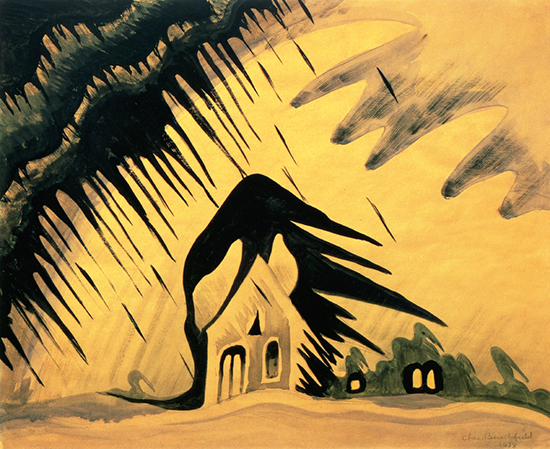
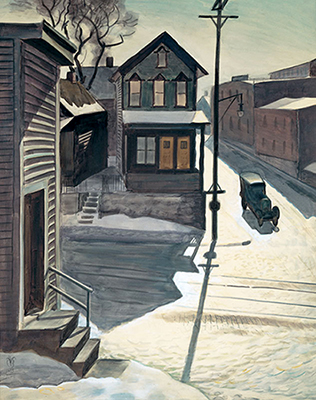
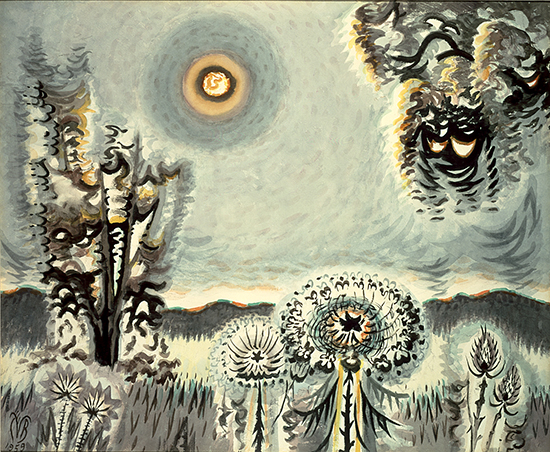
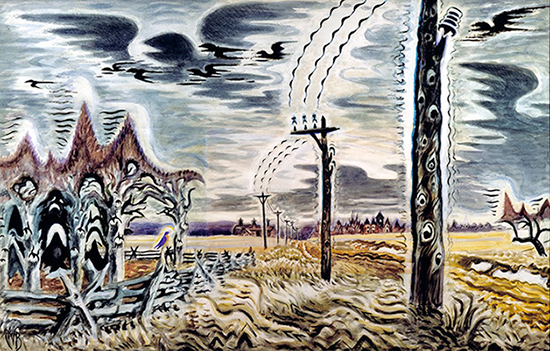
Charles BurchfieldThe second time I cried in an art gallery, it was at the Whitney in 2010, and I was with my roommates. We’d gone to see something else—three young men dressed like vagrants, playing harps and shouting, maybe?—and after we’d had enough of that, we wandered through the rooms until we came across Heat Waves in a Swamp: The Paintings of Charles Burchfield.
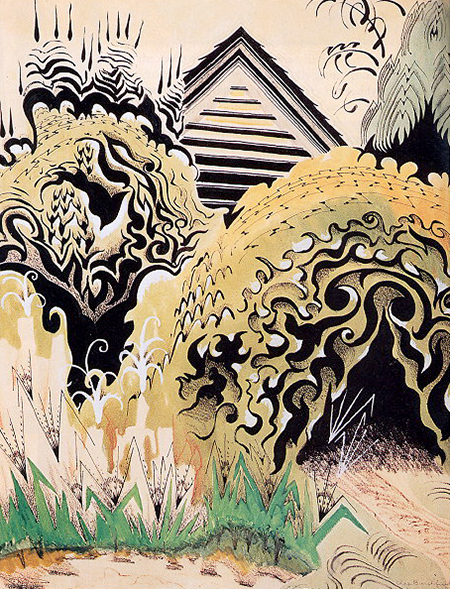
Charles Burchfield (1893-1967) was a quiet family man who spent much of his life in upstate New York. He painted watercolor landscapes, and he wrote in his journal, compulsively cataloging slants of light and mounds of snow, family card games and encounters with crows. In the gallery, the paintings and journal excerpts were displayed side by side, setting out for us an entire life.

The Insect Chorus

In youth, there is bravado, the promise of a great weirdness to come. And there is the beginning of Burchfield’s lifelong fascination with synesthesia, an obsession with painting sound as image—giving color and form to the chirps of crickets, the clanging of a train passing in the night, the howl of a dog in a distant yard.

The East Wind

On way to work. A great swooping wind out of the southwest. The tree tops roar against the cold gray sky; the clouds spit down a few wild flakes of snow now and then. Trees look blackly at the ground and the peaks and corners of the bleak houses are razor-sharp. I walk along exultantly with my chest out. All things are possible now. I felt like throwing a gauntlet into the face of the whole world; let me, like a winter wind, sweep all of the debris of the centuries away, I—alone—unaided!

In the middle years, there is comfort, complacency. Burchfield supported his family during the Depression by designing wallpaper and churning out conventionally pretty paintings of small town America—what one critic called “Edward Hopper on a dull November day.” He made his watercolors look like oil paintings; Life magazine named him one of America’s ten greatest painters.

Ice Glare

I think that I am standing on the brink of an abyss of stagnant mire—or are my feet already sunken? The old serious attitude toward life seems gone—Life is easy—I am fat & healthy—my job flatters & pleases me—it presents no hardships—

And then—the final years. Dissatisfaction; allusions to a psychological crisis. The years before are seen as a diversion, a squandering of obsession. In his later works, Burchfield returns to his early canvases and repurposes them, turning them into huge, hallucinatory paintings full of swirling strokes, exaggerated shapes, and an expressionistic light, a holy migraine shimmer. They perform a kind of trick, these paintings, translating an intensely private, mystical vision into shared experience: Edward Hopper painting scenes from Collective Unconscious Town. It’s a frightening place.

Sultry Moon

Song of the Telepgraph Pole

Spring in February: patches of melted snow on sidewalks reflecting the heavenly blue of the sky-cavern above, the snow on both sides of the walk honey-combed slantingly by the brilliant sun. The cawing of crows has taken on a new significance.

Growing stale is not so much in forgetting ideas but in losing the youthful vigour to consider them worth dying for—

A life set out on a few white walls: it made me cry. Endless snowfall, a thousand swirling birds. A cozy Christmas scene with the family. The sun painted as some blank horror that can never be looked at directly. You lose yourself in the middle of life—a dark wood, the path obscured, etc.—and when you find your way again, your youthful passions are like strangers to you. What was it you once cared about so much? The sound of a train passing in the night? A landscape that buzzes with the black hum of wires on a pole? The project is never completed.

Sizzurp and the Seven Deadly Sins

FaustusIf Lil Wayne had carked it on cough syrup this weekend, I would have spent today’s post trying to defend my fervently held but ridiculous belief that Lollipop is the best pop song ever. (It just is. Listen to it! If you told me it was created by robot lizards from outer space, I’d believe you. Of course, it’s also true that all of the song’s words are stupid and gross.) But it seems Weezy will live to take another sip of Texas Tea, thank goodness, and we can get back to reading Christopher Marlowe’s smashing Doctor Faustus, which needs no defense at all. It was written over four hundred years ago, but it feels like last week’s episode of a cheeky and surreal soap opera. Here (slightly abridged) is how three of the seven deadly sins introduce themselves to Faustus:

WRATH: I am Wrath. I had neither father nor mother. I leaped out of a lion’s mouth when I was scarce half an hour old, and ever since I have run up and down the world with this case of rapiers, wounding myself when I had nobody to fight withal.

ENVY: I am Envy, begotten of a chimney-sweeper and an oyster-wife. I cannot read, and therefore wish all books were burnt. I am lean with seeing others eat. O, that there would come a famine through all the world, that all might die, and I live alone! Then thou shouldst see how fat I would be.

SLOTH: Heigh-ho. I am Sloth. I was begotten on a sunny bank, where I have lain ever since, and you have done me great injury to bring me from thence.